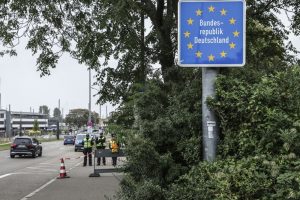






A German administrative court has declared a border identity check at the Luxembourg-German frontier unlawful, reigniting debate over the compatibility of Germany’s systematic internal border controls with European Union Schengen law.
On April 27, the Administrative Court in Koblenz ruled that the Federal Police’s identity check of a law professor on June 11, 2025, at the Perl-Schengen crossing on the A8 motorway had violated the Schengen Borders Code.
The plaintiff, Dr Dominik Brodowski, is Professor of Criminal Law at Saarland University, with a focus on the Europeanisation and digitalisation of criminal justice.
He was stopped in 2025 while returning from Luxembourg after attending a ceremonial event marking the 40th anniversary of the Schengen Agreement, the treaty designed to abolish routine internal border controls across much of Europe.
Travelling by scheduled bus, he was subjected to an identity check by the Federal Police at a rest area on the A8 motorway, shortly after crossing at Perl-Schengen.
Brodowski described the court’s ruling as “a strong signal for European integration, for European unification and also for Schengen law”, highlighting the irony of being hindered by border controls on a day celebrating their abolition.
The judges found that Germany’s extension of temporary border controls from March to September 2025 had not been sufficiently justified under Articles 25 et seq. of the Schengen Borders Code.
While the code permits member states to reintroduce checks in cases of serious threats to public policy or internal security, the court ruled that the federal government’s general references to migration pressure and crime were too vague.
According to the ruling, the government failed to demonstrate concrete, new circumstances — such as overwhelmed reception capacities or an acute threat that could not be managed by other means — that would justify suspending the principle of free movement within the Schengen Area.
The government, led by interior minister Alexander Dobrindt of the Christian Social Union in Bavaria (CSU), in Chancellor Friedrich Merz’s coalition, immediately downplayed the decision.
Officials stressed that the judgment applied only to the specific check in question and was not yet final, with an appeal expected.
Border controls at all German land borders, in place since late 2024 and repeatedly extended, will remain in force. In February 2026, Dobrindt extended the checks for a further six months, keeping them in place until at least September.
A spokesperson for the interior ministry reiterated that the measures were necessary because of irregular migration, secondary movements and threats from serious crime, including cases involving rejected asylum seekers.
The controls have reportedly led to thousands of arrests and returns. The previous German government had also defended the checks as a way of reducing irregular arrivals, pointing to turnbacks, arrests of suspected smugglers and a fall in asylum applications.
This is not the first judicial challenge against Germany’s border checks. On April 11, the Bavarian Higher Administrative Court similarly ruled that repeated extensions of controls at the German-Austrian border were unlawful for comparable reasons.
Further cases are pending, including in Stuttgart.
Germany first reintroduced systematic checks in response to the 2015 migration crisis and has maintained or expanded them under both the previous Social Democratic Party (SPD)-led government and the current Christian Democratic Union (CDU)/CSU-SPD coalition.
Critics, including parts of legal academia and opposition parties on the Left, argue that prolonged internal border controls risk undermining the Schengen system.
Supporters, especially within the CDU — which campaigned on tougher border policy — and the right-wing Alternative for Germany (AfD), insist they are a legitimate tool of sovereign border management amid what they describe as a migration emergency.
The Koblenz ruling comes at a sensitive time for Merz’s government, already under pressure over migration and internal security, and highlights a growing legal tension at the heart of the Schengen system: how long “temporary” border controls can remain in force before they become permanent in practice.