






The German economics ministry has significantly lowered its growth outlook for Europe’s largest economy, halving its forecast for 2026 and also revising up inflation expectations, in a fresh sign that Berlin’s long-promised recovery remains fragile.
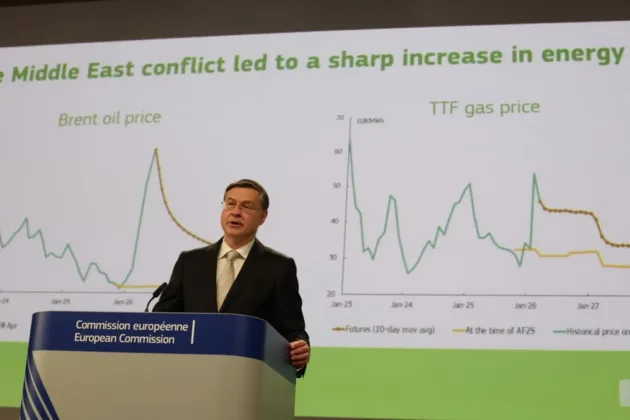
The pessimistic prognosis is a result of the fuel price hike caused by the Iran war — which has sent a new shock through oil and gas markets — but it also showcases Germany’s energy policy failures of the past decade.
On Wednesday, Germany’s minister for economics, Katherina Reiche (Christian Democratic Union, CDU) announced that the government was cutting the 2026 economic growth outlook from 1 per cent to just 0.5 per cent. The 2027 forecast was also lowered, from 1.3 per cent to 0.9 per cent.
“The war in Iran is driving up prices for energy and raw materials. This weighs on private households and increases costs for the German economy,” Reiche said. She also warned that higher import costs were feeding through into inflation and weakening the prospects for a stronger rebound.
The outfall from the war thus seems set to dash earlier hopes for a moderate recovery of Germany’s economy. After three years of recession and stagnation between 2023 and 2025, in January 2026 Reiche had still expected moderate growth of 1 per cent for 2026.
According to an on April 15 survey of 964 German companies conducted by economics think-tank IW Köln, almost 30 per cent of business owners plan to cut jobs in 2026 and 40 per cent said they will cut back on investments.
A full 43 per cent of respondents said their business was doing worse than a year ago; only 14 per cent saw an improvement.
IW Köln researcher Michael Grömling said: “The war in Iran has suffocated any hopes of a genuine economic recovery. The ongoing geopolitical crises are increasingly pushing the German economic model to its limits. This is increasing the pressure on the German government to reform.”
The vulnerability of Germany’s economy to rising fuel prices is an indictment of the failed energy policy of the past.
Economics pundit Josef Urschitz wrote in newspaper Die Presse on March 12: “Hundreds of thousands of well-paid industrial jobs have disappeared from Europe over the past six years.
“Deindustrialisation has hit hardest where the ideology-driven energy transition has been implemented most radically: in Germany. There, almost 270,000 industrial jobs have been lost in recent years. Just under half of these were lost last year.”
The biggest mistake in German energy policy, in the view of most experts, was the decision to shut down the country’s fleet of modern, powerful nuclear reactors.
Germany decided in 2011, under then-chancellor Angela Merkel, to phase out all of its nuclear power plants by the end of 2022. Merkel decided in favour of the phase-out after a tsunami hit the Japanese coast and caused a nuclear accident at the Fukushima power plant.
The decision, though, was mainly influenced by domestic political considerations, as it was thought to help Merkel’s CDU defeat the anti-nuclear Greens in the 2011 state elections in Baden-Württemberg.
After a last-minute extension due to the surge in energy prices following the Russian invasion of Ukraine in February 2022, the last three German nuclear plants went offline in April 2023.
Since then, Germany’s households and businesses have continued to groan under high electricity prices, paying some of the highest prices in the European Union.
Furthermore, since the nuclear phase-out, Germany’s electricity generation has relied ever more on natural gas and coal — making its power mix more carbon-intensive than many policymakers once promised, and leaving industry more exposed to commodity shocks.
While more and more politicians have recently spoken out against the nuclear phase-out – with both Chancellor Friedrich Merz and EC President Ursula von der Leyen calling it a “strategic mistake” – no serious initiatives are under way to restart those reactors that have not yet been completely destroyed.
Another energy policy mistake was the legal ban on producing natural gas domestically – through methods commonly known as “fracking”.
In 2016, the German parliament passed a series of laws banning fracking for commercial purposes. As a consequence, almost all natural gas has to be imported through pipelines or as LNG (liquefied natural gas) from overseas, meaning Germany is fully exposed to rising market prices for gas.
Pro-business publicist Daniel Stelter said on Marchh. 4 the war in Iran should be a turning point to abolish the fracking ban: “We have to abolish the taboo of national gas production … Fracking can be done in Germany without major risks and contribute significantly to energy security in Germany.”
In mid-March 2026, a team of consultants for Reiche’s economics ministry presented a study in favour of lifting the fracking ban. Since then, though, Reiche has not presented any initiative to actually do away with the ban.
For all Berlin’s talk of competitiveness, the broader picture is difficult to ignore: Germany remains heavily dependent on imported energy, burdened by some of Europe’s highest power costs and still unwilling to reverse the decisions that helped create that vulnerability in the first place. The Iran war did not create Germany’s economic weakness — but it has once again exposed it.