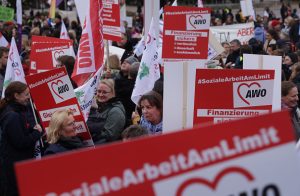












Germany’s coalition government has agreed a sweeping package of welfare cuts worth €38.3 billion by 2030, stripping back the country’s health system and pension guarantees to free up funds for military spending.
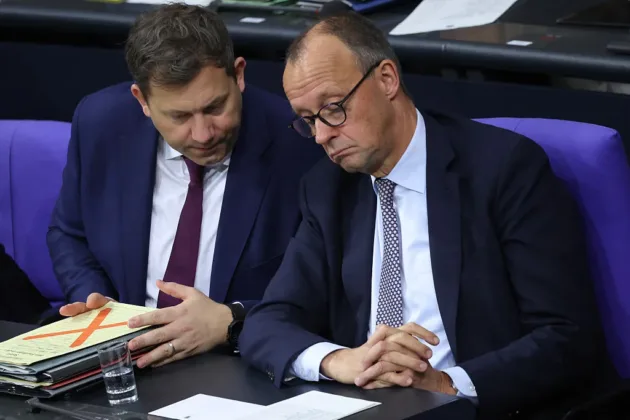
The Christian Democratic Union (CDU) and Social Democratic Party (SPD) — which form the governing coalition under Chancellor Friedrich Merz — reached the agreement ahead of a cabinet meeting on April 28, 2026. German media obtained the document before the official announcement.
The most contentious measure removes free health insurance coverage for non-contributing spouses. Under the new rules, spouses who do not pay into the statutory system will be required to contribute a minimum of 2.5 per cent of their partner’s insured income.
Exceptions will apply to families with children under seven, parents of disabled children, pensioners and carers of dependent relatives. The original proposal from Health Minister Warken had set the contribution at 3.5 per cent, though this was reduced in negotiations.
The SPD secured a significant concession: the income threshold for exemption from the statutory system has been raised to €100,000, a move designed to prevent high earners from migrating to private insurance.
Co-payments for medicines and hospital stays will also rise. Changes to the funding rules are expected to place additional strain on the statutory health funds, known as the Krankenkassen. In total, the austerity package is projected to save public health insurance funds €19.3 billion next year, rising to €38.3 billion by 2030, with reductions focused on spending at clinics, GP surgeries and on pharmaceutical costs.
The government said the aim of the health insurance reform is to “keep contributions stable for insured people and their employers”. It argues the current system is heading for collapse due to demographic change. The plans are based on 66 proposals from an expert commission appointed by the federal government.
PENSIONS TO BECOME “BASIC COVER”
The health cuts are not the only blow to German social security. Merz has stated that the state pension will be reformed into what he described as “basic cover” for old age and will no longer be sufficient to maintain living standards over time.
Long-term unemployment benefits are also being reduced. The combined effect represents the most significant dismantling of Germany’s welfare state since Gerhard Schröder’s Agenda 2010 reforms of the early 2000s — a programme that split the SPD so deeply the party has never fully recovered.
Analysts warn the current cuts carry similar risks for both coalition partners.
MERZ LAST IN POPULARITY RANKINGS
The political cost is already visible in the polls. In the latest Insa popularity ranking of 20 German politicians, Merz came last. His Defence Minister Boris Pistorius topped the list by a wide margin — a striking reversal for a chancellor who entered office promising economic renewal.
The erosion of support within his own conservative camp is particularly notable. Among CDU voters, Merz also ranks near the bottom, behind Bavarian Premier Markus Söder and Pistorius himself.
The picture is no better when it comes to voting intentions. The most recent trend barometer published by RTL on April 27, 2026, placed the right-wing Alternative for Germany (AfD) in first place with 27 per cent — five points ahead of CDU/CSU, which has fallen to 22 per cent. The SPD stands at just 12 per cent.
INTERNAL CDU REBELLION GROWS
Discontent within the CDU has begun to crystallise around a group of younger MPs who call themselves “Group 25”. Their core consists of 18 MPs elected to the Bundestag in 2025, all under 35 years old.
The group meets once a week at the Paul-Löbe-Haus in Berlin, coordinated by Johannes Winkel, Nora Seitz, Lukas Krieger and Konrad Körner. They first caused problems for the leadership last autumn over pension reform and have been gaining support since then.
Among the statistics they share internally: 69 per cent of Germans say they fear poverty in old age.
The president of the CDU’s seniors’ association, Hubert Hüppe, has also broken with the government’s position. “It is important that all those who have worked and paid contributions for 45 years receive noticeably more than basic security in old age, even if they only earned the minimum wage,” he said.
Without that guarantee, Hüppe argued, there would be even less incentive to work rather than rely on basic social assistance, and undeclared work would be encouraged.
The cuts are designed to redirect public funds towards defence, following Germany’s historic decision earlier this year to exempt military spending from its constitutional debt brake. For Merz, the policy question is whether the country can afford not to rearm. For growing numbers within his own party, the question is whether they can afford to let him continue.