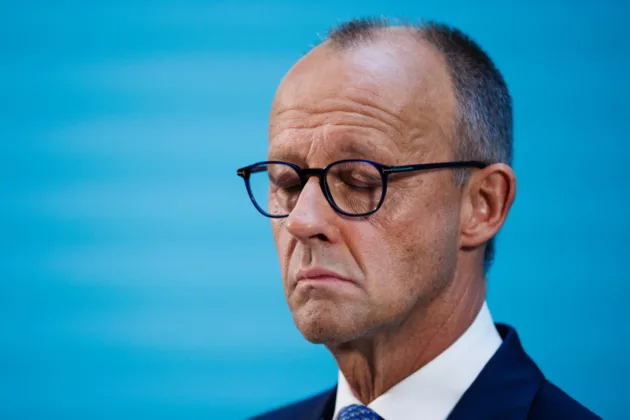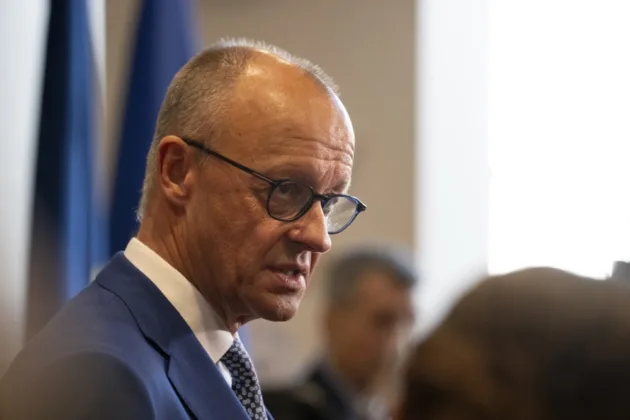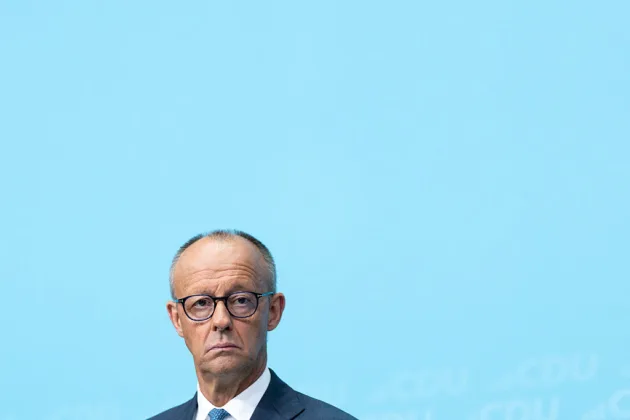







The survey, published today and widely reported across German media, marks a fresh blow to the Chancellor and his Social Democrat-backed coalition barely a year after Merz took office.
According to the INSA poll commissioned by Bild, Merz scored just 28.9 points and dropped from 18th to 20th place, putting him last among the 20 politicians ranked.
The Chancellor has now lost ground even among his own CDU voters, where he ranks only fifth. The three figures occupying the bottom three positions are Merz, economics minister Katherina Reiche (CDU) and CDU/Christian Social Union in Bavaria (CSU) parliamentary group leader Jens Spahn.
Among CDU/CSU voters, satisfaction with the Chancellor has fallen to 49 per cent.
In eastern Germany, the picture is bleaker still, with only 12 per cent satisfied and almost 80 per cent dissatisfied.
The ranking places defence minister Boris Pistorius (Social Democratic Party, SPD) firmly at the top with 49.0 points, followed by Green politician Cem Özdemir. CSU leader Markus Söder sits in fourth.
Both Özdemir and Söder are often perceived as having relatively pragmatic or more conservative profiles within their respective parties, a detail likely to fuel further questions over Merz’s own claim to represent Germany’s centre-right electorate.
Alternative for Germany (AfD) co-chair Alice Weidel fell to eighth with 37.0 points, while her colleague Tino Chrupalla improved slightly to 15th.
Merz’s personal approval has collapsed even as other CDU/CSU figures, including General Secretary Carsten Linnemann and interior minister Alexander Dobrindt (CSU), recorded modest gains.
The INSA ranking is the latest in a string of dire polls for Merz’s government.
Just weeks earlier, another INSA survey for Bild am Sonntag found 70 per cent of voters dissatisfied with the Chancellor’s performance and 73 per cent unhappy with the black-red coalition overall. Satisfaction with Merz stood at a meagre 21 per cent.
A separate RTL/ntv Trendbarometer released in early April showed 78 per cent of Germans unhappy with Merz’s work, a new record high.
Dissatisfaction was near-total among AfD and Die Linke voters, at 96 per cent, and remained overwhelming among Greens, at 87 per cent, and SPD supporters, at 71 per cent.
According to a survey by Morning Consult, published in mid-April, Merz is currently considered the most unpopular head of government among the democracies examined.
Only 19 per cent of Germans said they were satisfied with his performance, while 76 per cent said they were not.
Merz’s personal ratings have fallen faster than those of his predecessor Olaf Scholz at a comparable stage.
The CDU/CSU-SPD coalition came to power in 2025 promising economic renewal, fiscal discipline and a tougher stance on migration.
Yet public frustration has mounted over broken pledges, sluggish growth and a perception that the government has failed to deliver the “political change” voters had demanded after years of left-wing-led government under Scholz.
The Chancellor’s difficulties are also exposing a deeper problem for Germany’s mainstream centre-right: Merz won the CDU leadership by presenting himself as a sharper conservative alternative, but in office he has governed through a coalition with the SPD and has struggled to convince voters that a real political break has taken place.
The unpopularity is feeding directly into voting intentions. Recent polls show the AfD climbing to 27 per cent, making it the strongest single force in the country.
The CDU/CSU is languishing at around 23 per cent, with the SPD trailing in the low teens, behind the Greens.