



Mohamed has become the most common name given to newborn boys in Andalusia, Spain’s most populous region, displacing Manuel, which had led the regional charts every year since 2016. Andalusia is the latest European region to reach a milestone already recorded in England and Wales, Belgium and parts of Germany and France.
The figures show how rapidly the composition of Andalusia’s population has shifted. In Almería province, Mohamed had already equalled Antonio as the third most popular male name in 2023, with 51 babies registered under each name, according to the Instituto de Estadística y Cartografía de Andalucía. Only Hugo and Alejandro ranked higher. By 2025, the trend has spread across the wider region.
Traditional Andalusian names — María for girls, Manuel for boys — held the top positions in official rankings for years. That Mohamed has now displaced Manuel at the head of the boys’ list is not merely a shift in naming fashion. It reflects a demographic transformation driven overwhelmingly by immigration from Muslim-majority countries, principally Morocco, that neither the Spanish state nor the EU has made any serious attempt to slow.
EUROPE’S MOST COMMON NAME TELLS A CONTINENT-WIDE STORY
Spain is not alone. By 2023, according to Spain’s National Statistics Institute (INE), there were close to 76,000 people named Mohamed in Spain — more than those named Gonzalo or Felipe. Across Europe, the scale of the shift is even more striking. In Austria, the number of newborns given the name rose by 732 per cent over the past 25 years. In Ireland, the increase was 372 per cent. In France, 127 per cent. In England and Wales, Mohamed and its variants have led newborn name charts for several consecutive years.
The Pew Research Center estimated that in 2020, Muslims made up about 6 per cent of Europe’s population. Under a medium migration scenario, Pew projected that share would reach 11.2 per cent by 2050. There is little in current EU migration policy to suggest the scenario will be anything other than conservative.
THE SHADOW OF AL-ANDALUS
A part of nowadays Andalusia — from the Arabic Al-Andalus — was under Islamic rule for nearly eight centuries, from 711 until the fall of Granada on January 2, 1492. The memory of that era has never fully faded from either side of the Mediterranean, and the recovery of Andalusia has been a persistent claim of political Islam.
Osama bin Laden wrote that the Islamic nation should “raise again the unique flag of Allah on all stolen Islamic land, from Palestine to Andalus.” His mentor, Abdullah Azzam, established that the Islamic obligation to wage jihad to recover lost territories applies specifically to Andalusia. Al-Qaeda’s Ayman al-Zawahiri, in a 2007 tape, addressed North African Muslims directly: “The return of Andalus to Muslim hands is a duty for the nation in general and for you in particular.”
More recently, Islamic State jihadists produced a video vowing to make Al-Andalus part of a new caliphate. A fighter speaking in Spanish with a North African accent declared: “Spain is the land of our forefathers and we are going to take it back with the power of Allah.”
In recent years, much of the dynamism in Islamic preaching directed at Spain has shifted to social media. Young Muslim influencers — born in Spain and fluent in Spanish — have emerged on platforms such as TikTok and Instagram, combining religious messaging with lifestyle content aimed at young audiences. Spanish authorities have described the resulting landscape as a security and cultural challenge that is proving difficult to track.
A NUMERICAL EXPRESSION OF A TRANSFORMATION
Spain as a whole recorded more than 320,000 births in 2024. The ascent of Mohamed to the top of Andalusia’s boys’ rankings is the clearest numerical expression of a transformation that is measurable, documented and accelerating — and that no mainstream Spanish party has a coherent plan to address.
Integration requires shared language, shared civic norms and, above all, time. Mass immigration at the current pace allows for none of these. The naming data is one indicator among many. It is, though, the one that is hardest to dismiss.
ANDALUSIA HEADS TO THE POLLS ON MAY 17
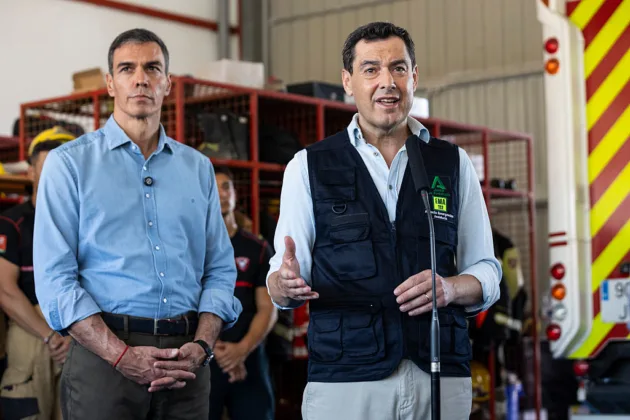
Regional president Juan Manuel Moreno Bonilla announced on March 23 that elections would be held on May 17, dissolving the Andalusian parliament ahead of schedule. Around seven million voters are called to participate in what is one of the most closely watched votes in Spain this year.
Moreno Bonilla is among the most vocal advocates of open immigration in Spain, backing labour migration schemes and opposing restrictions at both regional and national level — a position that sits awkwardly alongside the demographic data his own region is now producing.
Polling averages suggest his People’s Party (PP) will struggle to retain its absolute majority in the 109-seat Andalusian parliament. PSOE faces what could be its worst result in Andalusia’s democratic history. Its candidate, María Jesús Montero, has stepped down from her role as Spain’s finance minister to lead the socialist campaign — a move that underlines how much the party knows is at stake.
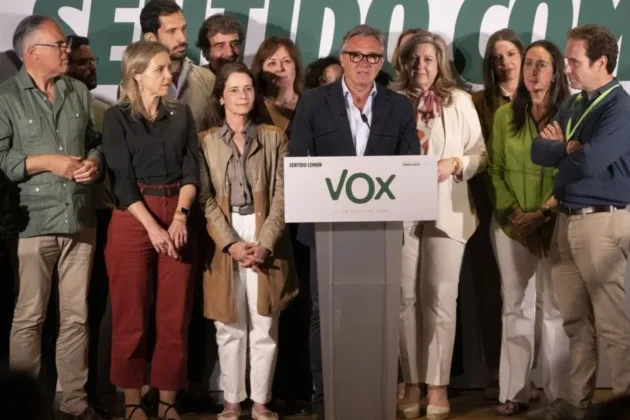
Of the parties contesting the election, only Vox has put the reversal of mass immigration at the centre of its platform — not merely stopping the flow but actively reducing the foreign-born population already settled in Spain. It is polling between 19 and 22 seats, up from 14 in 2022.
Immigration and public services are expected to feature prominently. The naming statistics will feature too, whether politicians wish them to or not. For many Andalusians, the data is not a talking point. It is the world outside their window.