










The European Ombudsman has highlighted a sharp rise in complaints against EU institutions and agencies in 2025, while urging greater transparency and accountability across the bloc in her annual report published on April 21.
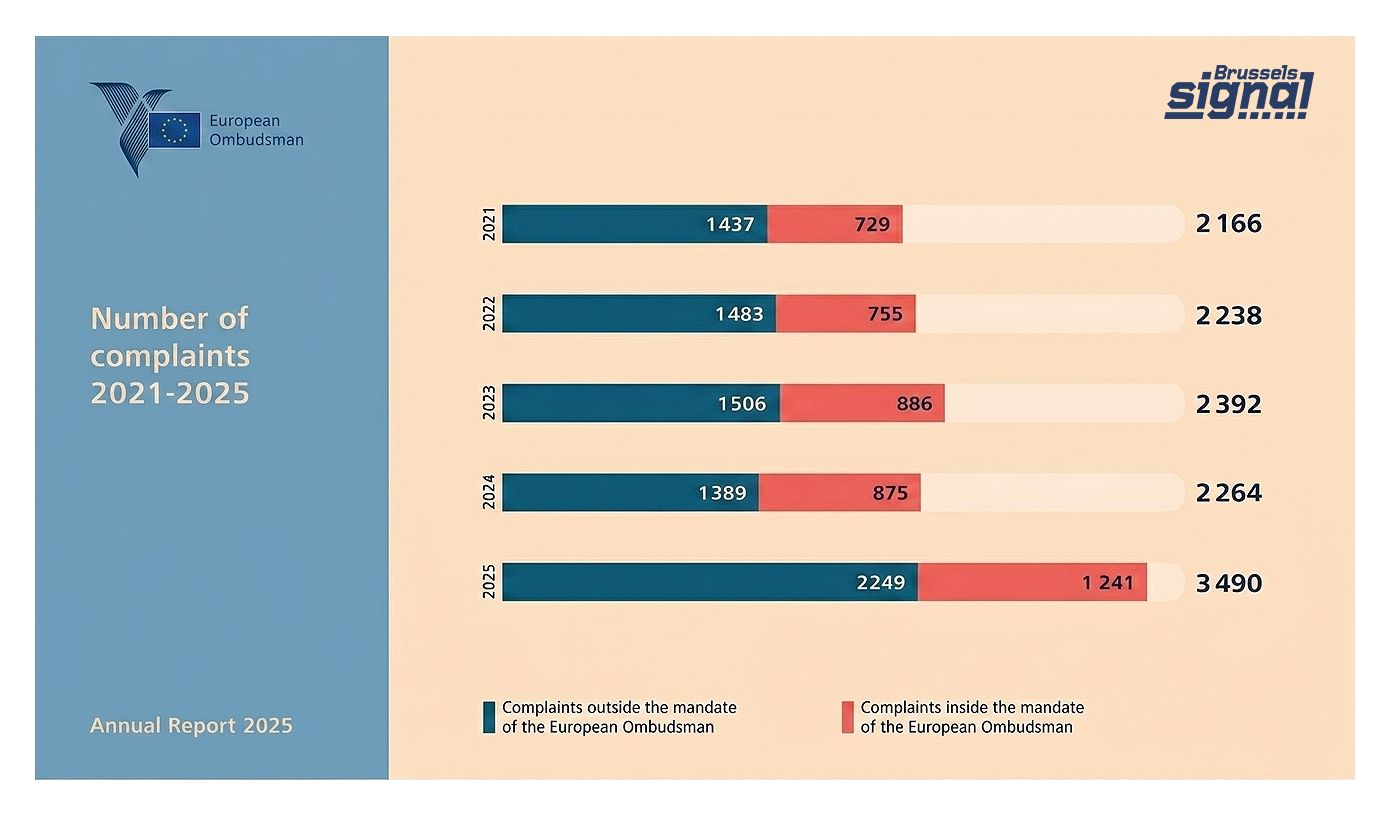
Complaints handled by the office increased by 54 per cent to 3,490 compared with 2024, while the number of inquiries rose by 19 per cent to 492.
This high number of complaints “has required the Office to adapt its internal working methods”.
The Office recruited a dedicated AI officer and set up a cross-department AI taskforce as part of efforts to reduce complaints about matters outside the mandate of the Ombudsman.
The surge was attributed in part to greater public awareness, with the Ombudsman’s office also indicating that AI tools may have played a role by directing more users to it when they sought help with EU administrative matters.
Transparency and accountability issues accounted for 38 per cent of all inquiries opened during the year.
Following closely were complaints about service culture, such as failures to respond, and issues related to the proper handling of infringement procedures.
Ombudswoman Teresa Anjinho noted that EU institutions followed the Ombudsman’s proposals in 89 per cent of cases and suggestions in 78 per cent, describing this as evidence of constructive engagement despite the higher caseload.
“As EU policymaking accelerates in response to geopolitical and technological pressures, urgency becomes the norm. Yet speed cannot come at the expense of legitimacy,” Anjinho warned.
“Transparency is another fundamental component of good administration. A significant portion of our work focuses on ensuring public access to documents, enabling citizens to follow and scrutinise decision-making processes,” she added.
“Here, improvements remain necessary, particularly in the timely and consistent handling of access requests. Strengthening these practices would reinforce accountability and public trust.”
The Ombudswoman put forward recommendations for improvement, which she hopes will be incorporated into the upcoming revision of the Better Regulation guidelines.
The report also addressed shortcomings regarding transparency in the adoption of AI harmonised standards, and access to documents in sensitive areas such as the EU-Mercosur trade agreement and risk assessments related to social media platforms.
The European General Court has criticised European Commission President Ursula von der Leyen for refusing to disclose text messages exchanged with Pfizer CEO Albert Bourla. https://t.co/xIupk8oKY8
— Brussels Signal (@brusselssignal) May 14, 2025
Positive developments noted included improved environmental and social data disclosure by the European Investment Bank, stronger conflict-of-interest measures for experts advising on the European Defence Fund, and updated policies on public access to documents at the EU Agency for Cybersecurity.
The findings come as questions over transparency, lobbying and administrative culture continue to simmer in Brussels, where access to documents, conflicts of interest and the handling of politically sensitive files remain recurring sources of friction between EU institutions and public watchdogs.
One day prior, on April 20, the Ombudsman had already issued another report, examining how 15 decentralised EU agencies manage “revolving doors” — situations in which senior officials and board members move to positions in the private sector after leaving public service.
The inquiry, which began in 2025, led to the publication of good practice guidelines aimed at ensuring a more uniform and robust approach to cooling-off periods, declarations of interest and conflict-of-interest safeguards.
EU officials getting top jobs in the private sector, often lobbying the EU institutions or using their contacts and insider knowledge, has been a hot-button issue in and around Brussels, with many condemning alleged self-serving behaviour and possible institutional conflicts of interest.
Despite verbal calls to counter such situations, incidents continue to happen.
Thierry Breton, the EU’s tech enforcer until September 2024, has received special approval to join Bank of America's advisory council without the usual two-year cooling-off period. https://t.co/jmuL80sZJ9
— Brussels Signal (@brusselssignal) January 17, 2025