

Approximately one third of the 103 enterprises involved in the production of Russia’s Su-57 multirole fighter jets are not subject to sanctions by any country in the international sanctions coalition, according to Ukraine’s Defence Intelligence (HUR).
The findings, published yesterday via HUR’s War&Sanctions portal, include an interactive model and detailed information on the co-operation network supporting the aircraft.
HUR states that the unsanctioned enterprises continue to maintain access to foreign technologies and component bases essential for Russian combat aviation development.
Examples of enterprises highlighted include OJSC Krasnyi Oktyabr in Saint Petersburg, which produces auxiliary power units for the Su-57, the National Institute of Aviation Technologies (involved in cockpit glazing design) and LLC Yashz Avia, a manufacturer of aviation tyres for the fighter.
The Su-57 is also used as a launch platform for missiles such as the Kh-69.
HUR emphasised that restricting the Russian military-industrial complex’s access to advanced technologies is vital not only for Ukraine’s defence but also for global security, to prevent Russia from launching a new technological arms race.
The disclosure comes amid ongoing scrutiny of sanctions enforcement. While the majority of the identified enterprises are already under restrictions, the unsanctioned portion allows continued procurement of dual-use goods through legitimate channels.
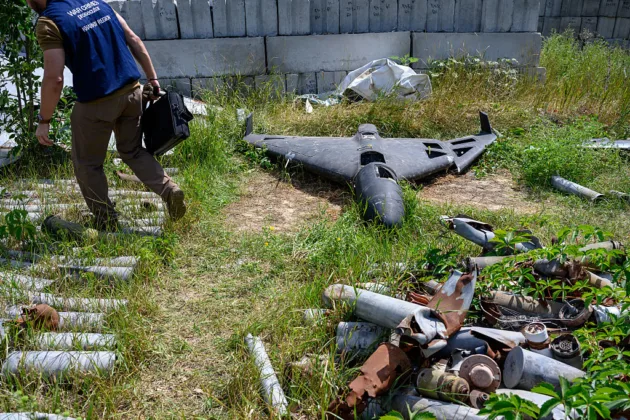
Separately, HUR data has previously shown German-made components, including transistors from Infineon Technologies, appearing in Russian Geran attack drones despite European Union sanctions.
Euronews reporting has highlighted how hundreds of thousands of such western parts continue to reach Russian weapons systems through evasion networks.
Neither the companies involved nor the German Government have been accused of deliberate breaches in relation to the latest Su-57 findings. Manufacturers maintain compliance with export controls.
The EU continues to review and tries to strengthen sanctions implementation to close remaining loopholes in supply chains via extra rounds of sanctions.
At the time of publication, the bloc has formally adopted 19 packages of sanctions against Russia.
“Cutting off the Russian Forces military-industrial complex’s access to the latest technologies is not only a matter of strengthening Ukraine’s defense capabilities but also a contribution to the future stability and security of the world by depriving the aggressor of the means to launch a new technological arms race,” the HUR’s War&Sanctions stated in its report.
New investigations show that European technology continues to fuel Russia’s military capabilities in Ukraine, despite numerous European Union sanctions. https://t.co/9lZwQ5OpI5
— Brussels Signal (@brusselssignal) February 18, 2026