




Spanish Prime Minister Pedro Sánchez has used a two-day summit in Barcelona to launch a global Left alliance that turned its back on the European Union’s main capitals, pairing Spain and Brazil with governments and activist networks largely from outside the EU mainstream, alongside Alexander Soros’s Open Society Foundations in a prominent co-hosting role.
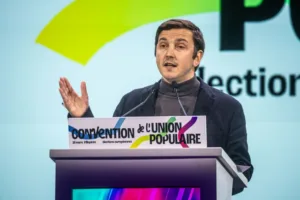
The gatherings, held on April 17 and 18, 2026 at the Fira Gran Via convention centre, drew around 3,000 registered participants and officials from more than 100 political parties, according to organisers. Brazilian President Luiz Inácio Lula da Silva co-hosted the event, which brought together the IV Meeting in Defence of Democracy, launched by the Spanish Government in 2024, and the inaugural Global Progressive Mobilisation, run jointly with the Party of European Socialists (PES).
Giacomo Filibeck, Secretary-General of the PES, said Left-wing parties needed to show voters there was an alternative to what organisers called the “right-wing international”.
A SUMMIT THAT BYPASSED THE EU
The summit was staged in an EU capital region – Catalonia – but conspicuously not under EU auspices. Neither the European Commission nor the Council of the European Union played any formal role. Neither French President Emmanuel Macron nor German Chancellor Friedrich Merz attended. Italy, Portugal and the Netherlands sent no heads of Government. Berlin sent Vice-Chancellor and Finance Minister Lars Klingbeil of the SPD.
European Council President António Costa was present, but no sitting prime minister of a large western European country took the stage.
Those who did attend came from the fringes of the European debate or from outside Europe altogether. Mexican President Claudia Sheinbaum, South African President Cyril Ramaphosa and Colombian President Gustavo Petro led the Latin American and African delegations. Ireland’s newly elected President Catherine Connolly chose the summit for her first foreign trip since taking office. Smaller countries including Uruguay, Lithuania, Albania and Ghana filled out the list.
SOROS ALONGSIDE SÁNCHEZ AND LULA
Beyond governments, the summit leaned heavily on private philanthropy with a political agenda, most visibly the Open Society Foundations (OSF) chaired by Alexander Soros, son of financier George Soros.
Mr Soros acted in practice as a third host alongside Sánchez and Lula. Writing on X at the close of the meeting, he said it had been “an honor to welcome so many incredible leaders” to Barcelona, and posted photographs of himself with the Spanish Prime Minister. Pedro Abramovay, a senior OSF programme official, appeared on the speaker list, and the Bill and Melinda Gates Foundation also took part.
The prominence of OSF at a gathering billed as intergovernmental underlined the role private US philanthropic networks now play in coordinating international Left-wing politics. Mr Soros has publicly backed Sánchez on a series of occasions, including the Spanish Government’s recent Royal Decree regularising around half a million migrants, a measure opposed by a majority of Spanish voters in national polling and now under legal challenge. Most progressive European media outlets covering the gathering did not mention the role of OSF or of the Gates Foundation.
A LINE HARDER THAN EU CONSENSUS
Though Lula told Spanish daily El País that “this is not going to be an anti-Trump meeting”, much of what followed read that way. Several speakers went beyond European social-democratic mainstream positions. Mr Petro warned that Latin America could see a “rebellion” against the US. Mrs Sheinbaum said Mexico would push for a declaration opposing any US military intervention in Cuba. Mr Ramaphosa called for reform of the UN Security Council on the grounds that its permanent members were among those breaching international law, a framing that implicates both Washington and Moscow.
Mr Klingbeil told activists that “the far right is international, so we must be too”. Sánchez, for his part, declared that “Spain is the daughter of migration and will not be the mother of xenophobia”, accusing conservative parties of exploiting the issue for electoral gain.
WEAKNESS AT HOME
Both co-hosts arrived in Barcelona from weakened domestic positions. Sánchez’s minority Government is under sustained pressure from corruption investigations involving members of his inner circle, and recent national polls have put the combined support of the opposition Partido Popular (PP) and Vox above the threshold for a parliamentary majority. Lula’s disapproval rating has climbed above 50 per cent ahead of Brazilian elections in October 2026.
The trend is broader. Right-wing and national-conservative parties now govern or lead the opposition in Italy, the Netherlands, Finland, Sweden and Hungary, while Alternative for Germany (AfD) and Rassemblement National (RN) continue to gain ground. Hungary’s former prime minister Viktor Orbán hosted the Conservative Political Action Conference (CPAC) in Budapest in March, drawing Argentinian President Javier Milei, Vox leader Santiago Abascal and AfD co-chair Alice Weidel.
The summit closed with a joint declaration promising coordinated action on democratic resilience, digital governance, climate policy and inequality. A timetable for follow-up mobilisations, and a breakdown of who funded the event, have not been published.