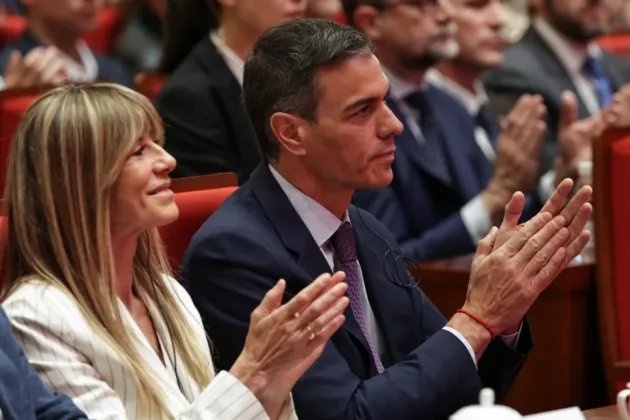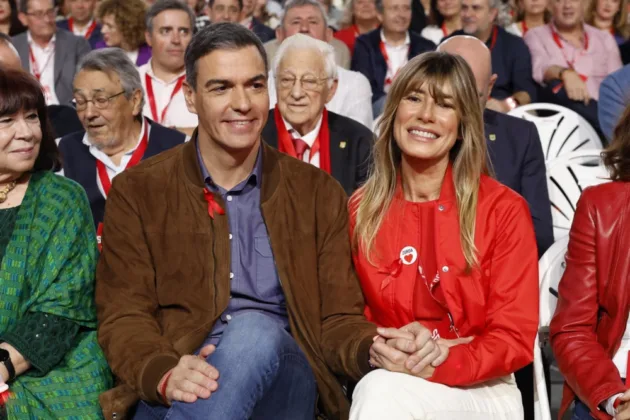


A Spanish investigating judge has formally charged Begoña Gómez, the wife of Prime Minister Pedro Sánchez, with four serious offences and ordered the case to proceed to trial before a popular jury.
In an order issued on April 13, the judge closed the two-year investigation and processed Gómez for influence peddling, corruption in the private sector, embezzlement of public funds and misappropriation.
He dropped a fifth charge of professional intrusion, saying the evidence here was “flimsy”
The judge has also processed Gómez’s former Moncloa adviser, Cristina Álvarez, as a necessary co-operator in the alleged offences, and the businessman Juan Carlos Barrabés for influence peddling and business corruption.
All parties have been given five days to submit final arguments before the case moves to the opening of an oral trial.
The investigation began in April 2024 after a complaint by the anti-corruption union Manos Limpias, later joined by others.
It centres on Gómez’s role as co-director of an extraordinary chair at the Complutense University of Madrid (UCM) focused on fundraising, social transformation and digital projects.
According to the judge’s 39-page order breaking down the details, Gómez is alleged to have exploited her position as the wife of the Prime Minister to secure “exceptional institutional access” and favourable public decisions for the university chair after her husband became PSOE leader and then head of government.
Meetings were held in the Palacio de la Moncloa, the official residence and workplace of the prime minister, and the judge states that “the mere condition of being the wife of the President served to exert influence”.
On the influence-peddling charge, the judge cites reciprocal favours.
For example, Barrabés and his companies allegedly provided support and teaching input for the chair in exchange for institutional backing and letters of recommendation from Mrs Gómez that helped his firms win public contracts, including from Red.e, a public corporate entity responsible for promoting and developing the digital economy, society, and public services in Spain, with training programmes partly financed by NextGenerationEU.
Business corruption concerns the alleged capture of private sponsorships from major Spanish companies (including Google, Indra and Telefónica) for the chair and associated digital platform.
The judge alleges these funds were not used solely for the public university project but were indicatively channelled towards Gómez’s personal patrimony, in return for competitive advantages in public procurement.
Embezzlement relates to the alleged misuse of a publicly paid Moncloa adviser, Cristina Álvarez, whose salaried time was diverted to private project tasks such as liaising with sponsors, managing the software platform and attending technical meetings.
Misappropriation stems from the development of specialised software for the chair, partly funded by public and private resources.
The judge says Gómez received the software on behalf of the UCM but registered the domain, brand and control under her personal ownership instead of handing it over to the university.
He described the corruption, “which comes from presidential palaces”, as “more typical of absolutist regimes, fortunately, already forgotten in time”, claiming it would be necessary to “go back to the reign of Ferdinand VII” to find similar cases of wrongdoing.
The Fiscalía Provincial de Madrid has consistently argued for the case to be archived, maintaining there are no objective indications of criminality and that the mere marital relationship with the Prime Minister is insufficient to prove influence peddling.
The judge has rejected those requests and proceeded regardless, provoking fury in Moncloa.
Government sources described it as “indignation” and a “shame” that has “irreparably damaged the good name of the justice system”.
Justice Minister Félix Bolaños said the investigation had “shamed many citizens and many judges and magistrates”.
Officials have questioned the timing, noting Gómez was accompanying the Prime Minister on an official visit to China when the ruling was published, and insist higher courts will ultimately exonerate her.
Defence lawyers are expected to challenge the indictment.
Gómez is not the only person in the close family circle of the Spanish PM suspected of wrongdoing.
David Sánchez, his younger brother, a classical musician, faces trial in a separate case linked to his 2017 appointment as coordinator of public music schools.
The Badajoz Provincial Court has ruled there is sufficient evidence to try him alongside ten others, including senior Socialist officials, for alleged influence peddling, prevarication (malfeasance) and related offences.
David Sánchez is accused of receiving a salary while allegedly performing few or no duties, living partly in Portugal (raising tax questions), and lacking a physical office in Badajoz. He has denied wrongdoing and resigned from the regional post.
This case also stems from a Manos Limpias complaint.
All these judicial battles form part of a wider pattern of corruption probes affecting Sánchez’s inner circle and former allies, including former Transport Minister José Luis Ábalos, who is on trial over alleged kickbacks on Covid-era PPE contracts and former PSOE number three Santos Cerdán, who is jailed pending trial on bribery and influence-peddling charges.
Europe is watching Spain’s Prime Minister Pedro Sánchez as he navigates the corruption investigation into the people considered to be the makers of his political career. https://t.co/RJCl1eQw9V
— Brussels Signal (@brusselssignal) November 28, 2025