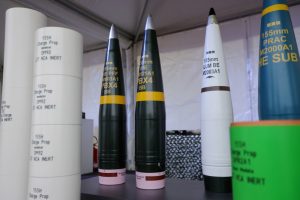






A major Central European defence contractor at the heart of the European Union’s emergency push to arm Ukraine is facing explosive allegations that it has built a lucrative business model around buying, refurbishing and reselling outdated Soviet-era ammunition rather than producing new shells at scale.
Investigative reporters from Hunterbrook Media’ targeted the Czechoslovak Group (CSG) Defence Systems, the Czech giant that completed Europe’s largest-ever military IPO in January, raising €3.8 billion and pitching itself as the continent’s answer to Rheinmetall.
Hunterbrook, which disclosed a short position in CSG, claimed in a story published yesterday that the company’s reported production figures do not add up.
While CSG’s prospectus touts capacity for around 630,000 large-caliber rounds annually — with 80 per cent supposedly 155 mm NATO-standard shells — the investigative outlet’s analysis of subsidiary accounts, factory footprints and satellite imagery suggests actual in-house output is far lower, perhaps 100,000 to 280,000 rounds.
The bulk of revenue, which made up two-thirds of the group’s total in 2025, appears to come from “recommissioning” third-party stockpiles acquired cheaply from global sources (often former Soviet or Warsaw Pact surplus in Africa and Asia) and marked up heavily before delivery to Ukraine and NATO allies.
The accusations centre on CSG’s central role in the so-called Czech Ammunition Initiative, launched in early 2024 as a desperate workaround when EU production promises collapsed.
Under that scheme, CSG subsidiaries such as Excalibur Army acted as intermediaries, sourcing shells and charging margins that critics say reached 22 per cent to 30 per cent above alternative offers, up to four times what Ukrainian brokers paid for comparable procurement.
One documented case showed CSG offering 155 mm shells to the Czech Government at €3,200 per unit while a Turkish supplier quoted €2,500 for similar goods.
This is not the first time the company has drawn fire.
Earlier reporting already highlighted quality problems and CSG itself admitted in 2024 that around half the shells it acquired required extensive reworking because of poor condition or missing components.
Delays mounted, costs soared and the initiative faced accusations of opacity and profiteering even before Hunterbrook’s deeper dive into the IPO prospectus.
Multiple investigations revealed undisclosed issues. The heavily promoted €58 billion Slovak ammunition deal had zero formal commitments, CSG’s Spanish propellant factory was suspended by NATO over sanctionable practices and a minority shareholder demanded €1.4 billion via a pre-IPO put option.
Hunterbrook noted that, in 2025, “CSG attributed nearly two-thirds of its revenue, or about €4.1 billion, to medium and large-caliber ammunition sales — an extraordinary figure considering Europe’s leading defence supplier, Germany-based Rheinmetall, reported just €3.5 billion in revenue for its combined weapons and ammunition segment.”
The broader context is an EU ammunition crisis and rearmament in light of promised support to Ukraine.
In July 2024 Brussels Signal reported that EU promises of hugely increased production were “vastly overstated”, with actual output closer to a third of headline targets. That was due to raw-material shortages, under-investment and bureaucratic inertia.
By February 2026, German defence minister Boris Pistorius was openly admitting there was “nothing left in the stockpiles” to send Ukraine.
All this suggested that the west is simply running out of ammunition after years of drawing down reserves to feed Kyiv while failing to rebuild industrial capacity at wartime speed.
The Czech Initiative was sold as the pragmatic fix, shopping around the world for existing shells rather than wait for Europe’s slow factories but it has always carried the risk of middle-man mark-ups and dwindling supply.
Ukraine has received hundreds of thousands of rounds through the programme but at premium prices that have strained donor budgets.
The newly re-elected Czech Prime Minister Andrej Babiš has halted Prague’s own financial contribution, citing discomfort with “excessive profits from the war”, although the initiative continues on foreign funding alone.
CSG shares plunged as much as 26 per cent on the day of the Hunterbrook report being published, their worst trading session since the IPO, wiping out billions in market value, although they improved later.
Their market value has been dropping steadily for a while.
Global stockpiles of recommissionable Soviet-era ammunition are reportedly running low and the entire reselling model looks increasingly unsustainable.
CSG said in a statement it “strongly disagrees” with Hunterbrook’s conclusions, insists all figures in its regulator-approved prospectus are accurate and maintains that every shell delivered to Ukraine meets quality standards after rigorous checks.
“The article contains inaccuracies, selective interpretations and mischaracterisations,” it said in its response.
It denies profiteering and says past Russian-linked business was wound down immediately after the 2022 invasion.
Hunterbrook Media is a recently-founded New York-based hybrid newsroom and investment firm. Unlike traditional media, Hunterbrook combines aggressive investigative reporting with a hedge-fund arm (Hunterbrook Capital) that takes financial positions, often short-selling the stocks of companies it investigates , before publishing.
This model lets it monetise scoops directly while making all reporting free, no ads or paywalls.
Ammunition production across the European Union has been vastly overstated, a recent report has found.
Read the full article 👉🏼 https://t.co/HlnXmU8WJt #NATO #defence pic.twitter.com/oeckzsJCsV
— Brussels Signal (@brusselssignal) July 10, 2024