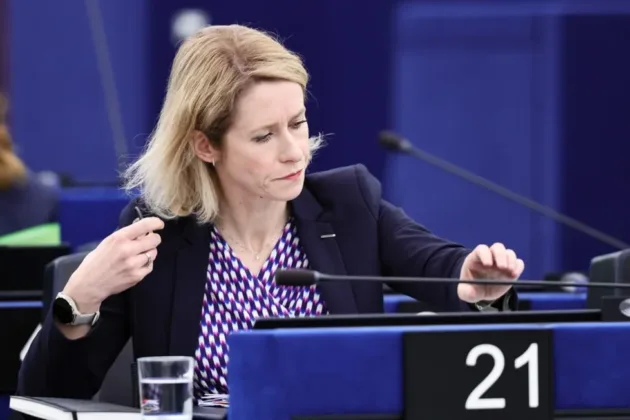





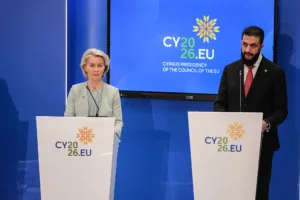

The European Union’s High Representative for Foreign Affairs and Security Policy, Kaja Kallas, has warned that Europe’s defence industry is not increasing production in line with the significant financial resources being mobilised by member states.
Kallas, also Vice-President of the European Commission, said that underscored growing concern over Europe’s industrial readiness at a time of heightened security pressure.
“Countries have allocated substantial funds, but the defence industry is not increasing production or accelerating its pace,” she said, speaking with defence ministers and industry representatives at the EU Foreign Affairs Council (Defence) in Brussels on May 12.
She added: “We therefore need to understand what the problem is.”
Her remarks reflect what European diplomats describe as increasing frustration in Brussels that, despite unprecedented defence spending increases across the EU, industrial capacity is struggling to scale. The issue has become more acute as governments rush to replenish stockpiles depleted by support for Ukraine and strengthen deterrence against Russia.
The current wave of defence investment began after Russia’s full-scale invasion of Ukraine in 2022, which triggered a structural shift in European security policy.
Since then, European defence spending has risen sharply, with several member states significantly increasing procurement budgets and accelerating long-term modernisation plans.
Among the largest contributors is Germany, which established a €100 billion special defence fund following its Turning Point (Zeitenwende) shift. Announced in 2022, that marked a strategic overhaul of German defence and security policy.
Poland has rapidly expanded spending to more than four per cent of GDP, while the Baltic and Nordic countries have significantly increased purchases of ammunition, air defence systems and heavy equipment.
France, Italy and several central and eastern European states have also stepped up procurement and modernisation efforts in response to evolving security risks.
At the EU level, defence initiatives have expanded alongside national efforts, including funding for joint procurement, munitions production and research and development programmes designed to strengthen the European defence industrial base.
Officials acknowledge, though, that these measures have not yet fully translated into sustained production increases.
EU institutions have launched multiple initiatives aimed at improving co-ordination, scaling up industrial capacity and streamlining procurement processes across member states. Yet structural obstacles remain, including fragmented procurement systems, regulatory divergence and limited long-term industrial planning, all of which continue to slow production growth.
While some sectors — particularly ammunition and air defence — have seen improvements, overall output still lags behind rising demand.
This mismatch has raised concerns that Europe’s rearmament effort may be constrained less by funding than by industrial bottlenecks.
Kallas’ intervention comes at a critical moment for EU defence policy, as member states debate how to convert higher military budgets into tangible capability gains.
The EC and the European External Action Service are expected to push further measures to streamline procurement and encourage cross-border industrial scaling.
Analysts argue that Europe’s core challenge is no longer financial but structural: Ensuring that a fragmented defence market can respond quickly and efficiently to sustained demand growth.
As Kallas stressed, the priority is now not only to fund defence, but to identify and resolve the obstacles preventing the industry from delivering at the required pace.