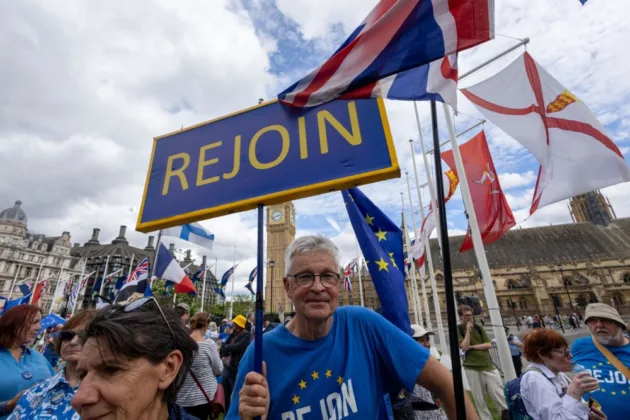






European Green Party leaders have made a call for the UK to rejoin the European Union.
At a conference in Brussels on 8 May, they described Brexit’s consequences as clearly visible, especially among younger people who they say increasingly want to go back.
The European Green Party sees the UK rejoining as a golden opportunity for Europe. They are not trying to impose anything but said they “believe in you”. UK Greens fully back the idea, particularly after recent local election results.
The European Greens also welcomed further enlargement, saying any country that wants to join – including Ukraine and the Western Balkans – should be able to do so. A bigger and more united Europe would be stronger and less vulnerable internationally, they argued.
Energy independence was a central topic. They said the current energy crisis has been fuelled by the US and stressed that Europe must become much less dependent on external suppliers, especially from the Middle East and other fuel-providing regions.
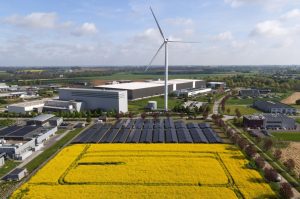
“Renewables are better,” they repeated, calling for more citizen empowerment through systems such as rooftop solar panels to deliver affordable clean energy.
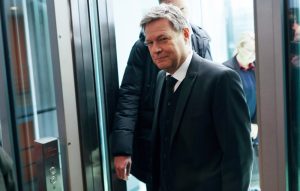
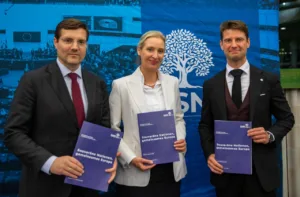
Marine Tondelier, the French Greens leader and candidate for the 2027 French presidential election, was among the key figures at the press conference organised by the Irish politician who has been Co-Chair of the European Green Party Ciarán Cuffe and Vula Tsetsi, the Greek political figure and urban and regional planner and who has also been Co-Chair of the European Green Party.
With former Hungarian prime minister Viktor Orbán now out of power, the European Greens believe the door is open to accelerate the Green Deal.
The European Green Deal is the European Union’s flagship growth strategy to make Europe the first climate-neutral continent by 2050. Launched in 2019, it aims to cut greenhouse gas emissions by at least 55% by 2030 (compared to 1990 levels) through investments in green technology, sustainable industry, and biodiversity
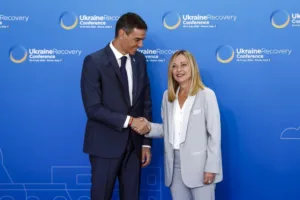
The European Greens pointed to successes in Portugal and said Spain – saying under Prime Minister Pedro Sánchez, Spain is now a top priority for new investment. They also want to fight tax evasion to help finance the “green” transition.
The party leaders insist the Green Deal goes beyond ecology. It is also social, aimed at solving the housing crisis, rising supermarket prices and the overall cost of living. Money from the EU carbon market (ETS) would be given back through grants to renovate buildings and support farmers. They want to relaunch European industry through the green transition.
The European Greens highlighted their local successes as the base for future growth. They noted Green or progressive mayors in several capitals including Copenhagen, Amsterdam, Budapest, Riga and Zagreb. In Denmark, their allies are now the second-largest party. Their strategy is to build credibility through local elections ahead of stronger results in the 2029 European elections.
When asked yssterday by Brussels Signal about nuclear power – one of the lowest-carbon sources that gives countries like France strong energy independence – Cuffe replied that it is up to each member state to decide.
He noted France’s policy shifts under President Emmanuel Macron but added that nuclear still has vulnerabilities and can be very expensive but said his “huge opposition has now diminished”.
The Greens acknowledged that the green transition is expensive but see it as a long-term investment. They want to move away from combustion engines towards electric vehicles, although questions remain about how this will help farmers who need reliable heavy machinery.
Answers on battery lifespans and reliability were somewhat vague during the conference. Europe also remains dependent on other countries for lithium and battery components.
The cost of the full Green Deal, its impact on Europe’s competitiveness (especially against China) and whether it will really bring down energy bills for ordinary citizens continue to be important issues.
Overall, the European Greens presented this moment – after Orbán’s departure and with local momentum – as a” golden opportunity” to build a greener, more united and more independent EU.
How well these ambitious plans deliver affordable energy and keep European industry strong will be the key test in the years ahead.