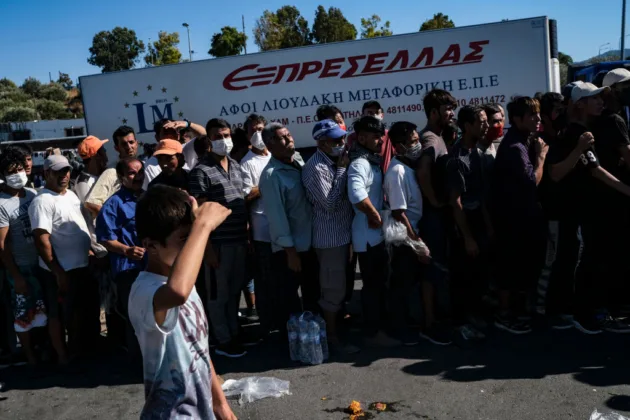




Greek migration minister Thanos Plevris has warned that approximately 550,000 migrants and refugees are currently waiting in Libya for an opportunity to cross the Mediterranean to Europe.
Speaking in a television interview yesterday, Plevris described the figure as an estimate by Greek authorities, highlighting Libya as a major departure hub for people-smuggling networks.
He noted that Athens is working closely with the European Union’s border agency Frontex and Libyan authorities to disrupt smuggling operations, detect vessels early and prevent departures from the Libyan coast.
“Those who are not entitled to asylum will be detained,” he told Greek news outlet Voria.
“Now, when it is likely that someone will not get asylum, they are not placed in a freedom status but in a detention status, so that with the rejection of asylum, they can be returned.”
He added: “There is no reason for Greece to open its borders and accept people,” although noted that it “will operate within the legal framework, but will also go to the limit in order to protect the borders”.
The warning comes amid a notable shift in irregular migration patterns toward Greece.
While arrivals via the eastern Aegean route from Turkey have reportedly fallen significantly (by around 70 per cent in some periods), crossings from eastern Libya to the southern Greek island of Crete have increased sharply in recent years.
Crete has become Greece’s busiest entry point for irregular migrants from Libya, with reports of several hundred arrivals in single days in early May 2026.
Greek coast guard operations have intensified, including rescues and interceptions of overcrowded boats making the hazardous multi-day journey.
Independent estimates of the total migrant population in Libya vary.
The International Organisation for Migration (IOM) has previously reported figures exceeding 800,000–900,000 migrants in the country in 2025, many from sub-Saharan Africa, Sudan, Egypt and other nations, although not all are necessarily intending immediate onward travel to Europe.
Plevris has emphasised a firm approach to irregular migration. He has stated that individuals not entitled to asylum will be detained and returned where possible and that Greece has no intention of opening its borders.
The Greek Government has introduced stricter legislation in recent months, including tougher penalties for rejected asylum seekers and measures to speed up returns.
Greece continues to co-ordinate with EU partners and Libyan authorities on both sides of the country’s divided political landscape.
Recent diplomatic engagements, including talks between Greek and Libyan foreign ministers, have focused on migration control alongside other bilateral issues.
The Libya route has long been a concern for southern EU states, particularly Italy, Malta and Greece. Smuggling networks exploit instability in Libya, where migrants often face difficult conditions, including reports of abuse in detention centres.
European efforts have included support for Libyan coast guard operations, although human rights organisations continue to raise concerns about conditions and returns.
According to the UN refugee agency UNHCR, the eastern Mediterranean, saw 107 fatalities registered last year.
Mary Khan, MEP for the Alternative for Germany Party (AfD), has said European Union policies that block Europe’s border agency Frontex from sharing data on people smugglers with the police are “absurd”. https://t.co/i4D3SmQjY4
— Brussels Signal (@brusselssignal) April 10, 2026