










Nigel Farage’s Reform UK party was the runaway winner of Britain’s local elections last week, winning almost 1,500 councillor seats on city and county governing bodies across the country. The governing Labour party was decimated (lost over 1,400 seats), effectively ending Keir Starmer’s premiership. Meanwhile, the Conservatives were also badly mauled, plunging further down into the abyss that had begun to swallow them at the 2024 parliamentary election after 14 years in power.
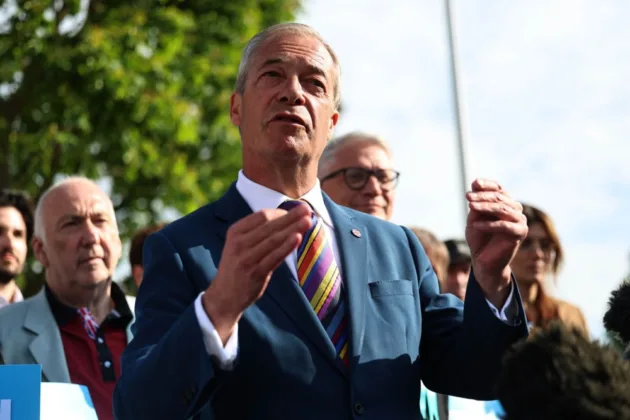
As the vote count finished, Farage stood triumphant, with a powerful political momentum behind his party as attention begins to focus on the next General Election. Now widely seen as a prime-minister-in-waiting, Nigel has not only broken all possible records in British politics, but has accomplished the hardest task facing any anti-establishment right-wing leader: Breaking out of the “extremism” box that the elites try to put them into, and becoming an accepted, mainstream political force. This is an ongoing lesson in politics, of historical proportions, that should be required study for any populist party in Europe – and for their opponents too.
Let us be clear about the scale of the challenge, which all major insurgent political movements of the post-2016 nationalist-populist “wave” have in common. By definition, and through practice, as “anti-system” insurgents they have set themselves up against not just the traditional, historic – in many cases, hegemonic – political parties in their countries, i.e. versions of Social Democracy (including Progressivism) on the Left and of Conservatism (including Classical Liberalism) on the Right. These were big, strong political machines with nation-wide grassroots campaigning infrastructures built over many decades – and in some cases, like that of the British Tories, over centuries. The fight against these behemoths alone would’ve been a hard task.
But populists have also taken on the entire support system and cultural outlook of the centre-left/centre-right duopoly, ranging from the mainstream media, to the donor networks, and to the public sector apparatus (including the judiciary) and Civil Service. The latter, in particular, has always and everywhere aligned to what’s been seen as the settled, legitimate political power players in the state. It is the expansion of the political fight beyond simple party-politics and into cultural warfare that fundamentally accounts for the frenzied, visceral reaction of the “system” to the threat posed by populist outsiders like Farage (and Trump, in the US) who seek to overturn the old order completely.
New political movements can certainly spring up on a wave of discontent with incumbent governments or driven by particular events – Angela Merkel’s great Migrant Welcome in 2015 – or single issues, such as the Brexit referendum in 2016. Examples previous to those include the set of Pirate Parties that came on the scene in the mid-2000s, with some entering parliament. But they find it hard, if not impossible, to actually break through and gain control of government. Even Viktor Orbán, the one and only genuine example of European populist rule – Meloni’s “credentials” being tarnished by collaborationism with Brussels and a strategy of working “within the system” – actually got to power well before turning national-populist and talking about illiberal democracy.
The key problem that populist “rebels” have is that their movements tend to be either snuffed out at an early stage or throttled – kept below a certain ceiling they cannot break beyond – by the intense adversarial propaganda against them, usually branding them as “far Right” or “extremists”. If that label sticks, they become beyond the pale and the rest of the (mainstream) political world tends to create cordons sanitaires to contain them. Often, polarisation resulting from the rise of populism in fact helps the establishment – the “uniparty” – maintain its grip on power.
Nigel Farage used to be in this situation not very long ago. He too had been successfully labelled “far right”, and boxed-in, by and large, as an unsavoury, unacceptable racist and even (especially to the Left) as an extremist. The EU Referendum campaign, and especially the vicious post-Referendum “Brexit wars” up to 2019, when Remainers were trying desperately, and undemocratically, to reverse the result of the June 2016 vote, concentrated huge negative press on him as the establishment (rightly) perceived Farage as the keystone of the political coalition ranged against them.
And yet, he did not break. In 2019 his newly-founded Brexit Party swept the European Elections that year and helped pave the way for the Tory landslide (which was then ill-used, but that’s another story). He took a break from frontline politics, and then returned with Reform UK – built on Brexit Party – to now top the polls in Britain at 28 per cent. How did he do it? There are three key ingredients to Nigel’s success.
The first is his personal political talent and career. Like him or hate him, Farage is the consummate politician: A courageous performer of considerable charisma with the ability to connect immediately with the ordinary voter; an astute judge of political moods, with an extraordinary sense of timing (crucial in politics); and an experienced political operator who really understands the business and who has built, by now, huge name recognition across the country and indeed beyond.
Many of the new-generation populists who expect fast results forget that Nigel co-founded UKIP all the way back in 1993: He has over three decades of political experience fighting no-hope campaigns as an underdog, and he has survived all of that – and even a plane crash. Objectively speaking, the level of personal determination and grit (and indeed luck) required to just stay the course in such circumstances, let alone making any success of it – for better or worse – is not a mere “CV detail”, but fundamental to what we are seeing with Reform today.
The second ingredient is strategy. Farage has made at least two important and correct strategic decisions along the way and implemented them with discipline. One was to carefully avoid associations with controversial activists branded by the media as “far right”, and “racists” such as Tommy Robinson, and to very visibly denounce and stamp out racism within Reform. Part of this approach, for example, has been to appoint Muslims such as Zia Yousuf or Laila Cunningham to prominent positions in the party, as well as promoting many other non-whites as Reform candidates. This has worked so well that even traditional Conservative political figures like Jacob Rees-Mogg spoke openly in defence of Farage, disputing the notion that he might be racist, and calling Reform’s views, “mainstream” – at least in the sense of being shared widely around the country.
The other key strategic decision Farage made from the very beginning of his time as leader of Reform was to correctly – from his party’s point of view – identify the need to completely destroy the Conservatives, and to reject any potential pact with them. Objectively speaking, this is the right focus for Reform, because in British politics no party can win an election unless it becomes the hegemonic force on its part of the de facto spectrum. This may sound like an obvious strategic choice now, but when starting out with Reform, the aim of demolishing the Western world’s oldest and most successful political party looked rather unlikely, if not ludicrous. In fact, for a good while there was talk of Farage being co-opted into the Tory party, or taking over it. Yet Nigel correctly perceived the sheer weakness and vulnerability of the Conservatives, and calculated that the odds are in fact in his favour. All this takes strategic vision as well as boldness in execution.
Beyond this, his broader strategic instincts have also been proven right. Two stand out, in particular: The willingness and ability to assemble “popular front”-style electoral coalitions across traditional ideological lines, as seen during Brexit; and the deliberate rejection (certainly in rhetoric) of Left/Right framing, pursuing a mix of free-market and working class-oriented policies. The latter has attracted copious scepticism as to the soundness of its policy framework, which of course remains untested in real-life; but Nigel has judged, correctly, that the risk of being attacked on policy is worth the benefit of appearing to support both the welfare state and a low-tax, unregulated free-market economy complete with loose rules for crypto.
Also part of the Farage approach to strategy is the more mundane and less glamorous organisational side of politics. Again, Nigel has proven to have made the right bets, although questions persist with regard to some of the advice, influence and associations he has been allowing on the part of party donors. But Brexit Party, for example, was a startling case of a start-up party created from scratch with the help of executives from Pagefield, a London communications agency. The internal organisation and structure of Brexit Party and then Reform, were also winning bets, as was the campaign rhythm imposed well in advance for the local elections this May. Finally, Reform’s PR game is likewise exceptional, with a constellation of Zoomers allowed and empowered to create clever, catchy digital content that appeals to the younger generation.
The third ingredient is something Farage does not control but which he is able to exploit with skill: Circumstances – from the shifting cultural Overton window to the missteps of his adversaries. One example of the first one is the launch of the right-wing GB News channel in 2021, as an alternative to the mainstream BBC/Sky News ecosystem, which has become influential and where Farage himself got a prime-time show that kept him in the limelight. As for adversarial missteps, there are examples aplenty – the most egregious ones involving failures and outright lies perpetrated by Conservatives in government, especially over immigration, as well as the elites’ cultural war on British national history and identity.
It is hard to think of too many politicians who were able to overcome their own political baggage and the constraints and “firewalls” built around them by the establishment they set themselves against. Farage managed to cross the danger zone, to get his political party going, to avoid an early failure or break-up – indeed, Reform had even bigger gains in a set of local elections last year – and to build momentum for the victory won last week.
This is now definitive proof that Reform is not just a protest movement collecting disaffected votes, but an election-winning machine in the process of resetting British politics. Its only – and potentially fatal – flaw? That it depends so overwhelmingly on a single and unusually effective politician. The next danger zone for Reform to cross is the interval of time that it takes to fully build up the party, its internal culture, and its top tier of leaders, so that it can carry on even without Farage. Until then, Reform remains impressive but exceptionally fragile at the same time.