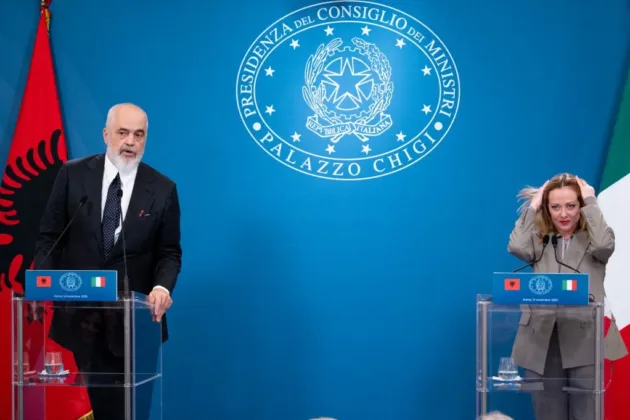




The Italian and Albanian governments have reaffirmed their commitment to a bilateral agreement aimed at tackling illegal migration towards the European Union, amid tensions over its long-term future.
Albanian Prime Minister Edi Rama has sought to calm the situation, declaring on social media on May 12 that “the protocol will remain in force for as long as Italy wants it,” in a message swiftly reposted by Italian Prime Minister Giorgia Meloni. Italian foreign minister Antonio Tajani later reinforced the message, insisting that relations between Rome and Tirana remained strong.
The agreement, centred on the establishment of Italian-run migrant processing centres on Albanian territory, had come under scrutiny following remarks by Albanian foreign minister Ferit Hoxha that appeared to cast doubt on its renewal.
The controversy erupted after an interview with Euractiv published in mid-May, in which Hoxha suggested the deal allowing Italy to process and detain migrants in Albania may not continue beyond 2030, the year Tirana hopes to join the European Union. The agreement, a flagship initiative strongly backed by Meloni, is currently set to expire in 2029.
Hoxha argued that Albania’s eventual EU accession would fundamentally alter the legal framework underpinning the arrangement. “Once Albania joins, that is no longer extraterritorial, it’s the territory of the European Union,” he told Euractiv, suggesting the change in conditions would make renewal of the agreement impossible. The remarks triggered an immediate political backlash in Italy.
Ratified in 2024, after being signed by Meloni and Rama in November 2023, the Rome-Tirana agreement allows Italy to transfer migrants intercepted at sea or detained on Italian territory to facilities in the Albanian towns of Gjadër and Shëngjin, where asylum applications and repatriation procedures are processed. Under the original scheme, only adult men from countries Italy designates as “safe” were to be sent across the Adriatic, with Rome projecting the two centres could handle up to 36,000 people a year.
The Italian government has estimated the agreement could cost around €670 million over five years, covering construction and management of the Albanian facilities, security, logistics and staffing. Some opposition figures in Rome have put the likely bill closer to €1 billion, and citizens have filed claims over the use of public funds with Italy’s financial courts.
Meloni has repeatedly framed the agreement not only as a tool for protecting Italy’s national borders, but also as a potential model for a more effective European approach to border management.
Rome has long been one of the strongest supporters of Albania’s EU accession bid, which it views as strategically important for stability in the Western Balkans and for Italian interests in the Mediterranean. Albania has been an official EU candidate since 2014, and Rama has set a target of completing accession negotiations by 2027 and joining the bloc by 2030. In recent years, that support has deepened further thanks to the close relationship between Meloni and Rama, who have expanded cooperation on migration, energy and investment.
Some Italian media have described the migration deal as part of an informal understanding between Rome and Tirana, under which Italy’s backing of Albania’s EU path is linked to close cooperation on migration management. In other words, Albania’s integration into the Union with Italian support is seen by some as closely intertwined with the agreement itself. Against this backdrop, Hoxha’s remarks were poorly received in Rome, as they were read as questioning a framework that also underpins broader cooperation on bringing Albania closer to the EU.
Facing mounting criticism, Tirana quickly moved to contain the fallout. Hoxha later insisted his comments amounted merely to “thinking out loud” rather than signalling any policy shift. Rama subsequently accused sections of the media of distorting the interview and reiterated Albania’s full commitment to the protocol.
The legal and institutional implications of a potential EU accession by Albania remain, though, unresolved in practice. It is still unclear what status the Italian-run hotspots would have if Albania were to become a member state. In principle, the concept of extraterritorial processing outside the EU legal space would no longer apply within the Union’s territory, raising questions as to whether such facilities could continue to operate or would need to be relocated to third countries outside the bloc’s external borders.
If the centres were to remain in Albania after accession, their status under EU law, including in relation to free movement rules, asylum procedures and jurisdiction, would require significant clarification at EU level, and would likely depend on whether a specific derogation or special regime were negotiated. As things stand, that remains an open question in both the legal and political debate surrounding the agreement.