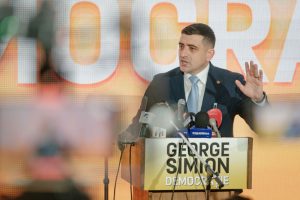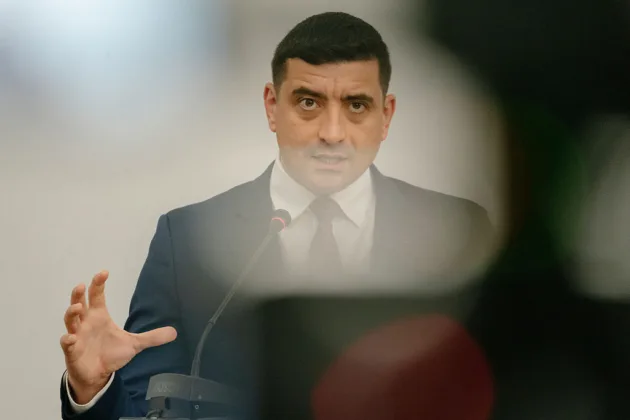


One year ago, on May 4, 2025, George Simion achieved a historic result in the first round of the presidential election, winning approximately 41 per cent of the vote. It was the moment when, in the midst of a democratic crisis, following the annulment of the presidential election at the end of 2024, Romanians sent a clear message regarding the country’s future direction: A profound change is needed.
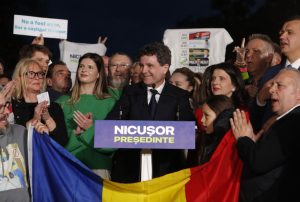
After a campaign rife with smearing, disinformation and false claims targeting George Simion, he lost the second round of the presidential election to the progressive candidate, Nicușor Dan. The resulting government, composed of social democrats (PSD), liberals (PNL), progressives (USR), representatives of the Hungarian community in Romania (UDMR), and minorities, presented to the public as a so-called pro-European coalition, continued the narrative from the campaign and positioned itself as a true cordon sanitaire against George Simion and his Alliance for the Union of Romanians (AUR), which they termed the “anti-European threat.”
In this scenario, the new government promised Romanians measures aimed at reviving the national economy, and, under the pretext of reforms, Romania was hit by a series of austerity bills: Increases in consumption taxes (value-added tax and excise taxes), and additional taxation on pensions and dividends. Moreover, pension levels were frozen, student grants were cut, mothers’ incomes were reduced and redirected to the state, and the business sector was brought to its knees.
The result? After nearly a year of “pro-European” governance, Romania is now facing the highest inflation, the largest budget deficit, the largest trade and current account deficits, and the highest interest expenses in the entire European Union. This context has led Romanian society to trigger a full-blown social crisis, amid an unbearable decline in living standards and due to the extreme austerity imposed by the Bolojan government.
Political reactions have been varied, but they have confirmed a single reality: AUR is the most important political party in Romania. The social democrats withdrew from the governing coalition and joined the initiative announced by AUR to file a motion of no confidence against the Bolojan government.
Early last week, the initiative was formalised, and the motion of no confidence was filed with a list of over 250 supporting lawmakers. Tomorrow, Tuesday, May 5, the motion will be tabled to the Romanian Parliament vote. According to the Romanian Constitution, the majority of the MPs (233 votes) is needed in order for the motion to pass and for the government to be dismissed, which is comfortably below the number of announced supporters. Political sources have announced that, in fact, the motion will be voted on by even more parliamentarians, including some from the liberals (PNL), the party led by Prime Minister Ilie Bolojan.
According to AUR leaders, their goal is to oust the current government and trigger snap elections, so that Romania can return to the democratic framework that existed prior to the annulment of the 2024 presidential election, and so that Romanians can be proportionally represented in parliament. The latest opinion polls place the party led by George Simion at the top of Romanians’ preferences, with a percentage between 35 per cent and 40 per cent, more than double that of the second-place party, the social democrats (PSD).
The political crisis in Romania is, right now, the clearest indication that the era of a progressive Europe, led by bureaucrats in Brussels, is drawing to a close. The so-called pro-European government has led to a severe crisis of direction, not just a political conflict, and the rift between the state and its citizens is becoming increasingly noticeable. Romania is currently facing a drastic ideology shift, and a sovereignist government could transform this country into the most important bastion of conservatism in Southeast Europe.
Alexandru Tafo is currently studying Economics & International Affairs in Bucharest and is a member of the “Titu Maiorescu” Foreign Policy Group