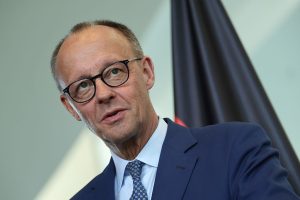


German Chancellor Friedrich Merz has reached the first anniversary of his swearing-in on May 6, 2026, with little to celebrate. A year on from the day he became the first German leader to need a second Bundestag vote to take office, Merz has presided over a stagnant economy, a coalition at war with itself and the deepest crisis in transatlantic relations Berlin has known in decades.
According to polling agency Forsa, just 15 per cent of Germans approve of his work, the lowest first-year rating recorded for a post-war chancellor and well below the score his Social Democratic predecessor, Olaf Scholz, posted at the same point.
Merz had promised an “autumn of reforms”. By his own account, voters were supposed to feel by summer that things in Germany were “changing little by little for the better”. Instead, the central files — welfare, healthcare and pensions — have been parcelled out to expert commissions while the two governing parties brief openly against each other.
Europe’s largest economy has barely grown since the pandemic. After two years of recession and a near-flat 2025, official forecasts now point to growth of about 0.5 per cent in 2026, and even that figure is being revised down because of the Iran war and the closure of the Strait of Hormuz. Around a fifth of the world’s seaborne oil used to pass through the strait before the United States and Israel attacked Iran on February 28.
The Iran shock has pushed energy security back to the top of the EU agenda. The European Commission says member states have spent an extra €25 billion (about $29.3 billion) on energy since the war began. In Berlin, the coalition has resorted to slashing the mineral oil tax by 17 cents a litre for two months in an attempt to soothe motorists. Chancellor Merz has admitted that “the war in Iran is the real cause of the problems we also have in our own country.”
A COALITION HELD TOGETHER BY MATHS
The “black-red” alliance between Merz’s CDU/CSU bloc and the Social Democratic Party (SPD) was sold as a return to grown-up government after the chaotic break-up of Olaf Scholz’s three-way coalition. A year in, it is held together less by conviction than by parliamentary arithmetic. Merz has ruled out cooperation with the Alternative for Germany (AfD), the so-called cordon sanitaire, leaving the SPD as his only path to a majority.
The Social Democrats are using that leverage. Bärbel Bas, the SPD co-leader and labour minister, used a May Day rally to denounce the Conservative welfare cuts as “despicable” and warned of a “swansong” for the German welfare state. Merz, in turn, has reminded his partner that “compromise is not a one-way street”.
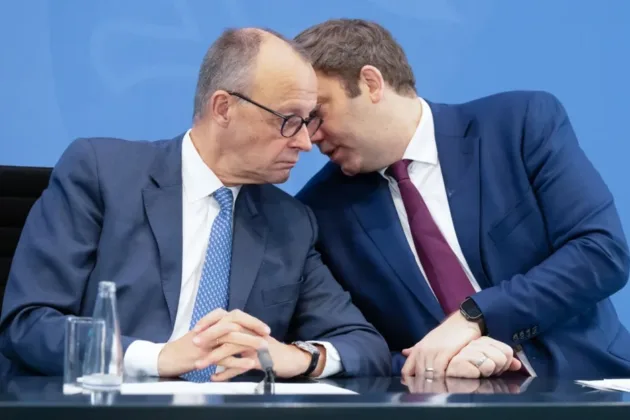
The strain has spilled into public view. German media reported that Merz shouted at his Vice-Chancellor and Finance Minister, Lars Klingbeil, during a crisis meeting on the energy package. Klingbeil suggested he was willing to be shouted at if it was the price of defending his principles. Merz, asked about the episode on public broadcaster ARD, denied raising his voice.
Daniel Goffart, a long-time biographer of the Chancellor, said heated exchanges in coalition talks were “not unusual” and pointed to a deeper question: “How far do the leaders stick to the coalition agreement?”
THE WASHINGTON BREAK
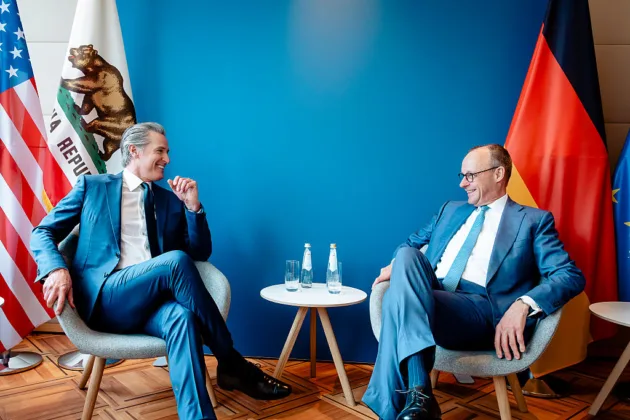
Abroad, Merz’s calling card had been a working line to the White House. That advantage has evaporated. After the Chancellor publicly criticised US strategy in the Iran war and refused to send German forces to help clear the Strait of Hormuz, President Donald Trump announced a hike in tariffs on European car imports from 15 to 25 per cent and ordered the withdrawal of about 5,000 US troops from German bases.
The breach has hardened Merz’s interest in a European nuclear umbrella under French leadership and pushed defence spending higher up the agenda, one of the few files on which his coalition still agrees.
A CHANCELLOR REJECTED AT THE POLLS
The combined effect is a Chancellor who polls below his predecessor at the same point and below every other German party leader. According to a survey by US firm Morning Consult, his international approval is also lower than that of Trump or Turkish President Recep Tayyip Erdoğan.
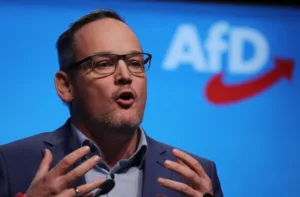
The party-political consequences are stark. An INSA survey published on May 2 placed AfD on 28 per cent against the CDU’s 24 per cent. About three quarters of voters told INSA the coalition was failing and 58 per cent said it would not survive until the scheduled 2029 election.
Goffart attributes part of the slide to personality. Merz, he said, can come across as arrogant, partly because, at almost 2m tall, he tends to “look down on people”. The image problem, particularly with women voters, predates the chancellery and has not faded.
Merz himself, in a recent Der Spiegel interview, suggested the problem lies elsewhere. Germans, he argued, expect democratic politics to work like a delivery service, and the country’s “prosperity illusion will not hold”. Asked on television what advice he would give the man who took the Chancellor’s oath a year ago, he had a one-word answer: “Patience”.
After 12 months in which almost everything has gone wrong at once, it may be the only thing he still has.