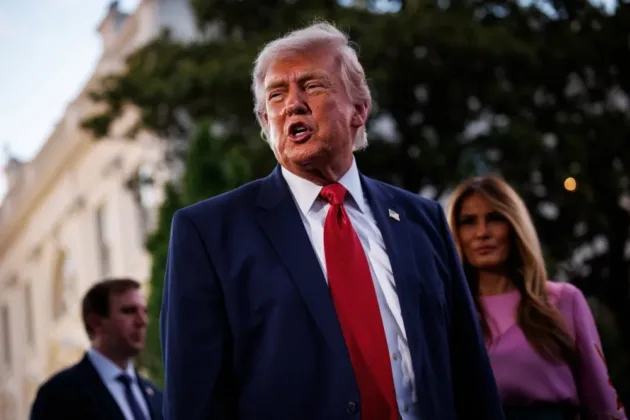





US President Donald Trump has stated that Washington would reduce the number of US military personnel stationed in Germany, indicating that the cuts might be much larger than the 5,000 people initially announced by the Pentagon. This represents an escalation of a deepening rift between President Trump and Chancellor Friedrich Merz which began with the US-Israeli-Iranian war.
On May 2, 2026, Trump spoke to reporters in Florida stating that the US intended to significantly decrease the number of US military personnel in Germany; however, he did not provide additional information regarding how many military personnel would be involved or why the reductions should be so extensive. “We’re going to cut way down,” Trump stated. “And we’re going to cut a lot further than 5,000.”
The day before, Pentagon spokesperson Sean Parnell confirmed that the US would withdraw approximately 5,000 troops from Germany as part of a complete review of US Department of Defense force posture in Europe and in response to current theatre requirements and conditions on the ground. It is expected that this withdrawal will be completed within 12 months, although specific time frames for certain units and locations are still being determined.
In late December, 2025, there were approximately 36,400 active duty US service members stationed in Germany on a permanent basis – the largest American military presence in Europe. Several senior NATO officials indicated privately that neither they nor other officials in NATO were informed in advance of the decision to withdraw some US forces and that the announcement lacks specificity and clarity regarding how this action will influence NATO’s overall force structure.
A SPLIT OVER IRAN
This decision comes amidst an increasingly contentious exchange over the manner in which the US has handled its war with Iran. On April 27th, 2026, Merz released a statement suggesting that Iran had successfully thwarted negotiations with the US, repeatedly failed to deliver concessions to US negotiators, and embarrassed the White House into making concessions to reach agreements with Tehran.
Two days later, on April 29, Trump responded by stating that Merz didn’t know what he was talking about and announced that his Administration was considering reducing the number of US troops in Germany. By May 1st, the Pentagon formally implemented those plans.
Since then, Merz has reportedly told German media outlet ARD that there is no connection between the increasing friction between him and Trump regarding the war with Iran and the pending reduction in US military personnel stationed in Germany, even if the timing has been viewed by many throughout Europe as an act of retaliation against Germany.
BERLIN DOWNTONES THE CUTS
German Defense Minister Boris Pistorius attempted to temper the blow when he stated that a significant reduction of US military personnel in Germany had been expected for many years and that Europe needed to begin taking responsibility for its own defense. “It is in our interest — and in the interest of the United States — that American soldiers remain in Europe, particularly in Germany,” Pistorius stated.
During a trip to Morocco, German Foreign Minister Johann Wadephul expressed that Berlin was preparing itself for the reduction and was working with all elements of NATO to discuss it. However, Wadephul emphasized that major US facilities located in Germany — such as Ramstein Air Base — are off-limits to consideration.
Germany is on track to meet NATO‘s 2% defense spending threshold under new Chancellor Friedrich Merz through increases in defense spending equaling more than 3% of GDP by 2027.
NATO ASKS FOR CLARIFICATION
The alliance is now seeking clarification from the US regarding both the scope and timing of these cuts. “The Alliance is working with the United States to better understand this issue,” said NATO spokeswoman Allison Hart. “At the same time this development emphasizes again the need for increased investment by Europeans and a fairer distribution of responsibilities for common security.”
The proposed withdrawal is estimated to represent nearly one-seventh of all US personnel currently serving in Germany. The sole permanent Brigade Combat Team in Germany is the 2nd Cavalry Regiment, which serves as an essential component to America’s and NATO‘s ability to deter potential threats. Additionally, the Pentagon recently confirmed that it intends to cancel the scheduled deployment of the Army’s Long-Range Fires Battalion in Germany, which includes Tomahawk and hypersonic missiles.
CIVILIAN DIVISION AMONG REPUBLICANS
The decision to withdraw some US military personnel from Germany has created divisions among Republican lawmakers. Both Senators Roger Wicker (Mississippi) and Representatives Mike Rogers (Alabama) serve as Chairs of the Armed Services Committees in their respective houses of Congress. Wicker and Rogers issued a joint letter expressing concern that this move could undermine deterrents to Russia while simultaneously providing a negative signal to Russian leader Vladimir Putin.
Wicker and Rogers called upon the Pentagon to relocate US military personnel in Europe to Eastern Europe rather than withdrawing them from Germany. They argued that Allies in Eastern Europe have invested substantially in hosting U.S. troops and strengthening NATO‘s forward defensive line.
GERMANY NOT ALONE
While it appears unlikely that similar reductions will occur in Italy, Trump stated publicly that Italy has provided little support and that Spain has been “horrible” regarding issues related to using Spanish airfields and airspace for operations tied to the Iran conflict. Madrid previously denied US requests for access to Spanish airbases or airspace for Iranian-related missions.
The reduction of US military personnel in Germany occurs at a sensitive moment for NATO. As reported by The Financial Times, several NATO countries — including the United Kingdom, Poland and Lithuania — are preparing themselves for delayed delivery of arms from the U.S., due to ongoing efforts by Washington to rebuild stockpiles depleted during its involvement in the Iran conflict — delays which could also potentially extend to supplies of Patriot missile systems and HIMARS ammunition destined for Ukraine.
To add another layer of complexity, European governments are already dealing with the ongoing war in Ukraine, unresolved trade disputes — including looming 25 percent tariffs on EU automobile imports/exports — and Trump‘s open-ended pledge to continue cutting troops from NATO member states represents yet another step toward de facto dismantling of post-Cold-War security structures