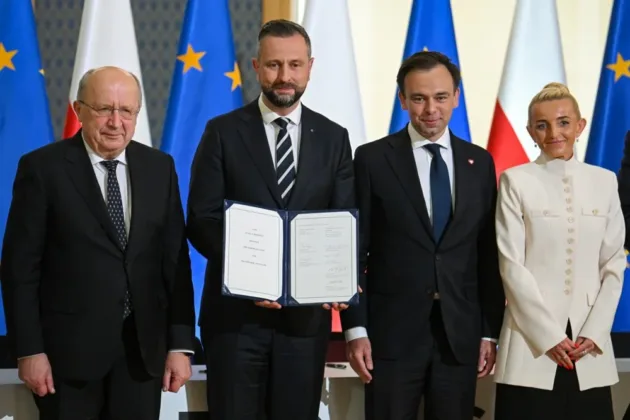









On May 8th, the Polish government was set to sign the SAFE defence procurement loan agreement with the European Commission in Warsaw. It was going to do so despite President Nawrocki’s veto of the law that would have greenlit such a large long-term commitment for Poland, as required by the country’s Constitution. Although the economic structure of the loan may constitute an argument for using it, the legal and political risks associated with the conditionality mechanism disqualify a sovereign state from having a positive attitude towards such a proposal.
On the one hand, the European Commission will not lose such an opportunity to make Poland dependent on its goodwill in the next crucial field of defence procurement. But on the other hand, the government of Donald Tusk is desperate to secure the money so that it can reallocate the sums that would otherwise finance Poland’s defence, which now amount to nearly five per cent of the country’s GDP each year, in the year of the parliamentary elections. And it is no wonder that Tusk is so desperate that he is willing to trample on the law and the Constitution for this money, which will help him maintain power.
In 2025, Poland’s budget deficit amounted to 7.3 per cent of GDP, placing it second in the unenviable European Union ranking, right behind Romania. For us Poles, it is no surprise that, due to defence and social spending, Poland may become this year’s leader in the ranking for the depth of the public finance deficit planned for 2026. This, according to the definition proposed by the European Union, will amount to as much as 6.8 per cent of GDP, and according to the April fiscal notifications from EU member states, it will be the worst indicator among all member states.
Annual public-finance deficits accumulate into a growing public debt, which in Poland last year stood just below the 60 per cent of GDP threshold (59.97 per cent, the highest on record), and this year is expected to exceed it significantly, reaching 65.1 per cent of GDP.
When Poland was placed under the Excessive Deficit Procedure (EDP) by the European Commission in June 2024, we wondered whether the government would use this to cut social spending and introduce radical savings in public spending, presenting this unpopular policy as “mandated by the European Union”. As we can now see, that didn’t happen, and the procedure itself is effective only on paper. In theory, having been placed under the EDP, Poland was obliged to submit a corrective action plan aimed at reducing the deficit to below 3 per cent of GDP, yet the projected budget deficit as a share of GDP for this year is more than twice as high.
However, even with worsening fiscal indicators, Poland is expected to remain an EU “average performer” this year in terms of the debt level measured relative to the size of its economy. Admittedly, Poland will be in the top half of the member states, but its public debt will still be less than half that of the leaders—Greece and Italy—and nearly half that of third-place France. It won’t be easy to catch up with the most indebted countries, because some of them (above all, France) are also increasing their debt levels. But it is worth analysing our climb into the upper part of the table over the past 10 years.
Polish government deficits before EU-backed Donald Tusk
For the sake of simplicity and given the chosen form and length of this opinion piece, I will omit, in the presentation of the data (all of which is provided below as per EU methodology), the context of the macroeconomic environment, including the phases of business cycles, the impact of inflation on the debt-to-GDP ratio, and the complex effects of the COVID pandemic on the economy, and focus instead on differences in approaches to debt and deficit management.
The Law and Justice party took power in Poland in the fall of 2015 and held it for eight years. In 2015-2017, the country’s budget deficit-to-GDP ratio declined (in 2015-2016 it hovered around 2.5 per cent), reaching its lowest level in the history of the Third Polish Republic (1.5 per cent in 2017), that is, since the fall of the communist People’s Republic in 1989–90. Then it increased slightly (1.9 per cent in 2019) until the COVID-19 pandemic, when the rate for 2020 jumped to 6.9 per cent of GDP. In 2021, it amounted to 1.8 per cent, and in 2022 to 3.7 per cent (see: General government deficit and debt in 2022).
Such large fluctuations stem from the fact that during the pandemic, countries were, in effect, allowed to run high deficits in the name of safeguarding higher values. The Polish government readily took advantage of this by including in the 2020 budget expenditures that were meant to be incurred in 2021. As a result, the high 2020 deficit also included expenditures that would normally have appeared in the 2021 deficit.
As a result of the outbreak of Russia’s full-scale attack against neighbouring Ukraine in February 2022, and with the need to increase Poland’s defence spending and to introduce new protective measures related to high inflation and energy costs, the country’s budget deficit under the Law and Justice government in the 2023 election year reached a level of 5.1 per cent of GDP.
The year 2024 (the first full year of Donald Tusk’s Civic Coalition government with its coalition partners) and the years that followed saw a further widening of Poland’s budget deficit. Effective January 1, 2024, social spending was increased. This was still a decision by the previous Law and Justice government. However, this is not the only reason for the increase in the budget deficit-to-GDP ratio to 6.6 per cent. In the subsequent years of the Civic Coalition’s rule, the rate rose even further, to 7.3 per cent in 2025 and a projected 6.8 per cent for this year. Recent years have therefore brought the highest government deficits in the history of post-communist Poland.
It should be noted that nominal public debt increased steadily throughout the entire period under review. During this period, debt relative to GDP rose from levels below 50 per cent around the transition between the first and second terms of the Law and Justice government to levels above 60 per cent in 2026, with a marked increase since the COVID-19 pandemic. Thus, a clear decline in unfavourable indicators can be observed during Law and Justice’s first term in office up until the pandemic, although even today public debt remains far from the 70-75 per cent of annual GDP level that the literature considers a critical threshold, the breach of which could even lead to sovereign bankruptcy.
The pandemic also contributed to a sharp widening of the gap between the debt-to-GDP ratios calculated under the EU and Polish methodologies. The immediate cause was the launch of off-budget funds to combat the pandemic—the Financial Shield managed by the Polish Development Fund and the COVID-19 Counteracting Fund, which is managed by Poland’s national development bank, Bank Gospodarstwa Krajowego (BGK). A similar mechanism was used after the outbreak of the large-scale war in Ukraine in 2022, when the process of substantially increasing defence spending began. Accordingly, the Armed Forces Support Fund has been operating since 2023, administered—again—by BGK. Debt generated by the activities of these funds is counted under the EU methodology for calculating public debt, but the funds themselves are outside the Polish definition of that debt.
They are also not counted toward the constitutional debt limit, set at three-fifth of the value of the annual gross domestic product, as specified in Article 216(5) of the Constitution of the Republic of Poland. Once this threshold is reached, state authorities may not incur new financial obligations by taking out loans and by granting financial guarantees and sureties. However, although legal doctrine holds that a breach of the foregoing prohibition may be deemed a constitutional offense, giving rise to the constitutional and political liability of members of the government, it is at the same time emphasised that this prohibition is not absolute and may be lifted in the event of a state of so-called “overriding state necessity”. Can spending to shield the Polish economy from the effects of lockdowns and defence spending in the face of the war in neighbouring Ukraine be considered a state of necessity? They probably can, although the very fact that politicians themselves create special “off-budget” funds to circumvent the constitutional ceiling may indicate how ambiguous the classification is.
The euro—a (concrete) lifebuoy?
We must be aware that with each additional year of the planned deep deficit, Poland will move up in the ranking of the most indebted EU member states. It is a self-reinforcing debt spiral, because an increase in risk for investors lending to the state makes it necessary to raise bond yields, i.e., a higher risk premium relative to the bonds of countries in the euro area. This will result in a higher cost of servicing debt, increased borrowing costs, and slow economic growth.
The above consequences will constitute yet another argument for replacing Poland’s sovereign zloty with the euro and, combined with the continued irresponsible policy of living on credit, could make a Greek-style scenario in Poland a reality. The danger is all the more real because factors such as high social spending, an overexpanded and costly public administration, excessive bureaucracy, demographic problems, complex labor law, and public resistance to structural reforms (above all pension and social welfare reforms) have long been present in Poland, and adopting the euro, which would enable the continued financing of populist policy with even cheaper credit rather than through economic development, could become a temptation that politicians cannot resist.
Łukasz Bernaciński holds a PhD in law and is the director of the Research and Analysis Centre of the Ordo Iuris Institute for Legal Culture, vice president of the Hipolit Cegielski Center for Legal, Economic, and Social Analyses, president of the Polish Scientific Society, and deputy editor-in-chief of the academic journal The Legal Culture