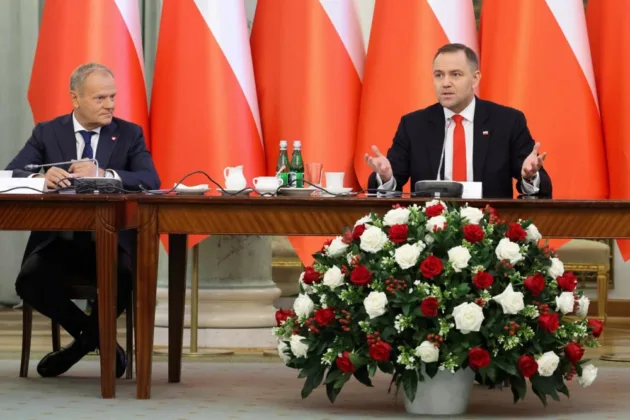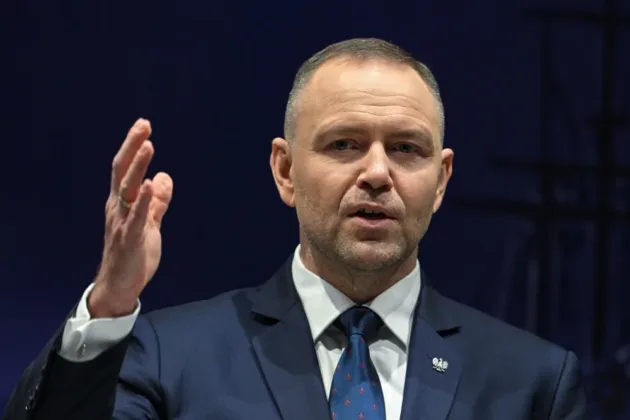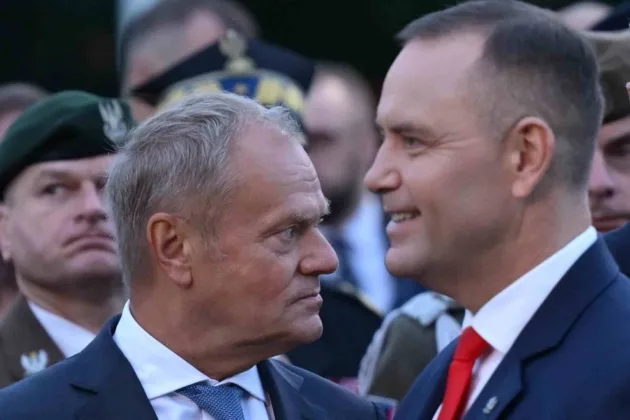

Poland’s second chamber of parliament, the Senate, has rejected a proposal by President Karol Nawrocki to hold a nationwide referendum on European Union (EU) climate policy.
The supporters of the centre-left government led by Prime Minister Donald Tusk voted along party lines in the Senate on May 21 Wednesday against approving the referendum sought by the opposition Conservatives (PiS) aligned Nawrocki.
The power to approve or reject presidential requests for a referendum is one of the few definitive powers of the Senate, which otherwise can only suggest amendments to the lower house of Poland’s parliament. That chamber can approve or reject such amendments as it sees fit.
Under Nawrocki’s referendum proposal, voters would have been asked whether they supported “a climate policy that has led to higher living costs for citizens, higher energy prices and higher costs of doing business and farming.”
Speaking in the Senate chamber, Presidential aide Paweł Szefernaker said the referendum proposal was aimed at giving citizens a direct voice on rising energy costs and the effects of the EU’s Green Deal policies.
“Energy is the foundation of economic and social life,” Szefernaker said. “If energy prices rise, the cost of everything rises.”
He cited an analysis by Polish lender PKO Bank Polski estimating that implementing the EU’s “Fit for 55” climate package could cost Poland more than EUR 527 billion by 2030.
The EU’s Fit for 55 package aims to reduce greenhouse gas emissions by at least 55 percent by 2030 compared with 1990 levels.
Tusk’s Climate and Environment Minister Paulina Hennig-Kloska criticised the proposal during a lengthy Senate debate, calling it “a festival of hypocrisy” and “political populism”.
She argued that the referendum question was misleading and said the vote would do nothing to strengthen Poland’s resilience to energy crises or rising oil and gas prices.
PiS parliamentarians defended the referendum proposal arguing that blocking the referendum showed that the government trusted officials in Brussels more than its own citizens.
Just a day earlier on May 20 the Solidarity trades union staged an anti-government protest in Warsaw under the slogan “Together for Poland and Poles,” demanding, among other things, a referendum on EU climate policy.
During the march Solidarity’s leader Piotr Duda, when the march passed the presidential palace, stopped to express thanks to Nawrocki for recently launching an attempt to force a referendum on climate change in line with last year’s election promises.
“We, as citizens, as Poles, demand this referendum,” declared Duda. “However, seeing what’s happening in our country, how they are trampling on the law, trampling on the constitution, we can expect the worst from them. They will serve their master, Donald Tusk.”
Solidarity, which led resistance to Poland’s communist regime in the 1980s, has for the past three decades been close to the political right and supports the PiS opposition. Last year it supported Nawrocki for President.
In March of this year PiS called on the government to immediately withdraw Poland from the ETS.
Speaking at the demonstration Przemysław Czarnek, the PiS candidate for Prime Minister in next year’s parliamentary elections pledged that under his government would leave the EU’s Emissions Trading System (ETS).
“Away with the ETS, we are leaving it. Together with the people of ‘Solidarity’ here today in Warsaw, we declare to Mrs von der Leyen: we do not accept your climate religion, your left-wing ideology that is destroying Europe and destroying Poland,” said Czarnek.
He added that “if Polish companies are forced to keep paying for CO2 emission allowances, if we remain in the ETS, these people will soon be unemployed; employers, trade unionists, entrepreneurs, and those working in the energy sector are telling us this.”
Czarnek argued that “Poland has its own coal, its own resources, its own capacity to generate electricity that will be cheap and will not force people to invest in renewable energy sources, which simply do not work in our country.”
Tusk’s government however argues there is no way to leave ETS without either incurring large, ongoing fines or leaving the EU altogether and that it has been able to delay the introduction of the second phase of ETS, albeit, so far, only by two years.