


The UK Government has issued a new general trade licence allowing the import of diesel and jet fuel refined from Russian crude oil, even as it maintains a strict ban on new oil and gas exploration licences in the North Sea.
Published on May 19, the licence, registered as GBSAN0004, permits specific petroleum products refined outside Russia from Russian crude to address shortages caused by the ongoing Iran conflict and the blockade of the Strait of Hormuz, a maritime chokepoint through which roughly a fifth of the world’s seaborne oil supplies pass.
According to the Department for Business and Trade, the carve-out applies indefinitely, though it is subject to periodic review and requires importers to keep records.
As Europe’s largest importer of jet fuel with no strategic reserves, the UK has been facing surging prices and flight reductions. The RAC has said the average price of a litre of petrol at British forecourts stood at 158.5p on Tuesday, its highest level since December 2022.
When the US announced similar exemptions on Russian oil imports in March, London warned that it risked helping Vladimir Putin’s “war machine”. US Treasury Secretary Scott Bessent has since said the waiver would “help stabilise the physical crude market and ensure oil reaches the most energy-vulnerable countries”.
The decision comes as the Labour Government has doubled down on its “green” pre-election pledge by introducing legislation to permanently ban new North Sea oil and gas exploration licences as part of its Energy Independence Bill, announced in the King’s Speech on May 13.
For a moment, there were doubts that the government would change its course as the shortages could lead it to resume drilling for UK oil, but Downing Street stayed on course.
This anti-drilling policy makes it illegal to grant new licences for exploration and significantly limits new field development. The bill also confirms a ban on fracking and introduces Transitional Energy Certificates to manage existing gas fields through their remaining lifetime.
North Sea production in the UK is in steep decline, with projections showing it will meet only a fraction of future demand. The Rosebank and Jackdaw projects — among the largest untapped reserves — remain paused following legal challenges on climate grounds.
Industry figures and conservative politicians note that the UK is effectively importing energy from the same geological basin (via Norway) while restricting domestic development.
Critics have called the move “insane”, arguing it prioritises net-zero ideology over energy security and domestic jobs.
They point out the contradiction of sanctioning Russia while allowing indirect imports of its crude-derived products and blocking British production.
Reform UK and the Conservative Party, the two leading opposition parties, have pledged to overturn the ban. Shadow Energy Secretary Claire Coutinho accused Energy Secretary Ed Miliband of being “utterly deluded”, saying: “He is not making us more independent. He is making us more reliant on foreign imports.”
Even traditional Labour allies have voiced concern. The Unite union has urged the government to “stop blocking oil and gas production”, while the GMB union’s Scottish branch has warned that a “rushed rundown” of the industry “risks a jobs calamity”.
Oil and gas accounts for three-quarters of the UK’s energy mix.
By buying oil from others rather than producing it, the UK not only pays a premium for imported energy, it also misses out on potential tax receipts that domestic extraction would generate.
Because the oil has to be shipped in from distant suppliers, there is also a net negative for the environment.
The government maintains that the licence is a temporary measure to stabilise supply chains and that expanding North Sea drilling would not meaningfully lower bills or enhance security, as UK-produced oil trades on global markets and much of it is exported.
John Foreman, a former British defence attaché to Kyiv and Moscow, told the Kyiv Independent that the move was “cynical but understandable”.
Foreman added: “It is hard to pose as the leader of the ‘coalition of the willing’ when doing dirty deals. Starmer has always maintained a very high moral tone, which this undercuts.”
Alexander Kirk, sanctions campaigner at German NGO Urgewald, said in reaction to London’s decision to allow Russian-derived fuel imports: “After years of campaigning to tighten the screws on the Kremlin’s war economy, this decision risks sending the opposite message: that sanctions only hold when they are politically convenient.
“Celebrations will be happening in the Kremlin today. Russian state media is already seizing on this as proof that Western resolve can be weakened when fuel prices rise.
“Sanctions were never supposed to be painless. Their purpose is to constrain the revenues that help finance Russia’s war machine. When the UK weakens pressure, it is Ukrainians who pay first, but the consequences will not stop at Ukraine’s borders. Europe and NATO will also feel the cost of signalling to Moscow that pressure works.
“The danger here is not just the economic signal, but the political message it sends. Moscow will read this as weakness.”
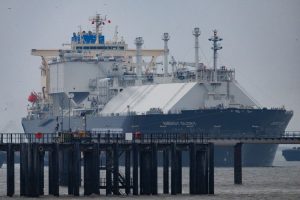
The European Union imported a record volume of Russian liquefied natural gas (LNG) in the first quarter of 2026, even as the bloc continues its efforts to phase out Russian energy supplies following the invasion of Ukraine. https://t.co/s9Omr0pkFx
— Brussels Signal (@brusselssignal) May 13, 2026