European Union carbon permit prices have fallen significantly following remarks by German Chancellor Friedrich Merz indicating that he may support an overhaul of the EU’s emission trading system (ETS).
The price for one ton of carbon dioxide (CO2) equivalent fell by 10 per cent to €71.40 today – the lowest in almost half a year – after Merz’s comments on February 11.
EU carbon permits are the tradable “licenses to pollute” under the EU’s flagship cap-and-trade mechanism, designed to ensure emissions fall over time.

This marks the continuation of a steep downtrend. Carbon permit prices have fallen more than 23 per cent from their highs of almost €93 per ton in mid-January.
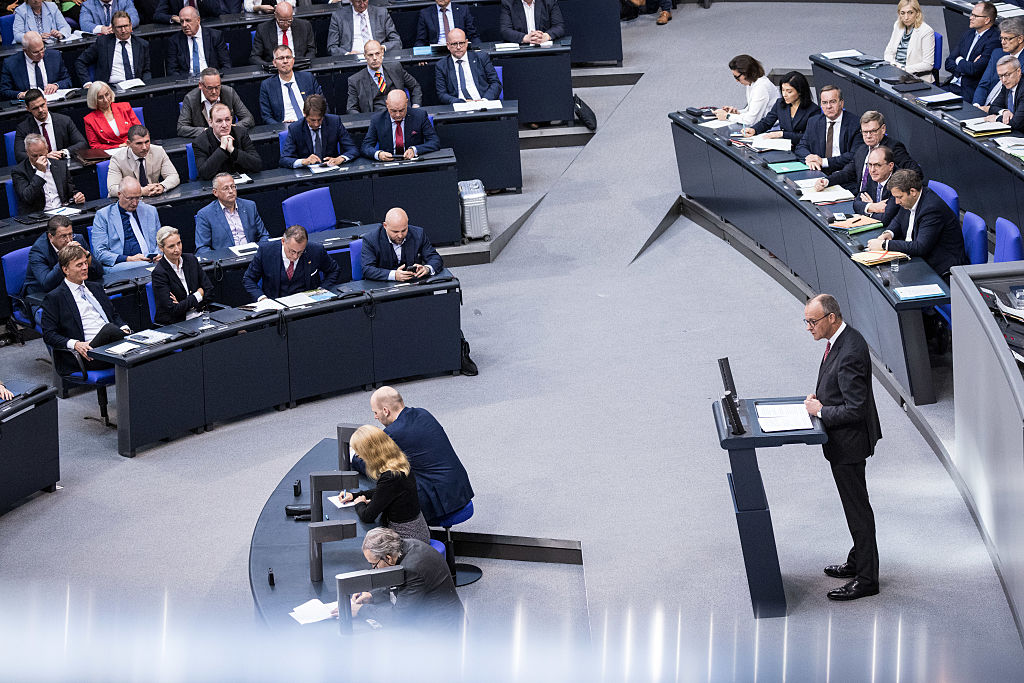
Speaking at the European Industry Summit in Antwerp, Belgium, on February 11, Merz had indicated that he might strive towards a redesign of European emission trading.
In a podium conversation with Markus Kamieth, CEO of chemicals giant BASF, Merz said: “I am fully in line with all those who are saying we are looking for the right instruments [to battle climate change] but at the cost of our industry, at the cost of the workplaces in our industry, this is unacceptable.
“That’s why I am in line with everyone who says: If this is not the right instrument, we have to talk about that and we have to change it if it does not work.”
Merz added that the ETS question was “the elephant in the room” and said country leaders were talking about it in the European Council.
His remarks line up with comments by other leaders who are demanding an overhaul of ETS.
Yesterday, Czech Prime Minster Andrej Babis said the price the EU was charging for CO2 emissions was “destroying out industry” and argued for a price cap at €30 per ton.
EU leaders met in Liège, Belgium yesterday to discuss European competitiveness but no definite agreement on ETS reform was reached.
While Merz is publicly amping up pressure on the European Commission to try to increase European competitiveness, the German Chancellor is facing increasing criticism from business associations on the home front over his failure to deliver on promises of reform.
In the latest instalment, on February 7, the chairman of the Federal Association of Small and Medium-Sized Enterprises (BVMW), Christoph Ahlhaus, sent an open letter to Merz, criticising his politics sharply: “Less than nine months after your election as Chancellor, euphoria has given way to sheer horror at the development of Germany as a business location,” he said.
Ahlhaus told state broadcaster ZDF that he was especially critical of Merz failure to cut red tape in Germany: “If we look at it honestly, almost nothing has happened. Bureaucracy – the biggest impediment for the competitiveness of German SMEs – has not shrunk back, but increased,” he said.