The big party convention of Germany’s Christian Democratic Party (CDU) has ended well for Chancellor Friedrich Merz, but may bode ill for the country as a whole.
In the election for party leadership over the weekend of February 21-22, Merz received 91.2 per cent of the vote, a better result than in 2024 when he got 89.8 per cent.
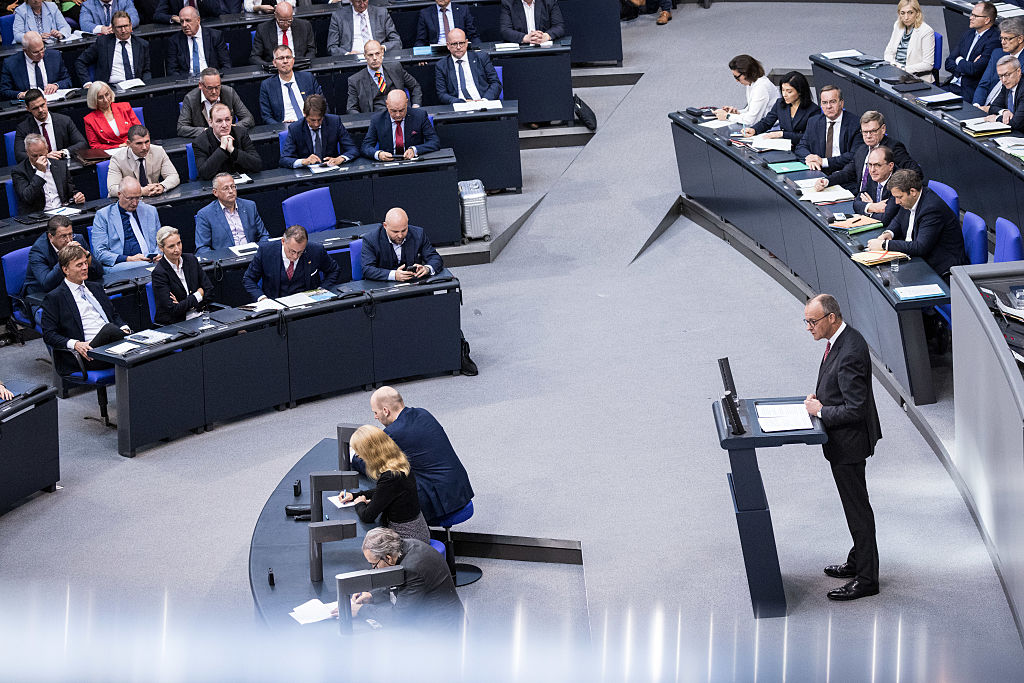
The ballot followed an hour-long speech by the conservative politician in which he urged his party members to strive for unity. He also demanded that the CDU and its junior coalition partner, the Social Democratic Party (SPD), work together more constructively.

“We need to get out of this situation where one coalition partner makes a suggestion that the other ritualistically rejects. We both must get out of this,” Merz stated.
Crucially, he also rejected the idea of any form of co-operation with the main opposition party on the Right, the Alternative for Germany party (AfD): “I have decided with finality to seek approval for our policies exclusively in the political centre of our country. Yes, for the moment that narrows us down to a coalition with the SPD,” Merz said.
“I am fully aware that this means that the only two parties left of the democratic centre, the CDU and the SPD, are dependent on each other”, Merz added, before attacking AfD head on.
“Eighty years after the end of the Nazi dictatorship, forces are gaining strength in our country that mock the victims of the Nazi regime, admire imperialism, ridicule the principles of human dignity, the rule of law and our Constitution and want to turn back decades of social progress.
“We will not allow these people from the so-called Alternative for Germany to ruin our country. And that is why I say with full conviction: This party cannot be a partner of the CDU. This party must expect a bitter fight from the Union,” the Chancellor stated.
Merz’ speech was praised on German state TV and was seen favourably by commentators from left-wing media.
Others were more critical.
Ulf Poschardt, libertarian publisher of newspaper Welt, wrote that Merz had become “the new Angela Merkel”.
Ex-chancellor Merkel is still reviled by many on the German Right for initiating Germany’s nuclear phase-out, enabling mass immigration from Muslim countries and other deeds.
As she led the CDU to some of its greatest ballot successes, though, she is still held in high esteem by the party. That was evidenced by the 70-second applause Merkel got when she attended this weekend’s conference, her first appearance at a CDU convention since the end of her chancellorship.
“It is remarkable how Merz denounces his conservative critics who demand a little more ambition and courage as treasonous pessimists. With such a course of action, he will end up like Merkel: He will lose the hearts and minds of the ambitious bourgeoisie and come to terms with a green-red-red coalition until the country is in ruins,” Poschardt wrote.
Swiss newspaper NZZ commentator Beatrice Achterberg also wrote that Merz’ plans did not bode well for Germany: “The CDU is permanently aligning itself with an SPD that is weak, leans to the far-left in its policies and always seeks to prevent genuine welfare state reforms. […] This course frees SPD from all necessity to work constructively in government.
“If you rule out any alternative on the Right categorically, you make your left-wing coalition partner indispensable,” Achterberg concluded.
Members of AfD also reacted with sharp criticism to Merz’s speech.
AfD MP Nicole Höchst wrote on X: “Merz uses means of blame reversal and reality shifting. When political responsibility for existing problems is attributed to an opposition that does not exercise governmental power, this seems like a reinterpretation of the actual balance of power.”
Höchst accused Merz of using “enemy rhetoric” and a “manipulative reversal of guilt”.