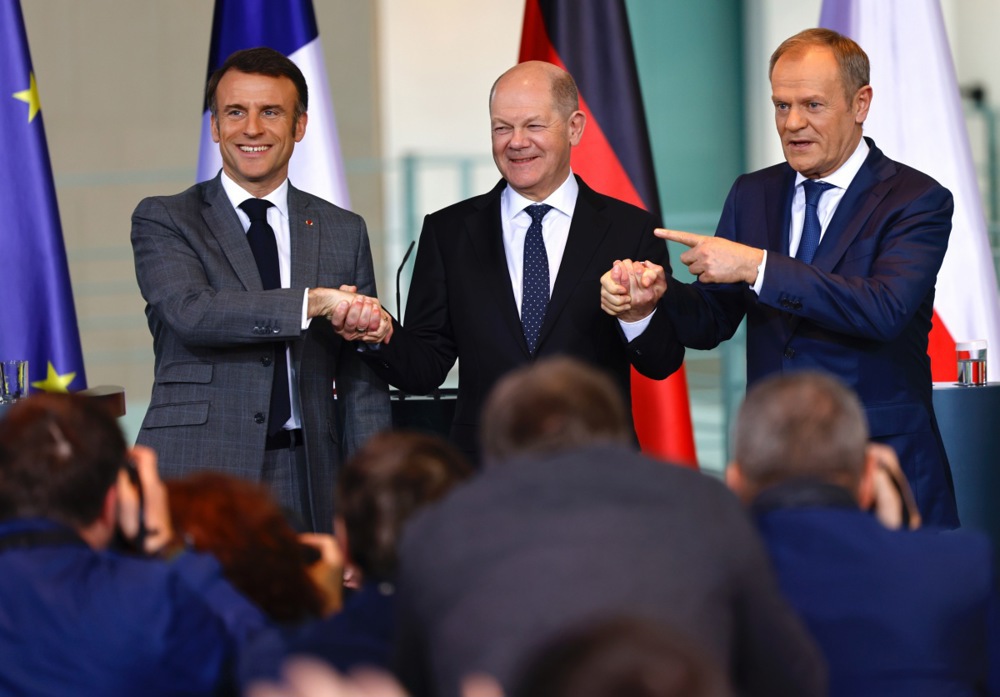
Polish Prime Minister Donald Tusk has entered talks with France over Poland being covered by the unfolding French nuclear umbrella.
Opposition-allied President Karol Nawrocki , meanwhile, has signalled that he believes the US is the only credible nuclear partner.
Tusk, who leads the present centre-left government said yesterday Poland had entered talks with France and a group of European allies on an advanced nuclear deterrence programme.

“Poland is in talks with France and a group of closest European allies on the programme of advanced nuclear deterrence,” he wrote on X.
“We are arming up together with our friends so that our enemies will never dare to attack us,” he added.
Earlier in the day, French President Emmanuel Macron announced that eight countries: Poland, Britain, Germany, Belgium, Denmark, Greece, the Netherlands and Sweden had agreed to take part in a French-proposed enhanced nuclear deterrence initiative.
Speaking at the Île Longue military base in Brittany, Macron said France would increase the number of its nuclear warheads, arguing that current geopolitics, marked by multiple threats, justified strengthening the country’s nuclear deterrence model.
The plans would involve “participation of allied forces in our nuclear activities”, including “the deployment, as needed, of strategic force elements to our allies”, he said.
According to Macron, Europe is undergoing a gradual shift toward an enhanced nuclear deterrence framework that would allow France’s European allies to participate in nuclear exercises.
He also revealed he had “ordered an increase in the number of nuclear warheads in our arsenal”, although added that France would “no longer disclose the size of our nuclear arsenal”.
The country is currently believed to have around 290 warheads, the world’s fourth-largest nuclear arsenal.
Macron stressed, though, that decisions on the use of France’s nuclear weapons would rest solely with the French President and stated the proposed French nuclear deterrence initiative would be fully complementary to NATO at both the strategic and technical levels.
Work on the joint project with European countries was being conducted with full transparency toward the US and in close co-operation with the United Kingdom, he said.
France is the only European Union member to possess a nuclear capability. The only other European country to have the weapons is the UK, which is no longer in the EU but, like France, is a member of NATO.
The two European nuclear powers adopted a joint declaration last July that enables their nuclear arsenals to be “co-ordinated” while remaining independent.
Germany’s Chancellor Friedrich Merz said in mid-February he had held “initial talks” with Macron on sharing Paris’s nuclear capabilities. He has publicly suggested the possibility of German warplanes carrying French nuclear weapons.
Poland, which has never had nuclear weapons of its own, has increasingly discussed the idea of a nuclear deterrent since Russia’s full-scale invasion of Ukraine in 2022. Then-Polish president Andrzej Duda said Poland was willing to host nuclear weapons on its soil and was discussing the matter with the US.
Current President Nawrocki, who like Duda is allied to the pro-US Polish opposition Conservatives (PiS), has recently said Poland wanted to have a nuclear deterrent because of the perceived threat from Russia.
According to his national security adviser Sławomir Cenckiewicz, though, the US remains the only reliable partner on nuclear issues.
Cenckiewicz told Reuters on February 27 that Poland needs to concentrate on existing NATO programmes such as nuclear sharing, which allows a country to host nuclear weapons owned by one of the NATO nuclear powers on its soil.
Cenckiewicz pointed out that use of nuclear weapons under NATO’s Article 5 in coming to the aid of a country that has been attacked should be an allied decision, not a unilateral decision of a single state.
Nawrocki’s top security aide pointed out that the French nuclear doctrine assumes full presidential control over nuclear weapons, which he said limits the real influence of partners.
Cenckiewicz also emphasised that US military and intelligence capabilities surpass those of France and Britain.