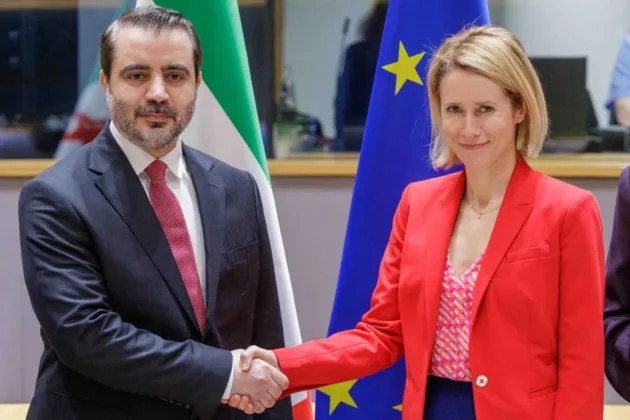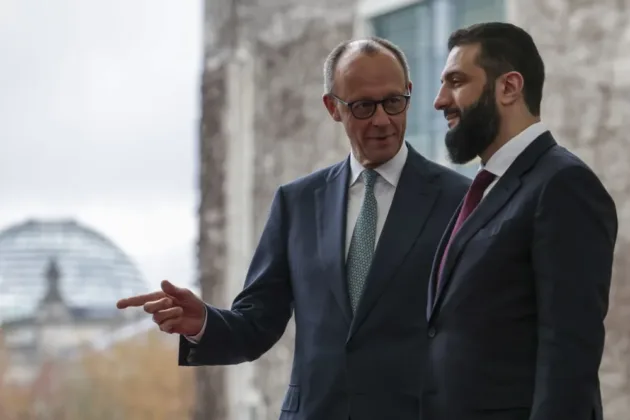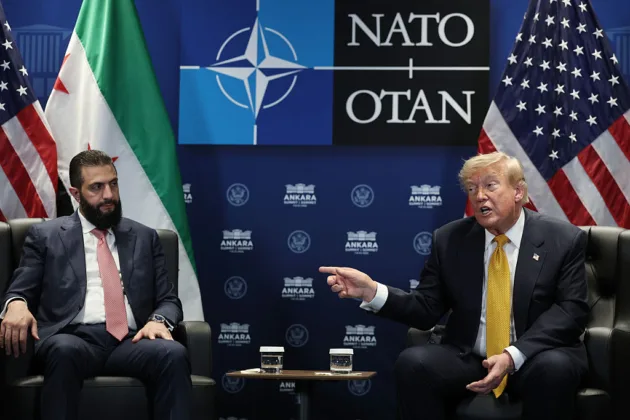






The European Commission has proposed the full resumption of the cooperation agreement between the European Union and Syria, partially suspended since 2011, in a move aimed at restoring the framework for economic and trade ties between the two sides.
The proposal, unveiled on April 20, marks the latest step in Brussels’ efforts to reset relations with Damascus following the ouster of Bashar al-Assad in December 2024 and the rise to power of President Ahmed al-Sharaa, a former jihadist who led the offensive that brought the Assad family’s more than five-decade rule to an end.
According to the Commission, the cooperation agreement has provided the framework for ties between the EU and Syria since 1978, supporting the country’s economic and social development and promoting fair and lawful trade relations. It abolishes customs duties on most Syrian industrial products exported to the bloc and prevents either party from imposing quantitative restrictions on bilateral trade.
Brussels froze large parts of the deal in 2011 in response to what it described as the systematic repression and grave human rights violations carried out by the Assad regime in the opening months of the Syrian civil war.
The new proposal has come almost a year after the EU lifted all economic sanctions against Syria in May 2025. It forms part of a broader strategy unveiled by EC President Ursula von der Leyen to support what Brussels has called a “peaceful and inclusive Syria-led transition”.
Von der Leyen travelled to Damascus in January, alongside European Council President António Costa, where she met al-Sharaa and outlined the three pillars of the new EU approach. These cover a renewed political partnership, a framework for enhanced trade and economic cooperation, and a financial support package of around €620 million for 2026 and 2027.
The Commission said the funding had been earmarked for humanitarian aid, early recovery support and bilateral cooperation projects.
“This is an important political signal ahead of the upcoming EU-Syria High Level Political Dialogue that will be held on 11 May 2026,” the Commission said in a statement.
The proposal must now be formally adopted by the Council of the European Union before it can be notified to the Syrian transitional authorities. EU diplomats have suggested the bloc could also seek a more ambitious agreement to deepen ties with Damascus in the coming months.
Before the war, the EU was among Syria’s main trading partners, with bilateral commerce peaking at over €7 billion in 2010. Trade flows collapsed during the conflict, which devastated the country and forced millions of Syrians to seek refuge abroad, a large share of them in European countries.
The Commission has acknowledged that the immediate impact on trade flows would be limited, though the move carries significant political weight as Brussels seeks to position itself as a key external partner for the new authorities in Damascus.
The shift in European policy has not been free of concerns. Sectarian tensions have continued to cause bloodshed in Syria since al-Sharaa took office, while the Islamic State group remains at large in parts of the country.
The Syrian President himself has come under scrutiny in Western capitals over his past leadership of Hayat Tahrir al-Sham, an Islamist faction once linked to al-Qaeda that spearheaded the offensive against Assad in late 2024.
Several EU member states have nevertheless made clear they are keen to see the bloc engage with the new authorities, in part to encourage the return of Syrian nationals who arrived in Europe during the war. Some European countries have expressed interest in seeing refugees return to their homeland, with Germany, Austria and the Netherlands among those that paused asylum decisions for Syrians shortly after Assad’s fall.
The Commission’s strategy represents a notable change of tone from Brussels, which had maintained sweeping restrictive measures against Damascus for more than a decade.
The high-level political dialogue scheduled for May 11 is expected to set out the practical agenda of the new bilateral relationship, including possible avenues for deeper trade integration and EU support for Syria’s reconstruction. The Commission has framed the proposal as a step ahead of that dialogue.
The Council of the European Union is due to consider the proposal in the coming weeks. Any final adoption would require backing from the bloc’s 27 member states, several of which have raised concerns over the trajectory of the new Syrian Government and the pace at which Brussels is moving to normalise ties.
Bilateral relations between the EU and Damascus would, if the proposal is endorsed, formally enter a new chapter for the first time in nearly 15 years.