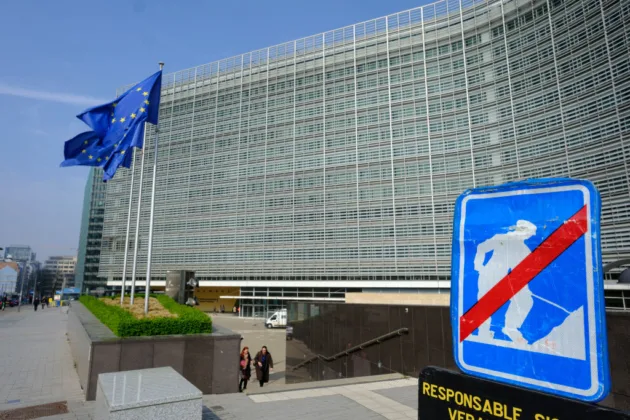





The European Union and several development finance institutions have signed a new fund designed to channel up to €20 billion in private capital into sustainable infrastructure in low- and middle-income countries.
The announcement that comes as confidence among European households has fallen to its lowest point in more than three years.
The instrument, framed within the Global Green Bond Initiative, was agreed today in Brussels. It will direct financing towards climate and environmental projects in economies that have limited access to international financial markets.
According to the European Commission, the fund will invest exclusively in “green” bonds issued on primary markets, giving priority to “first-time issuers” — governments, local authorities and companies entering this type of financing for the first time.
At least 20 per cent of investments will go to the world’s least developed countries. Operations will be conducted in local currencies and in euros, with the stated aims of “strengthening local capital markets” and “promoting the international use” of the euro single currency.
The fund is targeting up to €2 billion from private European and international investors, underpinned by approximately €1 billion in public capital. Of that, around €800 million is to come from a consortium led by the European Investment Bank along with other European development institutions.
The EC will add guarantees through its European Fund for Sustainable Development Plus, intended to lower risk for private investors. Day-to-day management will be handled by a major European asset manager, not publicly named, which will focus exclusively on acquiring green bonds meeting strict environmental standards.
The initiative also includes technical assistance for issuers seeking to design and launch green bonds for the first time and potential grants aimed at offsetting higher financing costs in a still elevated interest rate environment.
The signing comes as European households grow more anxious about their own finances.
The EC’s own flash estimate for April 2026 shows consumer confidence in the EU at minus 19.4 and in the eurozone at minus 20.6 — the lowest readings since the turn of 2022/2023 and well below their long-term averages.
The EC has attributed the deterioration in part to geopolitical tensions and rising energy prices squeezing household purchasing power.
A Boston Consulting Group survey of 16,000 consumers in nine European countries, published in July 2025, found that 54 per cent were pessimistic about their home country’s economy, a rise of seven percentage points since July 2024.
Oxford Economics has said it expects weak consumer spending in the eurozone to persist, while Ipsos has noted sentiment is “generally down” across Europe, with the sharpest drops recorded in Germany, France, Belgium and Poland.
The new fund forms part of the EU’s Global Gateway strategy, its infrastructure programme that Brussels positions as a counterweight to China’s Belt and Road Initiative. The EC has pledged up to €300 billion in combined public and private investment globally by 2027 under the initiative.
The fund’s emphasis on euro-denominated transactions also reflects a wider EU drive to strengthen the international role of the single currency, a policy priority the EC has pursued more actively in recent years.
The announcement comes ahead of the United Nations’ fourth International Conference on Financing for Development, scheduled for June 30 to July 3 in Seville, Spain.
There, green finance and private capital mobilisation for the developing world are expected to feature prominently.