





European Union leaders have moved to advance Ukraine’s membership bid, pressing ahead with accession negotiations in a Hungary reshaped by an election that Brussels itself did much to influence — and that has removed the main obstacle blocking the process.
The move came as European Council President António Costa met Ukrainian President Volodymyr Zelensky and European Commission President Ursula von der Leyen in Nicosia, Cyprus yesterday before all three travelled to the coastal town of Ayia Napa for an informal summit of EU leaders.
“It is the moment to look ahead and prepare the next step. The next step is to open the first cluster [negotiation block],” Costa said at a joint appearance. “We fulfilled the first two steps and we will fulfil the next step.”
Ukraine has held candidate status since 2022. In December 2023, the 27 member states agreed to open accession negotiations, although in practice the Hungarian Government’s repeated vetoes have blocked progress on any of the reform chapters Kyiv must complete before joining the bloc.
That blockage now looks set to shift. Conservative opposition leader Péter Magyar, who ran on a broadly pro-European platform and received vocal backing from across the EU establishment, won Hungary’s general election and is due to replace prime minister Viktor Orbán in early May.
EU leaders have wasted no time, using the Ayia Napa summit to push forward a €90 billion loan package for Ukraine and the 20th package of sanctions against Russia.
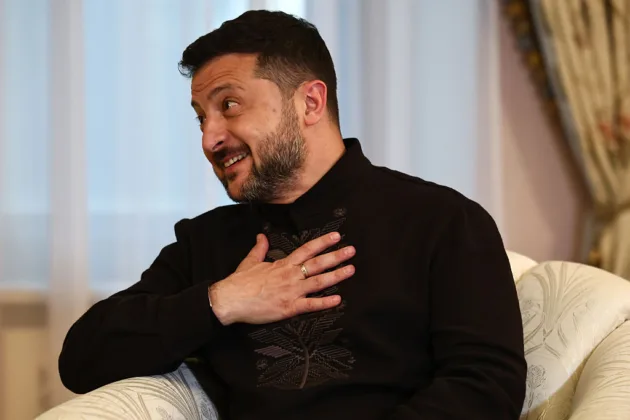
Zelensky, who attended the first session of the informal summit before leaders held a separate dinner without him, said it was “a great day.”
He described the loan agreement as a “strong and fundamental” decision and said his government would work to release the first disbursement “as soon as possible”.
He also called on the bloc to bring Ukraine’s membership about “as soon as possible”, adding that he believed the 27 were themselves open to accelerating the pace.
French President Emmanuel Macron said he expected the EC to present a “precise calendar and clear initiatives” within “the coming weeks”, setting out what both Ukraine and Moldova must do to unlock the opening of accession chapters.
EU High Representative for Foreign Policy Kaja Kallas declined to commit to any timetable but said Ukraine was “clearly on the path to membership”. She confirmed that leaders at the summit would discuss “how to actually accelerate” the process given what she described as “new circumstances”.
“Perhaps we can advance on issues that were red lines or had been blocked before,” Kallas said. “We will see if we can advance on that.”
She noted there were different proposals on the table on how to move forward, including whether to pursue partial or accelerated processes, although she declined to elaborate ahead of the leaders’ discussion.
Estonian Prime Minister Kristen Michal was among the most vocal in pushing for speed. He said the EU should “maintain the momentum” on enlargement for both Ukraine and Moldova while keeping up pressure on Russia.
“In my opinion, the future of Ukraine is absolutely in Europe. The sooner we start, the sooner we get there,” Michal said. He added that Kyiv was aware it must take “all the necessary steps” to advance towards full membership.
Michal said the bloc had previously been “held hostage” on Ukraine decisions — a direct reference to Orbán’s vetoes — and made clear that leaders intended to press ahead in the changed political landscape.
Spanish Prime Minister Pedro Sánchez made no public statement on arrival at the summit, although Spanish Government sources said Madrid had worked hard to make the loan agreement possible and that its finalisation was “long awaited”.
The same sources noted that Spain had been among Ukraine’s firmest supporters throughout the accession process and that it was during Spain’s rotating presidency of the Council of the European Union in the second half of 2023 that the 27 first gave the green light to begin negotiations.
The Ayia Napa gathering is an informal summit, meaning no formal decisions are taken. Although the EC will now be expected to produce a concrete roadmap, the process still depends on Magyar delivering the shift in Hungary’s position that Brussels has banked on — and on which it has worked actively.
Ukraine’s road to membership remains long, regardless.
Accession negotiations are structured around 35 policy clusters covering everything from rule of law to trade and completing them typically takes years. The country is also still at war with Russia, a factor several leaders acknowledged as they called on Kyiv to keep pushing Moscow “towards real diplomacy”.