




The European Parliament has dramatically escalated its demands for the European Union’s next long-term budget, calling for a €2.2 trillion Multiannual Financial Framework (MFF) for 2028-2034.
It is an eye-watering sum that exceeds the European Commission’s already ambitious July 2025 proposal by at least €200 billion.
The move, adopted in the EP’s negotiating position earlier this month, underscores the institution’s determination to secure significantly higher spending on competitiveness, defence, cohesion and agriculture amid what MEPs describe as existential geopolitical and economic challenges.
The EC had proposed nearly €2 trillion (around 1.26 per cent of EU Gross National Income (GNI) for the seven-year period, including debt repayment for NextGenerationEU.
It has so far defended its €2 trillion package as “ambitious and dynamic” but officials privately acknowledge that the EP’s demands will complicate the already delicate search for unanimity in the European Council.
The EP went further and is now pushing for a 10 per cent real-terms increase on top of that baseline, with additional resources allocated “outside the budget ceilings” to protect traditional policies while funding new priorities.
To fund its ambitions without sharply increasing direct national contributions, the EU is asking for a range of new “own resources”, essentially Brussels-directed revenues.
The EC has proposed a tobacco excise duty levy expected to raise around €11 billion annually, alongside a Corporate Resource for Europe (CORE) that would impose lump-sum payments on large companies with turnover above €100 million.
The EP is going further, calling for additional levies on digital services, online gambling and crypto assets to generate extra revenue from Big Tech and the digital economy.
In absolute terms, the €2.2 trillion figure would make the next MFF the largest in EU history, equivalent to more than one and a half times the current 2021-2027 framework when adjusted for inflation and scope.
The demand enjoys broad support across the EP’s four largest pro-European groups.
The European People’s Party (EPP), the Progressive Alliance of Socialists and Democrats (S&D), Renew and Greens jointly warned last autumn that the EC’s original text “cannot serve as a basis for negotiations” without substantial amendments and extra money.
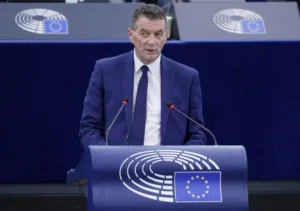
Siegfried Mureșan (EPP, Romania), the EP’s co-rapporteur, has been particularly vocal, stating yesterday: “Europe cannot afford to be weak or fall behind economically” in the current geopolitical climate.
On the Left and centre-left, S&D and Greens emphasise the need to safeguard cohesion funds and social spending, warning that any squeeze on traditional policies would harm poorer regions and rural communities.
Renew liberals back the push for competitiveness and innovation but stress the importance of new own resources to avoid burdening national budgets.
Carla Tavares, the EPs co-rapporteur on the Multiannual Financial Framework 2028–2034, said: “Today’s vote strengthens and consolidates Parliament’s position on the next multiannual budget.
“Our message has never wavered: we will not sign off on a budget that falls short of meeting Europe’s real needs.”
The S&D stressed that new challenges must not come at the expense of the EU’s core pillars of solidarity.
“The European Social Fund+, Cohesion Policy and Common Agricultural Policy are not optional – they are the foundation of our Union,” the group said, insisting these must be preserved alongside funding for LIFE and EU4Health.
It called for the next MFF to address citizens’ everyday concerns: Cost of living, housing, education, food security and infrastructure and urged member states to agree on new genuine own resources to fund an “ambitious” budget.
Taraves said the budget should be used for policies to “project Europe’s strength and values on the global stage”.
EU lawmakers on Thursday demanded a European Union-wide tax on the world’s biggest tech companies and online gambling sites to help fund the 27-country bloc’s next seven-year budget. https://t.co/OIGzAsn3Kt
— Brussels Signal (@brusselssignal) April 9, 2026
Right-leaning and Eurosceptic groups such as the European Conservatives and Reformists(ECR), Patriots for Europe (PfE) and Europe of Sovereign Nations (ESN) have been more critical, arguing that further expansion of the EU budget risks waste and undermines national sovereignty.
Alexander Sell (AfD-ESN) told Brussels Signal yesterday in a reaction, “While the German Chancellor [Friedrich Merz] prepares citizens for lower pensions and higher health insurance costs, his party colleagues, [EPP leader] Manfred Weber and [EC President] Ursula von der Leyen, are planning to dig even deeper into taxpayers’ pockets.
“If the European Commission wasted less money on lavish salaries, corruption and foreign aid, it wouldn’t have to ask for more funding now”.
In a statement, the ECR group said the future MFF must focus on “delivering real European public goods with clear added value, rather than simply expanding the overall budget.”
The group rejected the idea of a single national plan per Member State, warning it would risk fragmenting the Single Market and weakening agriculture and cohesion policies.
Instead, ECR prioritises food security, support for farmers and fisheries, well-targeted cohesion funding, cross-border infrastructure, border protection, migration management and defence capabilities — especially on the EU’s eastern borders — while calling for greater flexibility, spending efficiency and policy coherence.
Resistance is strongest among net-contributor (“frugal”) member states, who have repeatedly signalled they will not accept higher national contributions.
Fourteen member states, including several from the north, opposed key elements of the EC’s overhaul as early as July 2025.
Some national governments in the east and south, though, quietly welcome the prospect of higher overall envelopes, provided their traditional receipts are protected.
In the Council, positions remain “far apart and irreconcilable”, with diplomats warning that negotiations could drag on well into 2027.
The scale of the debate is all the more striking given the European Court of Auditors’ (ECA) repeated warnings about how the EU already manages (or fails to manage) its existing funds.
The European Court of Auditors (ECA) has warned that the European Commission’s proposed overhaul of the EU’s next long-term budget does not, on its own, guarantee that European money will be spent better. https://t.co/lCrKPGLywE
— Brussels Signal (@brusselssignal) April 28, 2026
In a series of opinions issued between January and April 2026 on the EC’s MFF proposals, the Luxembourg-based auditors highlighted “multiple risks to sound financial management”.
They singled out the proposed single “European Fund” merging cohesion, agriculture, fisheries and rural development spending as particularly problematic, warning that member states “may struggle to address all EU objectives satisfactorily” while tailoring interventions to local needs.
Vague targets, differing national interpretations and weak performance indicators could make it difficult to track results or compare outcomes across borders.
The ECA has also criticised the proposed performance framework and the competitiveness fund for lacking sufficient specificity and clarity, raising concerns over transparency and traceability of taxpayers’ money.
Similar issues have dogged previous budgets and the Court’s annual reports have consistently flagged error rates in payments – particularly in cohesion and agricultural spending – excessive complexity in flexibility tools and insufficient accountability once funds leave Brussels.
In recent years, the EU budget has ballooned. The 2021-2027 MFF plus the €750 billion NextGenerationEU recovery instrument already pushed combined commitments well above €2 trillion in current prices.
Yet oversight remains fragmented: National audit bodies often complain of limited visibility once money reaches managing authorities, while the EP itself has repeatedly demanded stronger scrutiny powers.
MEPs also expressed strong concerns over the expansion of performance-based funding in the next MFF.
In a report adopted by 527 votes to 85, rapporteur Monika Hohlmeier (EPP, Germany) warned that linking payments to milestones rather than actual costs — as used in the RRF — increases risks of fraud, double funding and errors.
The report noted 307 active European Public Prosecutor’s Office (EPPO) cases linked to the RRF by end-2024, with €2.8 billion in estimated damage.
MEPs called for limiting such instruments to smaller projects, keeping large investments cost-based and strengthening parliamentary scrutiny and transparency on final beneficiaries to protect democratic accountability.
More than €100,000 of European Union money has been spent on an electric vehicle charging station that currently sits in the middle of a meadow with no access road, rendering it unreachable by car.https://t.co/OHouUSk78s
— Brussels Signal (@brusselssignal) April 24, 2026