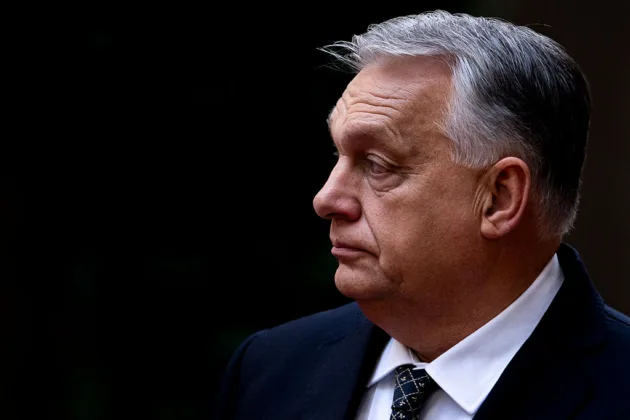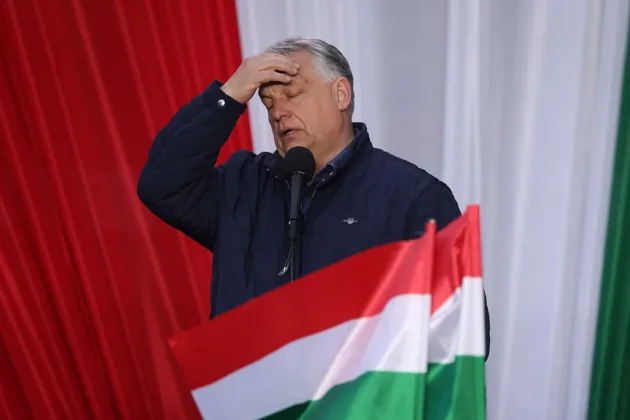


At 9.29 pm on Sunday, just moments after Viktor Orbán took to the stage to concede the Hungarian election, European Commission President Ursula von der Leyen announced on X that “Europe’s heart is beating stronger in Hungary tonight.” Before 10 pm, Emmanuel Macron announced he had already spoken with the winner, Péter Magyar.
The European elite’s eagerness to welcome Hungary “back into the fold” was well predicted by every analyst, both of the pro- and anti-Brussels persuasion. That the European elite were desperate to see the back of Orbán was not even an open secret – it was their publicly announced policy.
Veteran observers of European politics were quick to warn the liberal commentariat that Magyar’s victory was far from “a rejection of national conservatism and a rebuff of the global far-right movement”. Magyar, the former Fidesz insider, had campaigned on a kind of “Orbánism without Orbán”, promising to preserve the key plank’s of Orbán’s political legacy, including a rejection of Ukraine’s EU accession. Magyar had even criticised Orbán for allowing too many migrants into Hungary.
Among international social media commentators of the Right, a similar view was taken. A legion of semi-influential anonymous accounts and their outriders were quick to point out that Magyar was not about to flood Hungary with migrants, nor had conservative Hungary transformed overnight into the political milieu of a progressive city like Amsterdam.
It is of course true that Magyar promised no social revolution. Indeed, one is reminded of Margaret Thatcher’s remark that her greatest achievement was Tony Blair; perhaps Orbán’s greatest legacy was the establishment of ideological hegemony over the fundamental questions of migration, identity and energy security.
Even that much-maligned descriptor of Orbán – “populist” – is not about to be retired. Although Orbán never described himself as such, Magyar was quick to assume its mantel. In his speech the day after the election, Magyar claimed to be a populist, though of the good kind.
But then why were von der Leyen and Macron – indeed, the entire globalist class from Obama and Alex Soros – so eager to celebrate Magyar’s victory as a historic moment?
The EU elite seem to understand something that has escaped many commentators of both Left and Right: That populism is nothing without sovereignty; that right-wing opinions on migration are meaningless without the national independence to see them through.
For all of Magyar’s appealing noises about conservative priorities, his overriding political significance is his desire for reconciliation with Brussels. Indeed, this has been not just the primary topic of his pre-election campaign, but the subject of the first announcements since his victory. Magyar will work tirelessly to see the billions of Euros suspended by the EU sent swiftly to Hungary. The price of this sorely needed cash is submission to Brussels.
This is already clear from Magyar’s agenda: The granting of sovereign power to the European Public Prosecutor, the promise to abide by “fundamental values” (read: EU rulings and policies on LGBT), and the lifting of the veto on EU sanctions and energy policy. These are all part of the “27 conditions” that the EU has been trying to impose on Hungary in exchange for the blocked funds. Von der Leyen even smells a bigger prize: The abolition of the unanimity requirement in the European Council. Even Politico was surprised by how fast she moved, reporting that she waited “less than a day” after Orbán’s defeat to “call for the EU to get more power over national governments to force through foreign policy decisions”.
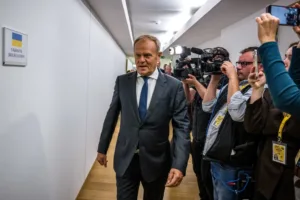
Magyar’s brand of submission to Brussels combined with tough-sounding noises on migration must be understood in the same mould as Donald Tusk. Tusk is also no left-liberal, and similarly made criticisms of Law and Justice for an overly-permissive approach to migration. Tusk, without lifting a finger to reform Poland’s “corrupt” institutions, was immediately rewarded for his victory by Brussels with cash. He even managed to secure a so-called “opt-out” from the EU’s Migration Pact – just as Magyar promises. The opt-out was however not as it seemed – merely a temporary derogation from refugee quotas justified by Poland’s support for millions of Ukrainian war-refugees. More importantly, it was not an assertion of national sovereignty, but a blessing bestowed by Brussels. Sovereign is he who decides on the exception.
Brussels may be prepared to strategically relax its most maximal demands, but only if it senses that it is working with someone who is “one of us”. The quid pro quo eventually comes due, as is clear in the case of SAFE in Poland – Tusk is desperately attempting to ram through a funding agreement which would seriously curtail Poland’s ability to choose its own defence partners and leave it dangerously reliant on Germany.
This makes it clear that the fundamental question is about the substance of populism, not its outward manifestations. Without the fundamentals of sovereignty, there is no national policymaking; subject to international institutions, politics becomes reduced to merely having opinions. Through repeated experience of the reality of EU policymaking, Orbán was drawn to the truth of this lesson. His increasingly combative relationship with the EU elite was the product of an understanding of the reality of power and just how precarious a democracy can be in the midst of the European Union’s relentless desire to draw all sovereignty to itself. This is a lesson that the so-called Eurofederalist Right would do well to learn as well.
The crucial point to maintain is that populism without sovereignty is mere words. It is ironic that this brand of “populism” is precisely the populism derided by liberal commentators who claim populists are unable to fulfil their promises. Real populism is inseparable from the commitment to maintain national independence – to which the EU is by far the biggest threat in Europe. There might be good reasons to be mistrustful of the patchy record of contemporary populists. But in replacing a commitment to national sovereignty with a few choice words about border security, it is these faux-populists who are, by definition, the ones really shilling slop.
Jacob Reynolds is the head of policy for MCC Brussels