






High-level sources within the Armenian Government have told Brussels Signal that Yerevan is ready to sign a peace treaty with Azerbaijan at any moment.
Such an agreement would help stabilise the country and facilitate the arrival of substantial EU aid packages designed to help Armenia reduce its dependence on Russia’s sphere of influence.
According to the same sources speaking on May 9, though, Baku continues to introduce additional conditions that are delaying the finalisation of the agreement.
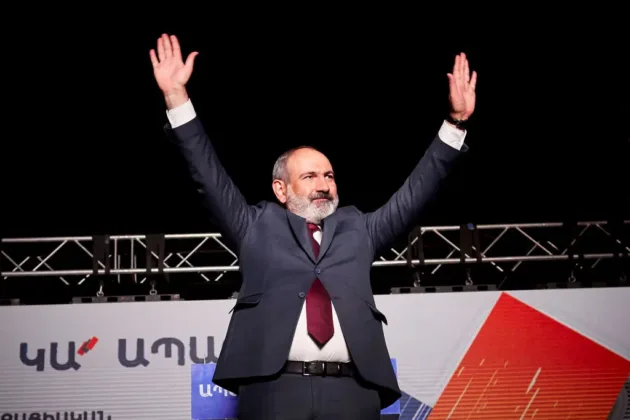
A key political turning point will come with the parliamentary elections scheduled for June 7, which are expected to determine whether Prime Minister Nikol Pashinyan and his pro-western geopolitical strategy remain in power. A victory for the opposition could reverse Armenia’s current trajectory and bring the country closer once again to Russia.
Conversely, a victory for Pashinyan would provide him with a strong popular mandate to implement Azerbaijan’s remaining demands. That could pave the way for the signing of a peace agreement and accelerate Armenia’s geopolitical pivot towards the European Union.
For Azerbaijan, the main demands focus on legal guarantees ensuring that any future Armenian government cannot revoke the peace agreement. The most sensitive issue remains Nagorno-Karabakh, which came fully under Azerbaijani control in 2023 after decades of conflict.
Although Pashinyan has already recognised Azerbaijani sovereignty over Nagorno-Karabakh within the framework of the peace process, Baku continues to insist on constitutional changes in Armenia.
Azerbaijani officials point to the 1990 Declaration of Independence, which references the unification of Armenia and Nagorno-Karabakh as a historical political objective, arguing that it could still serve as a legal basis for future territorial claims.
The EU supports the peace process while pursuing a dual-track strategy: Strengthening ties with Armenia in an effort to gradually pull it away from Russia’s sphere of influence, while at the same time maintaining strategic relations with Azerbaijan, which has become a key energy supplier to Europe following the reduction of Russian imports.
This balancing approach was evident during EU High Representative for Foreign Affairs Kaja Kallas’s visit to Baku on April 16, 2025, where she met President Ilham Aliyev. Kallas described Azerbaijan as an “important energy partner” for the EU while also stressing the importance of progress in the Armenia–Azerbaijan peace process.
The signing of a peace agreement between the EU’s two main interlocutors in the South Caucasus would significantly facilitate Brussels’ broader regional co-ordination efforts and strengthen its strategy of reducing Russian influence in the area.
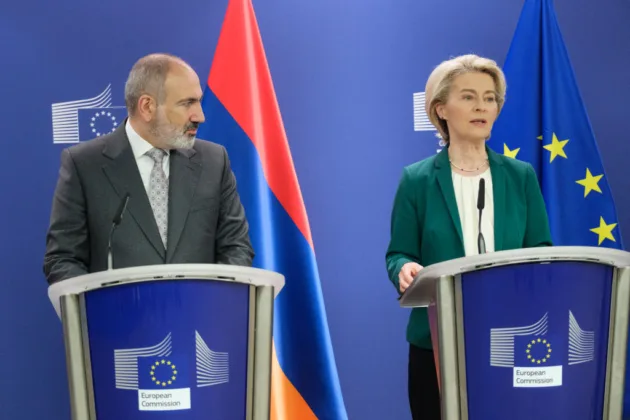
At the same time, the EU has significantly increased its political presence in Armenia. Recent high-level diplomatic visits to Yerevan have been widely interpreted as support for the government’s western-oriented course.
On the economic side, EU engagement has expanded through a combination of grants, loans, and investment guarantees worth several billion euros in potential mobilisation.
The centrepiece of this strategy is the Resilience and Growth agenda, aimed at economic diversification, infrastructure development and institutional reform, with the goal of reducing Armenia’s dependence on Russian markets and supply chains.
The EU has also increased funding for democratic resilience and civil society through instruments such as the European Instrument for Democracy and Human Rights. These initiatives support media organisations, rule-of-law programmes, and anti-corruption efforts, with the aim of strengthening institutional resilience, countering pro-Russian narratives in the domestic information space and encouraging a political and media environment more closely aligned with EU policy preferences.
Security-related assistance has also increased modestly through EU instruments, including non-lethal support and training programmes. These measures reflect a broader effort to reduce Armenia’s structural dependence on Russia without direct military involvement.
Taken together, these initiatives illustrate a gradual but coherent EU strategy: Anchoring Armenia economically and institutionally within the European sphere while supporting its geopolitical pivot away from Moscow.
Despite Armenia’s growing political alignment with the west, though, its economic ties with Russia remain extremely strong.
Russia is still Armenia’s largest trading partner, a major energy supplier and a key source of remittances. Bilateral trade increased sharply after 2022, partly because Armenia became an important re-export hub for goods entering Russia after western sanctions.
These structural economic links underline why Yerevan’s shift away from Moscow is likely to remain gradual rather than sudden.
The trajectory remains politically fragile, though. The outcome of the June elections will be decisive in determining whether Armenia’s westward shift is consolidated or partially reversed, potentially pulling the country back into Russia’s orbit.