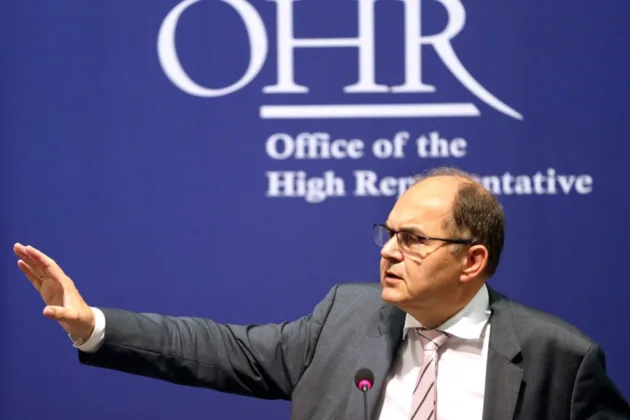










International High Representative for Bosnia and Herzegovina Christian Schmidt has resigned after nearly five years in post and months of confrontations with the authorities of Republika Srpska, the country’s Serb entity, his office has confirmed.
Schmidt, a former German cabinet minister and Bundestag lawmaker, will remain in the role until a successor is appointed, according to Sarajevo-based daily Oslobođenje, which first reported the news yesterday. The Office of the High Representative (OHR) has described the move as a personal decision.
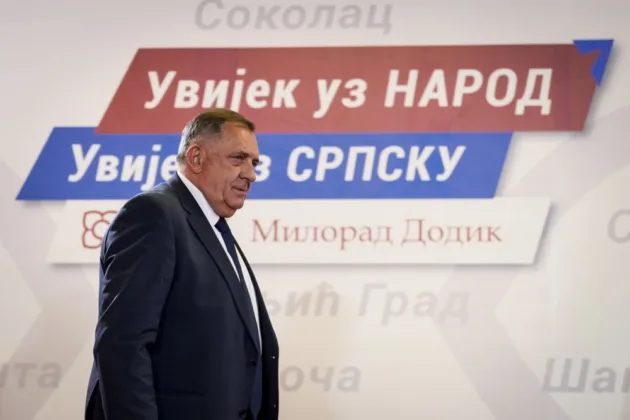
Schmidt’s tenure had placed him on a collision course with Republika Srpska President Milorad Dodik, who received a six-month disqualification from public office for failing to comply with the High Representative’s decisions.
The dispute escalated in June 2023, when the National Assembly of Republika Srpska voted to temporarily invalidate the rulings of the Bosnian Constitutional Court. Serb lawmakers argued that the inclusion of three foreign judges – a German, an Albanian and a Swiss – had tainted the court’s national character.
Schmidt invoked the powers granted to his office under the 1995 Dayton Agreement, brokered by the United States to end the war in Bosnia, to overturn the decision and treated the move as effectively an act of secession. A court in Sarajevo subsequently opened proceedings against Dodik that resulted in the disqualification sentence.
Dodik welcomed the resignation late on Sunday. “Christian Schmidt leaves Bosnia and Herzegovina the same way he arrived: with no legitimacy, no UN Security Council decision and no backing from international law,” he wrote on social network X.
Republika Srpska has never recognised Schmidt’s legitimacy, after Russia and China clashed with Western states at the UN Security Council over his appointment in 2021.
According to Oslobođenje, Schmidt has already asked the Peace Implementation Council, the body of 55 countries that supports the implementation of the Dayton Agreement, to start the process of choosing his successor.
He is due to appear before the United Nations Security Council tomorrow to deliver his periodic report on Bosnia and Herzegovina, an EU candidate country, and is expected to clarify the situation further at that point.
The OHR was set up after the end of the war in Bosnia, which ran from 1992 to 1995 and left more than 100,000 dead, to oversee the post-war order and the implementation of the peace deal signed in Dayton, Ohio. Schmidt, a member of Germany’s Christian Social Union (CSU), took up the post on August 1, 2021, succeeding Austrian diplomat Valentin Inzko.