










Andalusia, Spain’s largest region by population, votes for its regional parliament on Sunday, May 17. For the political classes in Madrid the ballot is far more than a routine regional contest: with no separatist parties competing seriously and a sociology that closely mirrors the country as a whole, the result will offer the most reliable preview yet of Spain’s next general election, expected by 2027.
Some 6.8 million Andalusians are eligible to vote, of whom 369,000 will do so for the first time. The community is bigger, in electoral terms, than the other three Spanish regions that have voted so far this spring put together.
Few Spanish elections offer a cleaner read on national sentiment. Andalusia is spread across eight provinces and 785 municipalities, with a balanced mix of large cities such as Seville and Málaga, mid-sized towns and depopulated rural areas. Unlike Catalonia, the Basque Country or Galicia, it has almost no separatist or peripheral-nationalist representation. The contest plays out essentially between the same five political families that dominate national politics – the centre-right Partido Popular (PP), the Spanish Socialist Workers’ Party (PSOE), the Conservative Vox party, the left-wing Por Andalucía coalition and the andalucista Adelante Andalucía.
For decades that uniformity made Andalusia the rock on which the PSOE built its national majorities. The party governed the region uninterruptedly from 1982 to 2019, often with more than half of the vote. Moreno Bonilla’s PP broke that hegemony in 2019 with the support of Ciudadanos and Vox, and won an absolute majority in 2022.
The reverse logic now applies. If the socialists collapse in their old fortress, the rest of Spain is unlikely to look much different.
WHAT THE POLLS SAY
Surveys published before Spain’s legal pre-election blackout have pointed consistently in the same direction. The polling aggregate produced by The Objective on May 11 gave the PP 57 seats out of 109, the PSOE 28, Vox 17, Por Andalucía 5 and Adelante Andalucía 2. The model placed Moreno’s chances of holding an absolute majority – the magic threshold sits at 55 seats – at 81 per cent.
Other recent polls have been more cautious. GAD3 for Vocento and Sociométrica for El Español have placed the PP between 54 and 56 seats, leaving the absolute majority hanging on a handful of provincial votes in Córdoba, Granada and Huelva.
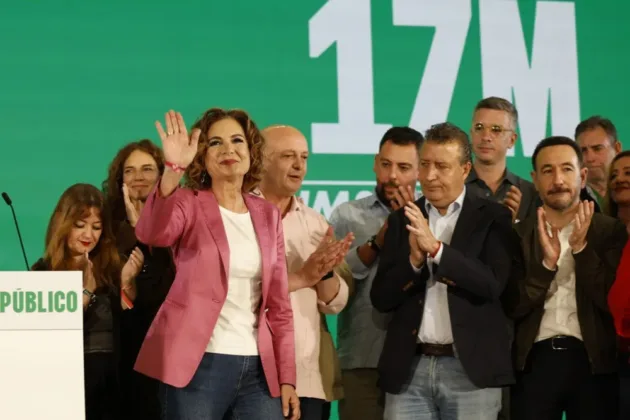
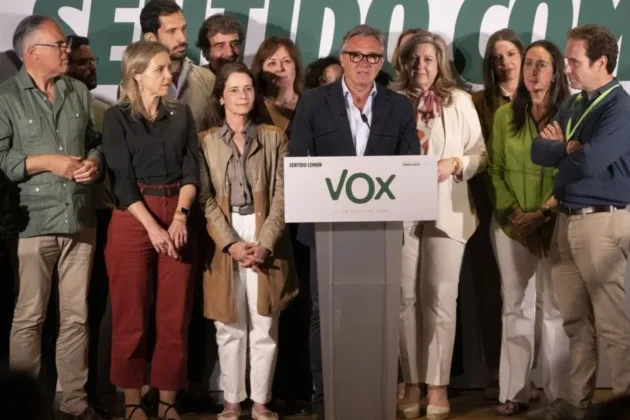
What every survey agrees on is the historic collapse of the PSOE. Its candidate, María Jesús Montero, is projected to fall to her party’s worst-ever Andalusian result, in the 21-24 per cent range and 25 to 30 seats. Vox is expected to improve on its 2022 score of 14 seats; should the PP’s absolute majority slip even by a single deputy, Santiago Abascal’s party would once again become indispensable for any government of the right.
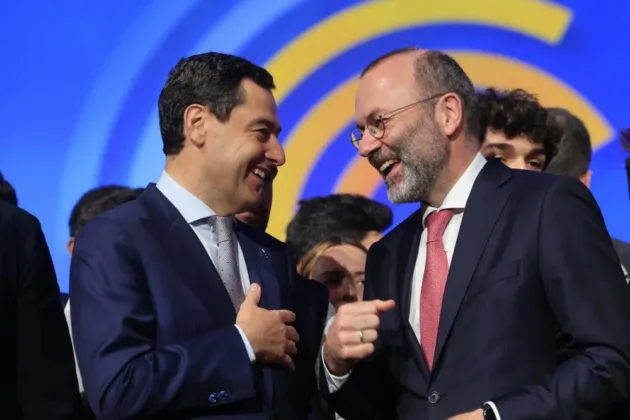
Moreno Bonilla, the PP globalist champion who would rather govern the quiet life
A TEST FOR SÁNCHEZ AND MONTERO
The most immediate national casualty of a heavy defeat would be Prime Minister Pedro Sánchez. Already weakened by a string of corruption investigations involving members of his inner circle and his own family, the premier has campaigned aggressively alongside former Prime Minister José Luis Rodríguez Zapatero in the region that elects almost one in five Spanish voters.
The bet is unusually exposed. Montero is no ordinary regional candidate: she served as Spain’s Finance Minister from 2018 until March 2026 and as First Vice-President of the Government from 2023, holding the PSOE’s number-two spot in Madrid before resigning her national offices to lead the Andalusian campaign.
A result below 30 seats would open a debate inside the PSOE over the party’s strategy on Catalan amnesty deals, the so-called financiación singular for Catalonia and the broader pivot towards alliances with Catalan and Basque nationalists – a pivot Moreno has built much of his campaign on attacking.
A TEST FOR FEIJOO AND ABASCAL
For the opposition the stakes cut in two directions. A solid PP absolute majority would validate Alberto Núñez Feijoo’s bet on a moderate, technocratic brand and hand the party leader his strongest argument yet against future general-election dependence on Vox. A shortfall, even by one seat, would force Moreno to negotiate with Santiago Abascal’s party and reopen the long bargaining processes seen this year in Extremadura and Aragón.
Extremadura spent four months negotiating before the PP and Vox finally agreed a coalition built around the latter’s “national priority” doctrine, which would prioritise Spanish nationals in access to certain regional benefits. Aragón has faced similar talks. Moreno has repeatedly invoked those examples as the kind of líos he wants Andalusia to avoid – a framing his right-wing critics view as a tactical hedge against the very voters whose support he will need if he falls short.
For Vox the contest is a strategic moment. Becoming kingmaker would consolidate its national leverage and align Spain with the broader European trend that has carried right-wing parties to government or first place in Italy, the Netherlands, Finland, Sweden and Hungary, with Alternative for Germany (AfD) and France’s Rassemblement National still rising. A more modest result would not undo that wave but would slow its Spanish chapter.
WHAT SPAIN WILL WATCH
By Sunday night, the answer to four questions will tell Spain a great deal about its next general election. Can the PP win alone? Can the PSOE hold its historic floor? Is Vox still rising? And does the moderate centre-right outpoll the harder right by enough to keep Feijoo’s strategy alive? Few regional ballots offer so much information in a single evening.
The next polling stations to open after Andalusia will, in all likelihood, be those of the general election. By then, half of the story will already have been told.