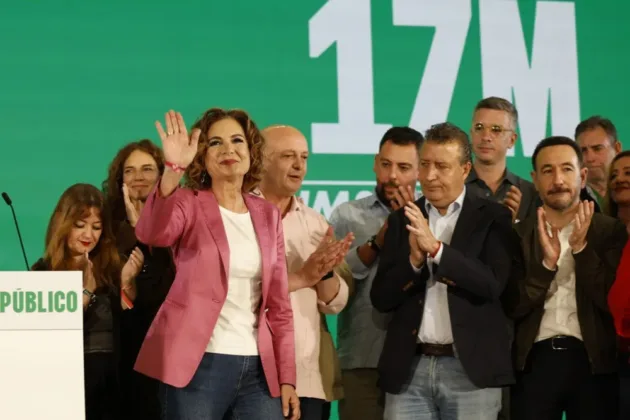
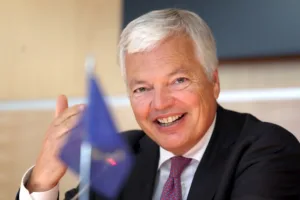

Juan Manuel “Juanma” Moreno Bonilla, the president of the Junta de Andalucía since January 2019, has built one of the most distinctive political brands in contemporary Spain: a soft-spoken, EU-friendly conservatism that cuts taxes and woos investors while studiously sidestepping the cultural and migratory debates that animate the rest of the Spanish right. Andalusia votes on his record on Sunday, May 17, 2026, and most polls project him to walk away with a second absolute majority.
A senior figure of the Partido Popular (PP), Moreno also serves as First Vice-President of the European Committee of the Regions, the European Union’s consultative chamber for sub-national government. The combination of regional power and Brussels visibility has turned him into one of the most internationally minded politicians on the Spanish right.
Moreno was born in Barcelona on May 1, 1970, the son of Andalusian emigrants from Alhaurín el Grande, in Málaga province, southern Spain. The family returned to Málaga three months after his birth. He read protocol and institutional relations at the Camilo José Cela University in Madrid and rose through the PP’s youth wing, becoming national president of Nuevas Generaciones in 1997.
He sat as a deputy in Spain’s Congress of Deputies from 2000 to 2011 and then served as secretary of state for social services under Mariano Rajoy. In March 2014 he took the helm of the Andalusian PP, a party that had not held regional power since the transition to democracy.
After a poor showing in 2018, he was sworn in as President of the Junta de Andalucía in January 2019 with the support of Ciudadanos and Vox, ending almost four decades of unbroken socialist rule. Three years later he called a snap vote and secured a historic absolute majority of 58 seats out of 109, governing alone since.
A GLOBALIST CHAMPION
Few Spanish so-called conservatives have embraced the policy menu of the European progressive consensus with as little visible discomfort as Moreno Bonilla. His administration has cut taxes and courted multinationals, but it has also adopted the climate, gender and migration vocabulary of the Brussels mainstream, often with rhetoric difficult to distinguish from that of the Spanish government he opposes in Madrid.
Moreno has been an active proponent of EU funds and the Green Deal language that travels with them. The region has secured Next Generation EU money for digitisation, photovoltaic energy and clean technologies, and has hosted its own Climate Action Sevilla Summit. Moreno has described the fight against climate change as a “battle without quarter”, placing his administration alongside the European Commission’s most ambitious targets. Since February 19, 2025, he has served as First Vice-President of the European Committee of the Regions, the EU’s consultative chamber for sub-national government.
On social policy the picture is similar. Moreno has called “real equality” between women and men an “absolute priority” of his government, refused repeated Vox demands to repeal the Andalusian law against “gender violence” and left the regional trans law of 2014 and integral LGTBI law of 2017, both inherited from his socialist predecessors, untouched. In 2023 his administration approved Andalusia’s first official strategy for LGTBI equality. The Spanish right outside Andalusia has framed many of those same policies as the imposition of a state-driven gender ideology; Moreno has placed himself firmly on the side of their preservation.
That international orientation extends to migration. Andalusia, with its long Mediterranean and Atlantic coastline, is one of Spain’s two main entry points for irregular arrivals. Moreno has repeatedly distanced himself from Vox’s national priority doctrine, which would give Spanish nationals preference in access to certain public benefits. “The Statute and the Constitution are above national priority,” he said on May 13, dismissing the slogan as “campaign language”. At the same time, he acknowledged that Andalusia is “at one hundred per cent capacity” for the care of unaccompanied migrant minors and complained that the central government had distributed them among regions without dialogue, while exempting the Basque Country and Catalonia. Seven hundred of those sent to Andalusia as minors, he said, had turned out to be over 18.
Why Sunday’s Andalusian vote is Spain’s true general-election dress rehearsal
THE ‘NO TROUBLE’ STRATEGY
Moreno’s campaign hinges on a single, almost domestic, plea: do not get Andalusia into líos – trouble. His launch in Seville on April 29 asked voters for a “strong government” and warned against the regional gridlock seen in Extremadura and Aragón, where PP-Vox coalitions have frayed.
He has called Prime Minister Pedro Sánchez “my president” in interviews, refused to be drawn into Madrid-style culture wars and offered Andalusia’s services to the central government on Gibraltar negotiations.
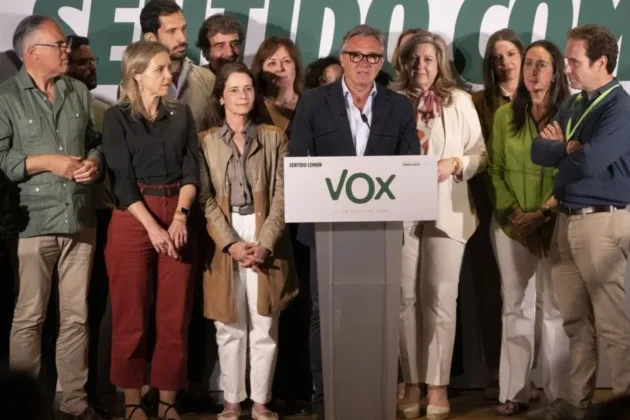
Critics on the left argue the moderation is more a matter of style than substance, pointing to overlapping policies in health, housing and tax cuts in both regions. On the right, others have noted that the same Vox voters Moreno has spent the campaign warning against would be needed in any coalition should his absolute majority slip by a single seat. Moreno is undeterred: “moderation, seriousness and proximity” remain, in his words, the values he wishes to project.
BEYOND SAN TELMO
Moreno Bonilla’s career has not been free of bruises. In 2014 his CV was found to overstate his academic credentials in what the Spanish press christened his “shrinking CV”. In October 2025 his health minister resigned over a scandal involving roughly 2,000 women caught up in delays of breast-cancer screening reviews.
Yet his moderate brand has survived both crises and a slow erosion of PP support nationally. Inside the party he is now openly named as a possible successor to Feijóo if the leader fails to dislodge Sánchez in the next general election, expected by 2027. Celia Villalobos, a veteran Andalusian PP figure, said in 2022 that Moreno had “projection beyond Andalusia”.
For now, he insists his only project is San Telmo, the palace from which he governs in Seville. A renewed absolute majority on Sunday would make that claim considerably easier to keep – and the choice of when to drop it considerably more interesting.