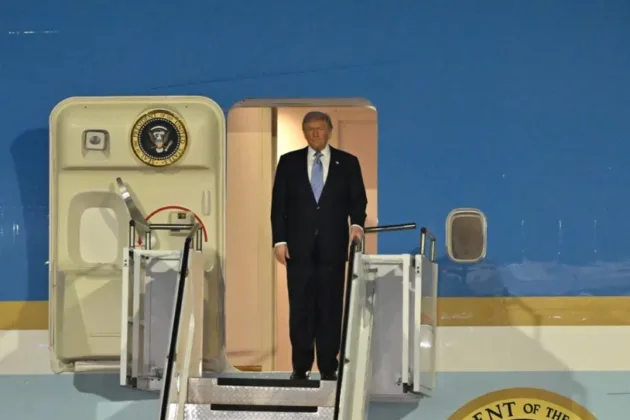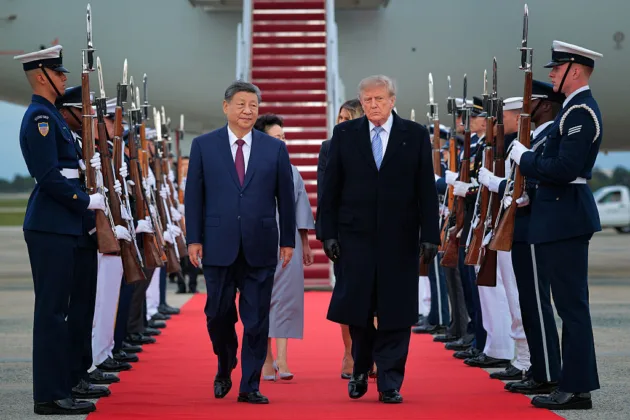



Chinese President Xi Jinping has warned his US counterpart Donald Trump that mishandling the Taiwan question could push bilateral ties into “a very dangerous situation”, on the opening day of a two-day Beijing summit that has left the European Union watching from the margins.
Speaking from the Great Hall of the People on Tiananmen Square on May 14, 2026, Xi has told Trump that “Taiwan independence and peace in the Taiwan Strait are incompatible.”
Improper handling of the dispute, the Chinese leader has said, would generate “frictions and even conflicts” between the world’s two largest economies, the official Chinese news agency Xinhua reported.
Xi has described Taiwan as “the most important issue” in China-US relations, while tempering his remarks by adding that maintaining peace and stability in the Strait was “the greatest common denominator” between Washington and Beijing.
The two presidents have held a closed-door session lasting roughly two hours and 15 minutes – their longest direct exchange since their October 2025 meeting in Busan, South Korea.
It is also the first visit to China by a sitting US president since Trump’s 2017 trip. A further encounter is scheduled for Friday at Zhongnanhai, the seat of the Chinese Government, before Trump closes the visit, as Brussels Signal reported on Wednesday.
A WHITE HOUSE READOUT THAT SIDESTEPS TAIWAN
A White House readout of the morning meeting has made no mention of the Taiwanese question, focusing instead on what officials have called a “good meeting” centred on expanding market access for US firms, increasing Chinese investment in American industry and raising Chinese purchases of US agricultural products.
The two sides have also agreed, according to the same statement, that Iran must not be allowed to acquire a nuclear weapon and that the Strait of Hormuz “must remain open” to ensure global energy flows.
Xi has expressed opposition to the militarisation of the waterway and has signalled interest in buying more US oil, US Treasury Secretary Scott Bessent has indicated on CNBC.
The Chinese leader has also offered his own diplomatic formula: a “constructive, strategic, stable relationship”, four words that, according to Beijing officials, are intended to define the next chapter of US-China ties.
TRADE TRUCE AT STAKE
The meeting has unfolded under the shadow of the Busan trade truce, which suspended heightened reciprocal tariffs until November 10, 2026, after Washington and Beijing briefly jacked up duties on each other’s goods to more than 100 per cent last year.
Xi has insisted the essence of the commercial relationship “is mutual benefit and cooperation”, arguing that trade wars have “no winners”.
Trump, for his part, has predicted “a fantastic future” with Beijing and described Xi as “a great leader”, surrounding himself with what he called “the 30 best” business executives, including Tesla chief Elon Musk, Nvidia chief Jensen Huang and outgoing Apple boss Tim Cook, alongside Boeing, BlackRock, Blackstone, Goldman Sachs, Citi, Mastercard, Meta and Qualcomm representatives.
EUROPE WATCHES FROM THE MARGINS
For Brussels, the Beijing meeting is less an opportunity than a worry. European officials fear any “managed trade” arrangement between Washington and Beijing could sideline the European Union, leaving member states to absorb the fallout.
A central concern is Chinese dominance of rare earth supplies – critical minerals used in electric vehicles, semiconductors, green technology and defence systems. Beijing’s October 2025 export curbs on rare earths, since partly suspended under the Busan truce, exposed how dependent European industry remains on Chinese supply chains.
Industrial competition is the other headache. Chinese electric vehicles are between 25 and 50 per cent cheaper to produce than European models, according to analysts. A Chinese compact SUV such as the MG4 starts at around €30,000, while comparable European models such as the Volkswagen ID.3 begin at about €40,000.
European producers fear that if Trump strikes a deal absorbing Chinese overcapacities into the US market in exchange for concessions, those goods could be redirected to Europe at prices its industries cannot match.
The European Union Institute for Security Studies has cautioned that Trump and Xi are unlikely to strike a grand bargain in Beijing, with the summit set to centre on managing rivalry, preserving fragile trade and technology truces, and containing geopolitical tensions. For Taipei, the chief fear is a subtle softening of Washington’s stance from not supporting Taiwanese independence to actively opposing it – “the most destabilising outcome”, in the words of Bonnie Glaser of the German Marshall Fund.
‘SHARED VALUES’ AT THE STATE BANQUET
The evening has produced a markedly warmer tone. Toasting Xi at a state banquet in the Great Hall of the People, Trump has called for a future “of greater prosperity, cooperation, happiness and peace” based on what he described as the “shared values” of the American and Chinese peoples – “hard work, courage and achievement”.
The US President has invoked a 250-year history of commerce and exchange, citing Benjamin Franklin’s reprinting of Confucius in his colonial newspaper, the role of US travellers in spreading “literacy and modern medicine” in China, Theodore Roosevelt’s funding of Tsinghua University and the contribution of Chinese workers to American railways.
Trump has added a lighter note: Chinese citizens, he has said, “love basketball and blue jeans”, while Chinese restaurants in the United States outnumber the country’s five largest fast-food chains combined.
He has described the day’s talks as “extremely positive and productive” and has formally invited Xi and his wife to the White House on September 24. The Chinese leader’s last visit to the United States was the 2023 APEC summit in San Francisco.
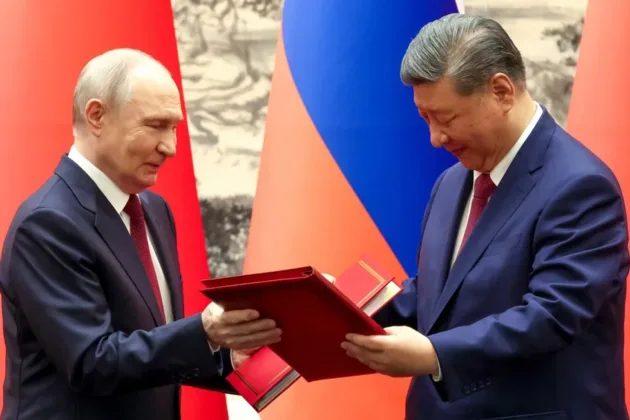
Russian President Vladimir Putin is expected to visit Beijing shortly after Trump’s departure, underlining Xi’s diplomatic balancing act.