A landmark study published in Cell Reports Sustainability has cast serious doubt on the ambitious targets set for offshore wind energy.
Researchers found that offshore wind farms worldwide may be unable to deliver the energy output promised by national governments.
Led by Carlos Simao Ferreira of Delft University of Technology, the research analysed data from 72 wind farms across Europe, showing that current policy targets often overestimate actual energy production by up to 50 per cent.

The team developed a model to define the “physical upper limit” of offshore wind farm output, highlighting how densely packed, large turbines can reach a point of diminishing returns—where adding more turbines does not proportionally increase energy yield.
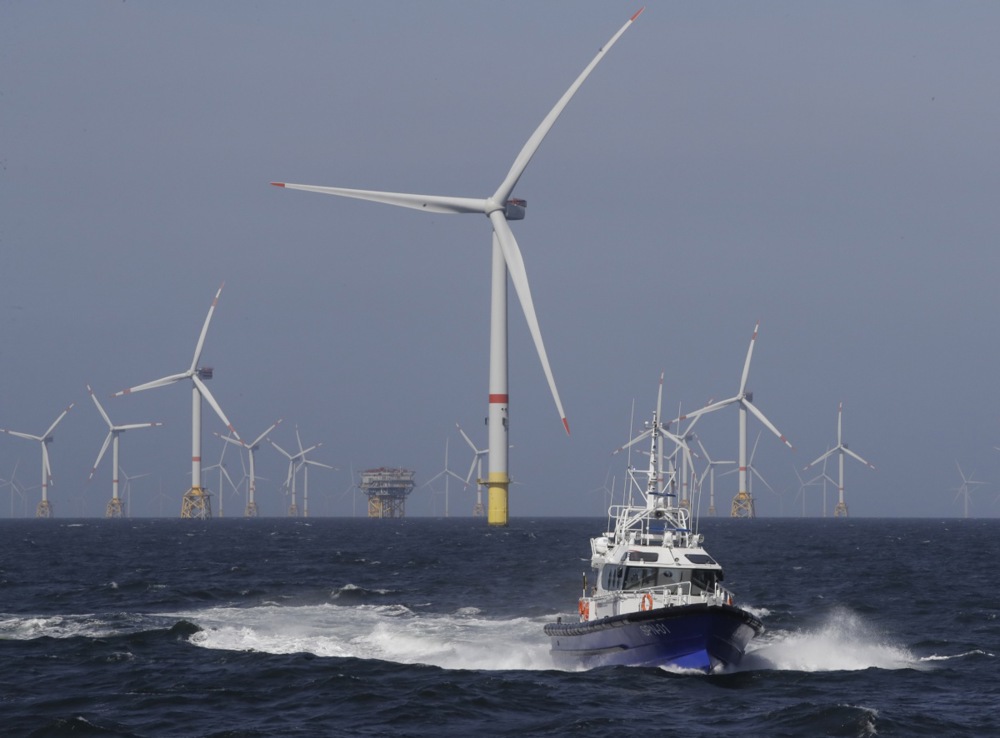
As wind farms become more crowded, turbines compete for the same wind resource, reducing the overall efficiency of the farm. The study calls this the “wind shadow” or “wake effect”, where upstream turbines slow the wind for those downstream.
Leveraging this validated model, the researchers evaluated offshore wind policy targets from several countries, including the UK, France, Germany, the US, the Netherlands, and Belgium.
Their analysis identified between national policy projections and realistic aerodynamic limits.
Notably, the Dutch offshore wind programme exhibited the most significant overestimation, predicting capacity factors nearly 50 per cent above feasible limits.
Similar, though less extreme, overestimations were observed for France (up to 22 per cent), Belgium (24 per cent), and the US (13 per cent–20 per cent).
Such widespread discrepancies underscore a , potentially leading to misguided investments, infrastructure planning failures, and energy supply shortfalls, the study warned.
As countries race to expand offshore wind capacity, the study warns that overcrowding turbines in limited sea space reduces overall efficiency.
Current Dutch plans to increase turbine density on the North Sea could result in a capacity factor as low as 34.6 per cent, far below what is needed to meet climate goals.
This shortfall risks leaving a 20 per cent gap in expected carbon-free electricity by 2040, according to the researchers.
COMMENT: Wind power isn’t cheap, simple, or green — it’s friction, fire, subsidy, and failure, writes Kevin Myers. https://t.co/BZBi7X94j8
— Brussels Signal (@brusselssignal) September 2, 2025
Dutch media outlet NRC noted that the Dutch government bases its assumptions on future scenarios developed by grid operators, consultancy firm TNO and the Netherlands Environmental Assessment Agency (PBL).
“These parties unanimously estimate that wind farms will generate slightly more than half of the maximum energy capacity. Like the wind energy industry association NedZero, they expect the efficiency of wind turbines to increase in the coming years as a result of innovation.”
These assumptions are much higher than in surrounding countries. Germany, for example, put them at 36 per cent.
None of the 72 existing parks that Ferreira examined generates more than 50 per cent of the maximum capacity, including in the North Sea.
Machiel Mulder, professor of energy economics at the University of Groningen, called the findings “new and also quite shocking”.
“We are planning wind turbines in the North Sea precisely because the yield there would be so much higher than on land,” he told NRC.
The PBL told the newspaper it bases its scenarios on figures from TNO, which in turn says they were based on “realistic assumptions.”The research institute also refers to an “additional analysis” that appeared last summer at the back of a report from the climate ministry, with a yield of 42 percent. At the time, that scenario was still described as a ‘”relatively pessimistic estimate”.
While not dismissing offshore wind as a solution, the authors call for policymakers to adopt more realistic planning, accounting for the physical constraints of wind energy extraction, arguing that overoptimism could undermine public trust in the energy transition.
The study’s model offers a tool for governments to set credible targets, ensuring that the global shift to renewables remains both ambitious and achievable
The outgoing Dutch Government said it would cut back its ambitions to build new wind farms in the North Sea. https://t.co/TGspCA57cr
— Brussels Signal (@brusselssignal) July 22, 2025