







Energy multinationals BP and TotalEnergies, major investors in Germany’s North Sea offshore wind sector, are seeking to slow the pace of future auctions and capacity build-out in a move that would delay the country’s 70 GW target by up to 16 years.
That is according to an investigation by public broadcaster NDR and Tagesschau today.
The companies, which together secured rights to areas with a combined capacity of about seven gigawatts in the 2023 auctions (paying €12.6 billion) and additional zones in 2024 for a further €3 billion, have put forward what they term a “Re-Order” plan.
This would push back the auction schedule for remaining North Sea sites so that the statutory 70 GW target, currently foreseen in the Site Development Plan (FEP) for around 2041 and anchored in law by 2045, would not be reached until 2057.
To support their proposal, Jera Nex bp (BP’s offshore wind joint venture with Japan’s JERA) and TotalEnergies commissioned the Fraunhofer Institute for Wind Energy Systems (IWES) to model the scenario.
The resulting study, presented to the Federal Maritime and Hydrographic Agency (BSH), responsible for offshore spatial planning, concludes that the delayed, lower-density approach would deliver 2 per cent to 10 per cent higher yields in the companies’ own “focus areas”.
It would, though, cause a “significant drop” in overall offshore wind energy production across the German North Sea, with yields falling by up to one-third at times.
As part of its energy transition, Germany wants to get 80 per cent of its electricity from renewable sources by 2030.
Bernhard Stoevesandt, Chief Political Officer at Fraunhofer IWES and a contributor to the study, summarised the trade-off: “The Re-Order plan naturally leads to a clear slump in offshore wind energy yields in the German North Sea overall. This is a weighing-up between how profitable it should be for the companies and how much electricity offshore wind should deliver to society.”
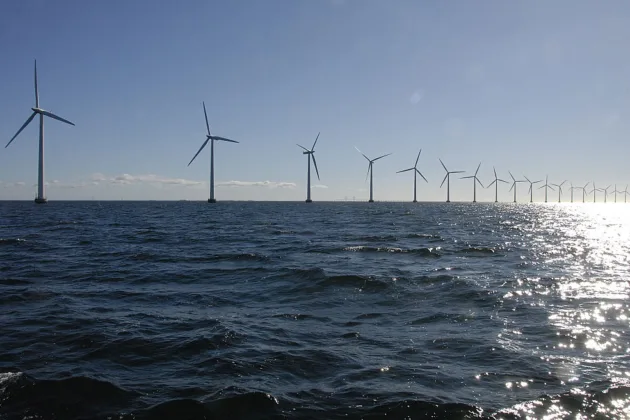
The proposal rests on the known phenomenon of wake effects (or “shadowing”), in which turbines upstream reduce wind speeds for those downstream.
BSH department head Lea Haefke said these effects were already understood when the companies bid successfully in 2023 and 2024.
She described their intervention as “surprising” because it “contradicts the legal foundation”, although she acknowledged the economic calculations as “plausible”.
A separate, publicly available Fraunhofer IWES study commissioned by BSH in September 2025 reached similar conclusions on wake impacts.
It modelled North Sea expansion scenarios to 2050 (aligned with the Ostend Declaration targets of 120 GW by 2030 and 300 GW by 2050 across North Sea countries) and found wind-speed reductions exceeding 30 per cent in dense German Bight clusters, with full-load hours in German waters falling to around 3,300 by 2050.
TotalEnergies has defended the Re-Order plan as a “proactive proposal” to make offshore wind “more efficient and therefore cheaper for electricity customers”.
The company argues that grid-connection delays already cast doubt on current timelines and that shortfalls in German production could be offset by higher build-out in neighbouring countries.
Jera Nex bp declined to comment.
The timing is sensitive. The current Site Development Plan is overdue for its 2026 update,and a revision of the Wind Energy at Sea Act is also required this year.
Germany’s Federal Ministry for Economic Affairs, which received a request from the companies to discuss the Fraunhofer study, has yet to schedule a meeting.
Economy minister Katherina Reiche has previously spoken in favour of a more measured expansion pace.
Germany’s Social Democratic Party’s (SPD) energy spokesperson Nina Scheer said avoiding wake effects was sensible but “must not result in a net reduction in yields or failure to meet expansion targets in volume and time”.
Greens offshore rapporteur Alaa Alhamwi warned that lower-than-planned output would create gaps potentially filled by gas-fired power.
BP and TotalEnergies have invested billions in German offshore wind and said they remain committed to the projects already awarded.
BP has transferred its offshore wind activities to the London-headquartered Jera Nex bp joint venture.
TotalEnergies continues to develop its North Sea concessions – some originally in consortium with RWE, which withdrew in 2024.
A landmark study published in Cell Reports Sustainability has cast serious doubt on the ambitious targets set for offshore wind energy. https://t.co/wpvr176Hbk
— Brussels Signal (@brusselssignal) December 12, 2025