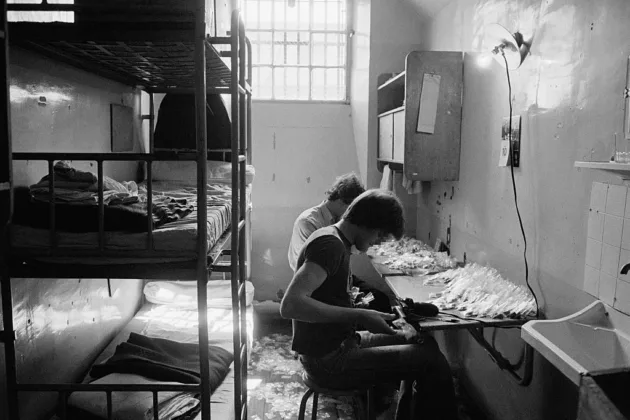







France has the most overcrowded prisons in the European Union, holding 131 inmates for every 100 available places, a newly published report has found.
The figures come from the Council of Europe’s latest annual prison survey, which offers one of the clearest pictures yet of how member states are coping with rising inmate numbers and persistent pressure on cell space.
A figure of 131 inmates for every 100 places means cells designed for one person are routinely shared, mattresses are placed on floors and access to work, education and health care is squeezed. The numbers also feed directly into France’s wider debate over immigration, security and the cost of its justice system.
FOREIGN NATIONALS HEAVILY OVER-REPRESENTED
Foreign nationals account for about a quarter of the French prison population, with 18,752 foreign inmates recorded as of January 31, 2024.
By comparison, foreigners made up 8.8 per cent of France’s population in 2024, according to the national statistics body INSEE. That left them over-represented behind bars by a factor of around three.
The Council of Europe noted that foreign prisoners were not only long-term immigrants but also asylum seekers, undocumented migrants, tourists and people linked to cross-border criminal networks. Most prison data does not separate these groups, making it difficult to draw firm conclusions about what is driving the trend, as Remix News reported.
HOW THE FIGURES WERE COMPILED
The overcrowding figures were compiled by the University of Lausanne for the Council of Europe, the 46-member human rights body based in Strasbourg, eastern France.
It is a separate organisation from the European Union and oversees the European Court of Human Rights. The body is frequently confused with EU institutions, though it has a distinct membership and a different mandate.
A rate above 100 means a country is holding more people than its prisons were built for. France shared the highest figure across the whole survey with Turkey, also on 131, though Turkey is a Council of Europe member and not part of the European Union.
The figures date back to early 2025. Since then the French authorities have provided more recent and even more alarming numbers, with overcrowding in the country estimated at 139.1 per cent in April 2026.
Of the 51 prison administrations that supplied figures, 14 held more prisoners than they had places for. Some countries, such as Spain, Britain and Bosnia, report by region rather than nationally, which can mask local pressures.
WHERE OTHER COUNTRIES STAND
Behind France among EU member states came Croatia, with 123 inmates for every 100 places, followed by Italy on 121 and Malta on 118.
Cyprus (117), Hungary (115), Belgium (114) and Ireland (112) were also among the most crowded systems. Several of the worst-affected countries are clustered in southern and central Europe, suggesting overcrowding is not confined to any single region of the bloc.
The better performers included Spain, at 77 inmates for every 100 places, and Germany at 80. Ukraine, which is not an EU member, recorded the lowest figure at 50, though its data should be read with the caveat that the country has been at war.
A WIDER EUROPEAN PICTURE
Measured against population rather than capacity, the EU member state that locked up the most people was Hungary, with 206 inmates per 100,000 inhabitants.
It was followed by Poland on 189 and the Czech Republic on 178. Capacity and incarceration rates do not always move together, so a country can be crowded without jailing an unusually high share of its people.
Overall, as of January 31, 2025, there were just over 1.1 million inmates across all the countries studied. That marked an increase of 8.5 per cent on the previous year, an indication that the strain on prison systems is a Europe-wide trend rather than a problem unique to France.
The proportion of women among the prison population rose from 4.8 per cent to 5.2 per cent between January 2024 and January 2025, the report said. Women still make up a small minority of those held, but the share has edged up steadily.
PRESSURE FROM STRASBOURG
Prison overcrowding has repeatedly been the subject of rulings by the European Court of Human Rights, which is part of the Council of Europe.
The court has used such cases to press governments over conditions inside their jails, and France has previously faced scrutiny over the state of its prison estate, including moves to release some inmates early to ease the pressure.
Such measures tend to be controversial, with critics arguing they amount to managing the symptoms rather than building enough capacity. With the most recent national figures pointing to worsening conditions, the pressure on the French authorities is unlikely to ease.