

Emmanuel Macron’s Renaissance (RE) party cannot agree on immigration, cannot secure its borders, and cannot articulate a coherent policy toward political Islam. This didn’t prevent one of its deputies, Christophe Marion, from travelling to Port Sudan this month as part of a parliamentary delegation – the first visit reported by European parliamentarians to Sudan since the war began in 2023 – to negotiate contracts with the Sudanese Armed Forces (SAF) and the Sudanese government.
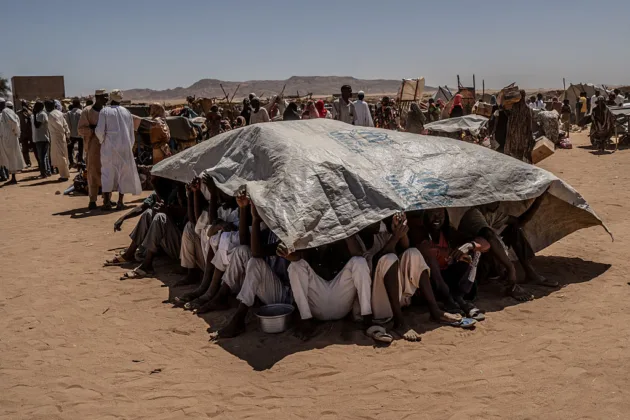
It is difficult to find a benign reason for Marion’s trip to Port Said: He is a deputy who seeks to do business with an extremist government that insists on continuing a war estimated to have killed at least tens of thousands of people, displaced nearly nine million, and shows no sign of ending. As if the slaughter in Sudan wasn’t enough, the publication of a leaked report from the French Ministry of the Interior, The Muslim Brotherhood and Political Islam in France, points to a serious problem of political Islamic infiltration in France itself.
Port Sudan is the SAF’s wartime capital and operational centre of its allied Islamist networks. These include the Kizan, the Islamist cadres that supported Omar al-Bashir, the head of state who was overthrown in 2019, and his ousted National Congress Party. They also include extremist militias such as the Al-Baraa Bin Malik Brigade, which was sanctioned by the United States in December 2025. Connecting all these groups is the Sudanese Muslim Brotherhood, designated a terrorist organisation by the US. So, in practice, Marion’s trip is worse than a cynical mercantile bid. It strengthens the very groups the West has sanctioned as terrorists, strengthening the radical Islamist networks of the SAF, which is reportedly 75 per cent composed of Muslim Brotherhood affiliates.
Concern over Islamist networks extends well beyond the United States, particularly regarding the Muslim Brotherhood’s transnational influence. The European Parliament hosted a conference on March 4 of this year to examine the growing threat posed by transnational Muslim Brotherhood networks. Even Egypt, one of the SAF’s regional backers, has detained Islamist fighters affiliated with the SAF when they have crossed into its territory.
Yet Marion’s trip was as partisan as you’d expect from someone schmoozing the SAF. He publicly framed his visit in humanitarian and political terms, advocated a harder French line against the SAF’s opponent Rapid Support Forces, and heard testimony from survivors from Darfur and Khartoum about atrocities attributed to the RSF. All this despite Sudanese civilian actors such as the Sudan Founding Alliance (Tasis) warning that Sudan’s Islamist movements pose a significant obstacle to any durable peace settlement.
France’s cordial relations with the Port Sudan government reflect a pattern already visible during the early 2000s Darfur crisis, when Paris resisted US-led efforts at the UN to impose sanctions against Sudan.
Then, too, France appeared to privilege its own economic and geopolitical interests over humanitarian pressure in the region. More recently, France has taken an ostensibly even-handed position in multilateral forums, formally calling for a nationwide ceasefire between SAF and the RSF. In practice, including at the United Nations, France has called for sanctions only against RSF generals, turning a blind eye to the SAF.
France has a contradicted policy towards Islamist organisations. Within France, Macron has called for action against the Muslim Brotherhood. Outside of France, his party members are propping up the SAF, which is largely composed of Muslim Brotherhood members. This inconsistency reflects a broader lack of strategic coherence: While Macron has signalled concern about Islamist influence at home, his early presidency included statements that were conciliatory toward non-assimilating Islamist constituencies.
Infamously, Macron asserted that there is “no such thing as French culture, only a culture in France. And it is diverse”. Later in his candidacy, he shifted his immigration policy more to the Right, but his party remains divided on the issue.
This incoherence within the ruling party and its leadership now falls squarely on Gabriel Attal, the president of the Renaissance group in the National Assembly and a leading contender for the 2027 presidential race. As this former Prime Minister and a long-time Macron protégé manoeuvres for the Élysée, Marion’s mission to Port Sudan exposes a significant lack of institutional control or, perhaps more damagingly, a deficit in geopolitical judgment. By failing to restrain a deputy’s trip to a Sudanese Muslim Brotherhood stronghold, Attal appears either too inexperienced to manage his party’s international policy or willing to overlook the ramifications of doing business within a regime intertwined with radical Islamist groups.
The notion that French companies can operate in Port Sudan without the explicit approval and enrichment of the SAF and its Islamist allies is a dangerous delusion. For Attal, a politician whose legitimacy rests on a promise of modern, decisive leadership, allowing a member of his parliamentary group to engage with an Islamist-backed military junta is a major oversight. It suggests that Attal may be a continuation of Macron’s legacy, one that remains fundamentally confused when confronting the transnational influence of movements like the Muslim Brotherhood.
Adam Bielan is a Polish MEP and a member of the European Conservatives and Reformist Group