






US President Donald Trump has landed in Beijing for a two-day visit centred on trade, with the tariff truce agreed last October on the table and the war with Iran and the status of Taiwan framing the encounter as the first call on Chinese soil by a sitting US president in nine years.
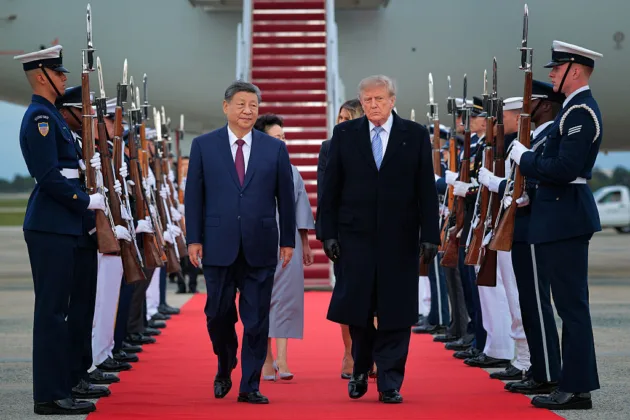
Air Force One touched down shortly after 8pm local time on Wednesday carrying the President and a large delegation that includes Secretary of State Marco Rubio, Defense Secretary Pete Hegseth and close to 20 senior executives of major American multinationals. Trump was received at the foot of the aircraft steps by Chinese Vice-President Han Zheng, as dozens of men and women in blue and white waved small American and Chinese flags to the sound of fanfares.
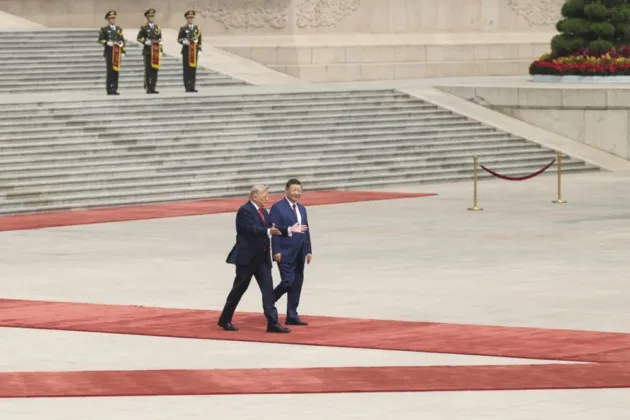
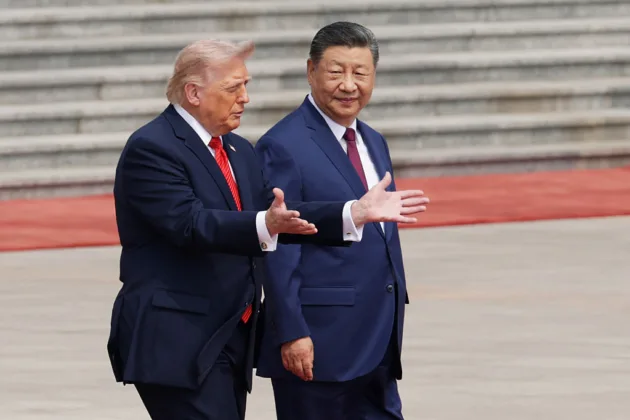
The formal summit with Chinese President Xi Jinping is set for Thursday morning at the Great Hall of the People on Tiananmen Square, followed by an official dinner. A further meeting is scheduled for Friday at Zhongnanhai, the seat of the Chinese Government, where the two leaders will hold a working lunch before Trump closes the visit.
Speaking before his departure, Trump told followers on his social media platform that “great things” lay ahead for both countries, and identified one objective above all: persuading Beijing to open its market to American firms.
TRADE AND TARIFFS
Economic relations dominate the public agenda. While the headline meeting is taking place in the Chinese capital, US Treasury Secretary Scott Bessent and Chinese Vice Premier He Lifeng are leading parallel consultations in neighbouring South Korea, designed to prepare the ground for the leaders’ encounter.
Washington wants Beijing to step up purchases of US-made aircraft, soya and beef, and to ease entry conditions for American companies in the Chinese market. China is pushing for tariff reductions on its exports, an extension of the truce brokered in Busan in October 2025 and a softening of US controls on semiconductor imports.
A CORPORATE CONTINGENT LED BY SILICON VALLEY
The composition of Trump’s business delegation underlines the stakes. Travelling with the President are Apple chief executive Tim Cook, Tesla and SpaceX founder Elon Musk, Boeing CEO Robert Kelly Ortberg, BlackRock’s Larry Fink, Blackstone’s Stephen Schwarzman, Goldman Sachs’ David Solomon, Citi’s Jane Fraser and Mastercard’s Michael Miebach. GE Aerospace, Cargill, Visa, Meta, Micron, Illumina, Coherent and Qualcomm are also represented.
The most closely watched name on the list, though, is Nvidia chief executive Jensen Huang, whose firm has overtaken every other listed company by market value on the back of the artificial intelligence boom. Huang told CNBC last week that he would consider it “a privilege” to represent the United States on the trip, and his presence in Beijing turns him into a de facto barometer for the semiconductor file. Washington’s curbs on advanced chip exports to China are among the most contentious items in the bilateral relationship, and the Chinese side has flagged them as a priority for any package emerging from the summit.
TAIWAN AND UKRAINE
The status of Taiwan is set to be the most sensitive item discussed by the two leaders. Trump has invoked his rapport with Xi to argue that Beijing knows Washington opposes any move against the island, and has drawn an explicit parallel with Russia’s invasion of Ukraine, claiming the conflict would not have started had he been in office.
“If you have the right President, I don’t think it’s going to happen,” Trump said of a possible Chinese military move on Taipei. “Things will be fine. I have a very good relationship with President Xi and he knows I don’t want that to happen.”
Beijing’s position is that US arms sales to Taipei must end. Chinese Foreign Ministry spokesman Guo Jiakun on Tuesday repeated that the government’s “firm opposition” to American weapons transfers to the island was “constant and clear”, in remarks carried by Chinese state media.
IRAN AND THE STRAIT OF HORMUZ
The summit takes place against the backdrop of the unfinished war launched by the United States alongside Israel against Iran. After six weeks of operations, hostilities have given way to an indefinite truce and stalled negotiations, with discreet contacts so far failing to bridge gaps on Tehran’s nuclear programme and on the reopening of the Strait of Hormuz.
The strategic waterway remains closed by Iran, with the US Navy maintaining a perimeter blockade of Iranian ports. Trump argues that Beijing, a heavy importer of Gulf crude, has a direct interest in seeing the route reopened and should help push Tehran towards a settlement.
China has so far favoured a diplomatic path, working behind the scenes with Pakistan and other mediators on a framework based on sovereignty, international law and what officials describe as “peaceful coexistence”.
DISSIDENCE AND THE EUROPEAN ANGLE
Trump is also expected to raise the case of jailed Hong Kong opposition figure Jimmy Lai, whose release he has said he will request. Beijing describes Lai as the “principal instigator” of the 2019 protests in the territory and has so far shown no sign of relenting.
For the European Union, the visit matters as much for what it signals as for what it produces. An understanding between Washington and Beijing on tariffs, semiconductors or Gulf shipping would reshape the trading environment in which European firms operate; a fresh stand-off would do the same in reverse. Brussels has so far limited its public comments to general calls for stability and open markets.