





The United States has refused to back the United Nations’ latest migration declaration, with the State Department accusing UN agencies of working to “advocate and facilitate replacement immigration in the United States and across the broader West”.
In a statement published on May 11, the department said Washington did not take part in the second International Migration Review Forum (IMRF), held at UN headquarters in New York from May 5 to 8, and would not endorse its concluding “progress” declaration.
It pointed back to US President Donald Trump’s 2017 rejection of the Global Compact on Migration, adding that “the intervening years have confirmed the wisdom of that opposition”.
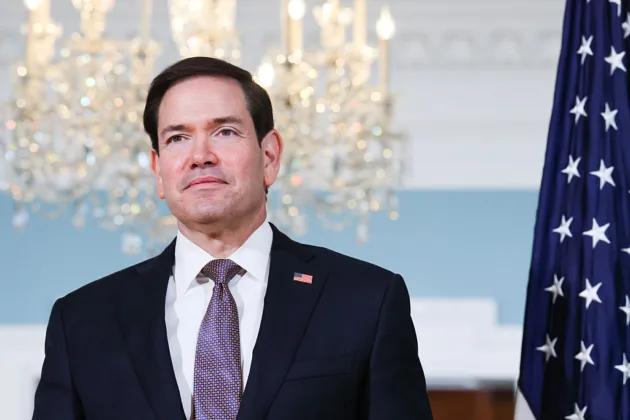
US Secretary of State Marco Rubio said opening US doors to mass immigration had been “a grave mistake that threatens the cohesion of our societies and the future of our peoples”.
THE REPLACEMENT IMMIGRATION CHARGE
The statement was unusually blunt for an official US communication, using language more typically heard from European national-conservative and right-wing parties.
The department accused UN agencies and the NGOs they fund of having facilitated “the invasion of our country” and of having “proceeded to redistribute our own people’s wealth and resources to millions of foreigners from the worst corners of the world”.
It said “billions of taxpayer dollars” had been “funneled towards hotels, plane tickets, cell phones and cash cards for migrants”, citing “crime and chaos at the border” and “states of emergency in major cities” as evidence of harm done by mass immigration.
The phrase “replacement immigration” echoes the Great Replacement thesis advanced by French writer Renaud Camus, who has pointed out that European populations are being deliberately substituted through migration from outside Europe. Its use in a State Department release marks a sharp break with the diplomatic register of previous US administrations of either party.
The 2018 Global Compact for Safe, Orderly and Regular Migration, the framework under review in New York, was adopted in Marrakech and committed signatories to managing borders “in an integrated, secure and coordinated manner”. It was endorsed by most EU member states, though Hungary, Poland, the Czech Republic, Slovakia, Bulgaria, Italy, Latvia and Estonia at the time either withdrew, abstained or voted against, citing sovereignty concerns.
‘REMIGRATION’ OVER MANAGEMENT
The department went further than a simple boycott. “Our goal is not to ‘manage’ migration, but to foster remigration,” it concluded.
The word “remigration” — the systematic return of immigrants and, in some readings, their descendants to their countries of origin — has been popularised in Europe over the past decade by Austrian activist Martin Sellner and adopted by parties such as Alternative for Germany (AfD).
In Germany, the term ignited a political row in January 2024 after investigative outlet Correctiv reported on a private meeting in Potsdam at which AfD figures and others discussed plans described as “remigration”. Its appearance in a US State Department release marks a significant normalisation of the vocabulary in transatlantic policy.
The statement also took aim at what it described as a UN-sponsored immigration “pipeline” through Central America to the southern US border. UN agencies and the NGOs they fund, the department said, had “established a migration corridor” and then “condemned the deportation of illegal immigrants”.
EUROPEAN CONTEXT
The International Organization for Migration (IOM), which coordinates the UN Network on Migration, holds the forum every four years to review progress under the Global Compact. Its May 8 declaration described all immigrants as “human rights holders” regardless of status and called on states to protect their “human rights and fundamental freedoms”.
For European capitals, the US move complicates an already fractious debate. The EU Pact on Migration and Asylum, adopted in 2024, is being implemented amid resistance in several member states. Italy, the Netherlands and Denmark have pushed for tougher external measures, while the European Commission, led by President Ursula von der Leyen, has explored “return hubs” and partnerships with non-EU countries to accelerate deportations.
Viktor Orbán has long argued that Brussels has underestimated public hostility to high levels of arrivals, and Poland’s Law and Justice party (PiS) made similar arguments during its years in government. The US declaration is likely to be cited by these voices in the coming European Parliament debates on asylum implementation.
German Chancellor Friedrich Merz, who took office in May 2025 promising sharply lower arrivals, is caught in the middle: aligned with Washington’s tougher line in substance, but increasingly at odds with the White House on tone and on Iran. Officials in Berlin and Paris are likely to read the State Department’s language with discomfort, even as some governments in central and eastern Europe quietly welcome it.
The State Department concluded that the US “will not support a process that imposes, overtly or by stealth, guidelines, standards, or commitments that constrain the American people’s sovereign, democratic right to make decisions in the best interests of our country”.
President Trump, the department added, is “focused on the interests of Americans, not foreigners or globalist bureaucrats”.