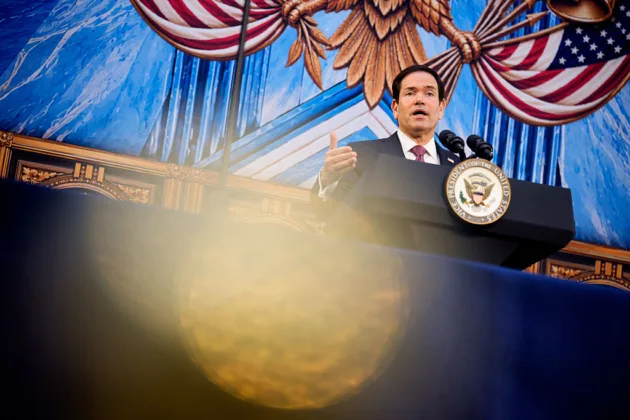



US Secretary of State Marco Rubio met Italian Prime Minister Giorgia Meloni in Rome during a closely watched visit to Italy.
The trip. today, officially focused on high-level consultations on geopolitical issues, quickly became a key test of the increasingly delicate relationship between Washington and one of Europe’s most prominent conservative leaders.
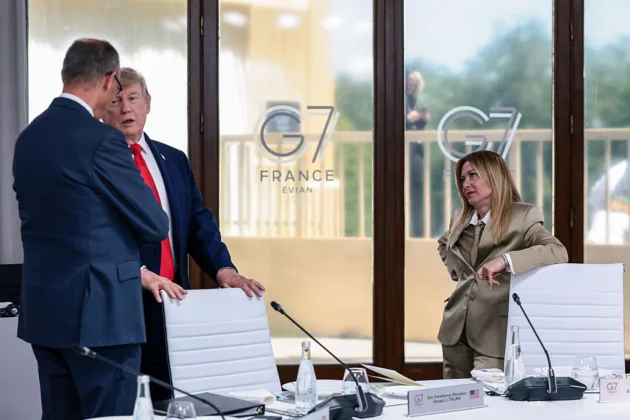
That came following recent tensions in US–Italy relations after Meloni — long considered closely aligned with US conservative administrations — came under heavy criticism from US President Donald Trump in recent weeks.
Rubio’s two-day visit was formally aimed at reinforcing strategic US–Italy co-operation across security, defence and economic policy, with a focus on Ukraine, Middle East instability, NATO co-ordination and broader discussions on western security priorities, including the evolution of the US military position in Europe.
At the same time, the visit was widely interpreted by observers as an attempt to ease US tensions with both the Italian Government and the Vatican.
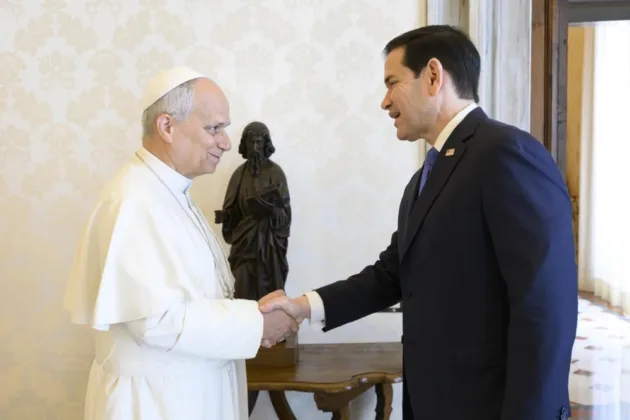
Alongside meetings with Italian officials, the US Secretary of State also held an audience with Pope Leo XIV, part of a broader diplomatic effort to stabilise relations with the Holy See after months of friction.
Rubio met Meloni and Italian foreign minister Antonio Tajani at Palazzo Chigi, the official seat of the Italian Government and the central hub of the Council of Ministers in Rome, in a meeting lasting more than an hour and a half.
Although Meloni has traditionally been viewed as one of the European leaders closest to the US conservative political sphere, relations with its current administration have become increasingly strained in recent months.
Since Trump’s return to the White House at the end of 2024, Meloni initially attempted to balance ideological proximity with Washington and a mediating role between the US and European capitals, which often diverge on security and economic policy.
That approach began to unravel earlier in 2026 following a series of policy disagreement. They included Italy’s cautious stance on joint US-Israeli strikes on Iranian targets and its refusal to endorse certain US geopolitical proposals.
Rome also maintained a restrained position on the use of Italian bases for US operational support linked to those actions.
Tensions further escalated in April 2026, when Trump publicly questioned the state of the transatlantic relationship. On April 15, 2026, he stated: “No, we don’t have the same relationship as before.”
In the same period, he also raised the possibility of reviewing US military deployments in Europe, including a reduction of forces stationed in Italy, a move that sparked concern among NATO allies.
Later in April 2026, he suggested that a reduction of US troops in Italy and Spain was “possible”, although no formal decisions were announced.
Against this backdrop, Rubio’s latest meetings in Rome are aimed at stabilising and relaunching bilateral co-operation.
The meeting with Meloni was described by Italian officials as “frank and strategic”.
According to briefings from the Italian foreign ministry, discussions focused on Ukraine, Middle East crises and maritime security in the Strait of Hormuz.
Italy’s role in Mediterranean operations, NATO co-ordination and stability efforts in Lebanon and the Red Sea also featured prominently. Italian sources also indicated that the possible withdrawal or reduction of US troops from Italy was not part of the discussion.
Ukraine remained a central issue, alongside broader NATO discussions and allied military deployments. Economic relations were also addressed, with Rubio stressing the need to safeguard western economic interests amid global competition, while Italian officials reiterated the importance of continued US–EU co-operation.
Despite underlying political tensions, the tone of the meetings was described as constructive and pragmatic. Meloni positioned Italy as a stabilising actor capable of bridging Washington and European positions, particularly on Mediterranean and energy security issues.
Italian sources also indicated that the possible withdrawal or reduction of US troops from Italy was not discussed during the talks.
No major agreements were announced, but both sides signalled a shared interest in preventing recent frictions from escalating into a longer-term strategic rift.