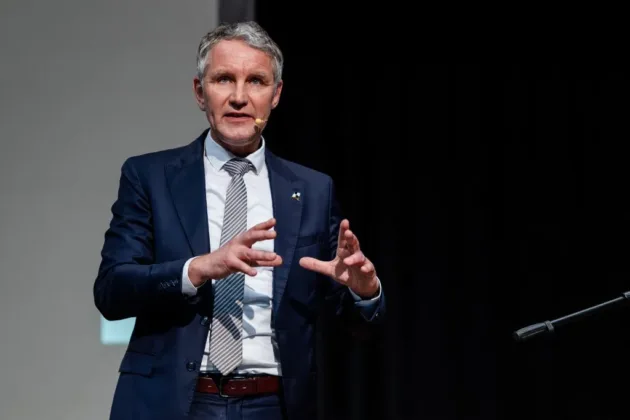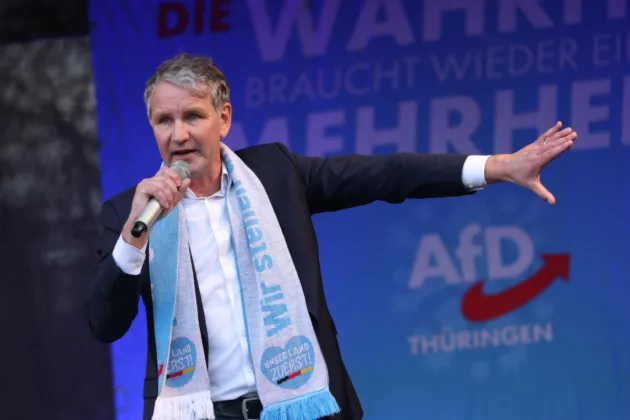



The four-and-a-half-hour interview that Björn Höcke, the AfD leader in Thuringia and enfant terrible of German domestic politics, gave to the German podcaster Ben Berndt was treated by much of the German press as an event somewhere between a public hygiene crisis and a constitutional emergency. By comparison, an interview with Friedrich Merz, the actual Chancellor, attracted a fraction of the same attention. That asymmetry alone speaks volumes: Höcke is the figure the German political class has most consistently tried to render unsayable, and yet he commands attention in a way the Chancellor of the Federal Republic does not. Maybe the “firewall” is also working as a flare, drawing attention to those the political establishment would like to silence.
What is rising across Europe, in Germany, in Austria, in France, in the Netherlands, in Italy, is not a single party but a recognition by an every growing number of citizens: That elections, in the form they have taken since the 1990s, have stopped producing the changes voters keep asking for. The British political scientist Colin Crouch described this condition twenty years ago in a book called Post-Democracy. Although the formal rituals continue – people going to the polls, watching the debates, not studying the party manifestos – all the substantive decisions most people see as existential priorities like migration and energy, are made elsewhere: At the European level, in supranational bodies, in NGO networks supported by public money, and in administrative organs accountable to nobody the voter can remove. The state, whose representatives often speak about “saving democracy” these days, actually likes this pattern.
A recent German example illustrates this in a stark way. The Bundestag has formally requested that Lars Klingbeil, the SPD finance minister and vice chancellor, disclose how many millions of public euros are flowing to NGOs that describe themselves as defenders of democracy. Klingbeil has refused to provide the figures, citing administrative difficulty. The columnist Jan Fleischhauer noted recently that this is one of the more flagrant violations of parliamentary budgetary oversight in recent memory, and yet the political consequences are minimal, because the press does not consider this a story. The party officially designated as a threat to democracy is the one demanding transparency about taxpayer money flowing to organisations dedicated to fighting that party.
This is the soil in which the so-called firewall, the Brandmauer, grows, but in the opposite direction as it was originally intended. People flock to the AfD not because they had it with democracy, but they actually want to save it.
Officially the firewall protects the constitutional order against extremism. In practice it functions as a guarantee that elections will not change the policies the established parties have already settled on. A coalition rightward of the centre is mathematically possible in several recent elections, in Germany and elsewhere (think Austria and France) but politically it has been ruled out in advance. Voters who supported the parties that, taken together, won a parliamentary majority discover that the policies enacted are the policies of the parliamentary minority. This is an open conspiracy where the political class that has come to believe its current settlement is the end of history and that any serious challenge must be a pathology rather than a disagreement. You see, voting for the “far right” is not an expression of your political preferences, but shows that you are a despicable human being that should be barred from voting altogether.
It is in this context that Höcke, and figures like him across Europe, become legible. The substantive content of the Berndt interview was less inflammatory than its reception suggested. Höcke spent considerable time distinguishing what he calls cultural nationalism from the ethnic nationalism of the 1930s, citing Ernst-Wolfgang Böckenförde, and acknowledging that there are foreigners more German than the so-called Bio-Deutsche (“organic Germans” a wordplay for native Germans). None of this is new in European political thought. Hans Kohn drew the distinction between civic and ethnic nationalism in 1944. Anthony Smith and Liah Greenfeld elaborated it for a generation of scholars. The European tradition before fascism, from Mazzini to Herder, was overwhelmingly cultural rather than racial. The notorious slogan of the Austrian pan-Germanist Georg Ritter von Schönerer, an early hero of the young Hitler, captured what came next: “Die Religion ist einerlei, im Blute liegt die Schweinerei” — religion is irrelevant, the trouble is in the blood. That was the rejection of the older European tradition, not its continuation.
The cultural nationalism that the new European Right represents is, in fact, the same idea on which the post-1945 secular liberal state quietly depends. Böckenförde’s famous dictum, that the secular liberal state lives off preconditions it cannot itself guarantee, is the philosophical centre of the issue. A constitution does not produce loyalty. A welfare system does not produce solidarity. A passport does not produce belonging. These things are inherited from a cultural and historical substrate that liberal proceduralism takes for granted and that progressive politics actively dissolves. When Robert Putnam published his study E Pluribus Unum in 2007, the finding that surprised even his sympathisers was that diversity reduces trust not only between groups but within them. People in heterogeneous communities trust their own neighbours less. Multiculturalism has failed on almost all accounts, and Höcke is correct when he calls for its abandonment.
The European political class has chosen to interpret these findings as embarrassments to be managed rather than realities to be addressed. Habermas’s project of constitutional patriotism, the idea that a polity can be held together by rational adherence to legal procedure alone, was a brave attempt to construct a post-national basis for European politics. It has not worked, and the reason it has not worked is the reason no large polity in history has worked that way. Loyalty is not a contract. It is closer to what Plato called thymos, the part of the soul that wants to be recognised and to belong to something larger than the calculation of personal advantage. A politics that denies this desire does not abolish it. It only ensures that the desire will be channelled into parties that the political class would prefer did not exist.
That is the reason the Right keeps rising. It is not because European voters have suddenly become illiberal, or because social media is making them angry, or because economic anxiety is curdling into ethnic resentment. It is because a substantial and growing portion of the population in country after country has correctly perceived that their elections do not change their policies, that their concerns about migration and energy and cost of living are dismissed before they are debated, and that the institutions they were taught to revere have become instruments for ratifying decisions made elsewhere. The figures who articulate this perception will keep finding audiences as long as the perception remains accurate, and the firewall, far from defending democracy, has become the most visible piece of evidence that something has gone fundamentally wrong with the way Europe governs itself.