





The Spanish Socialist Party (PSOE) has slumped to its worst-ever result in Andalusia, a region it had governed almost without interruption from 1982 to 2019. The defeat extends a losing run for Europe’s progressive family that has stretched across the continent for almost a year.
The vote on May 17, 2026 was held on home soil for the Socialists, in a region whose population of more than 8 million would make it the European Union’s 15th-largest member state if it stood alone. The PSOE has taken 28 of the 109 seats in the Andalusian parliament on around 22.7 per cent, two deputies fewer than in 2022.
The result lands on top of fresh setbacks elsewhere. British Labour suffered heavy losses in local and devolved-administration elections this spring, while Denmark’s Social Democrats retreated at March’s general election, leaving Prime Minister Mette Frederiksen’s grip on power in question. In Germany, where the SPD shares power, polling averages now put it at around 14 per cent.
A WIDER PATTERN OF DECLINE
The map looks little better beyond those three governments. French socialists posted some encouraging results at the recent municipal elections, though those gains were concentrated in cities, where the party has retained the educated urban vote even as its grip on working-class neighbourhoods has loosened.
In Italy, Giorgia Meloni’s government lost a referendum on judicial reform earlier this year, cheering the centre-left, though referendum and general-election dynamics rarely coincide. In central and eastern Europe the progressive family barely exists. In the Netherlands it is weak. Sweden offers more hope in opinion polls, but the overall picture is bleak.
The numbers from the European Parliament tell the same story. The Socialists and Democrats (S&D) group won 136 seats in 2024, down from 154 in 2019 and 191 in 2014. According to Europe Elects’ rolling poll-of-polls, the family would now be reduced to 125 seats if a fresh vote were held.
ANDALUSIA WAS NO ORDINARY DEFEAT
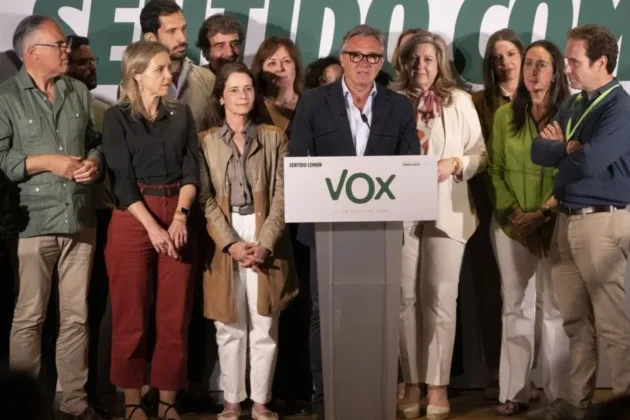
The Andalusian result is more than an electoral footnote. The region, almost the size of Portugal and historically a Socialist granary, swung to the centre-right Partido Popular (PP) under Juan Manuel “Juanma” Moreno Bonilla in 2018 and has stayed there. The PP has won the new vote on around 41.6 per cent and 53 seats, two short of an outright majority. That has left Santiago Abascal’s right-wing Vox party as the kingmaker, on 15 seats and about 13.8 per cent.
There were specific reasons for the PSOE’s misery. The party parachuted its number two, María Jesús Montero, from Madrid to lead the campaign — a pattern of hyper-leadership that critics say signals disconnection from the territory. A wider resentment runs through much of Spain over the concessions Pedro Sánchez’s government has made, or promised, to Catalan nationalists. Corruption investigations close to the prime minister and reaching former leaders such as José Luis Rodríguez Zapatero have not helped either, and Moreno’s relatively well-regarded regional record has proved a difficult target.
SHRINKING WORKING-CLASS APPEAL
What is more telling is what the PSOE could not capitalise on. Even a serious mismanagement scandal in Andalusia’s public health service — the failure of breast-cancer screening notifications, which sparked nationwide protests last year — did not lift the historic party of public services. That non-effect is, in itself, an emblem of European social democracy’s drift: it cannot mobilise its core assets even when the political context appears to invite it.
For more than a decade, social-democratic parties have paid the price of being perceived as co-authors of an unbounded capitalism they did not rein in, and of a globalisation with darker sides. Voters disillusioned by that record have looked elsewhere. In Andalusia, the andalucista Adelante Andalucía has quadrupled its seat count from two to eight, overtaking the broader Por Andalucía coalition on the left. Elsewhere on the continent, defectors have more often moved to the harder Right.
A POLITICS WITHOUT A PULSE
The deeper problem for the progressive family is that it appears unable to claim ownership of its own founding pillars — strong public health and education systems — at a moment when many voters say those services matter more, between pandemic-era anxieties and a fast-moving technological revolution.
The contemporary political arena has settled into an emotional, identity-charged debate that runs at high voltage. Social-democratic leaders have struggled to find a register that resonates in that space. The challenge is not to chase populism but to build a message with enough emotional weight to be heard. So far, none has been found.
Andalusia confirms the trend rather than launching it. The Andalusian outcome, layered on Britain, Denmark, Germany and the European Parliament, is one more piece of evidence that Europe’s progressive family has the right policies in many places. It has not yet found the politics — in the singular — that would let it implement them.