

The European Union has held talks with Britain about London joining its €90 billion loan to Ukraine, a move officials said would deepen defence industrial ties between the two sides and could open the door for British firms to supply Kyiv with weapons over the next two years.
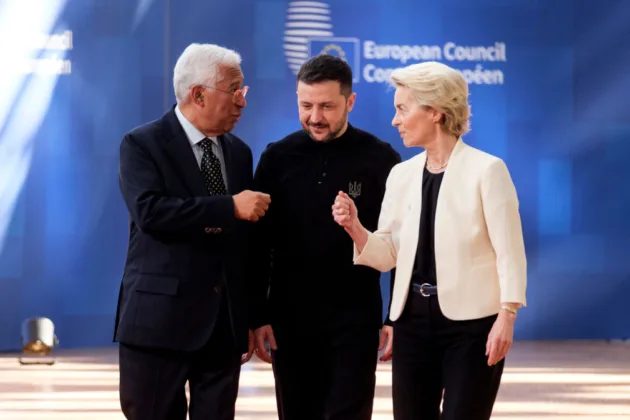
The discussion has come in a joint statement issued after a meeting between European Commission President Ursula von der Leyen, European Council President António Costa and British Prime Minister Keir Starmer on the margins of the European Political Community summit in Yerevan, Armenia, today.
The three leaders said British participation would mark “an important step forward” in defence industrial relations between the EU and the United Kingdom. They also reaffirmed their backing for Ukraine in the face of Russia’s continuing invasion.
DEFENCE INDUSTRIAL TIES
If finalised, British involvement would knit London more tightly into a procurement scheme designed to keep Ukrainian forces armed through what is now the fifth year of fighting with Russia. The plan would allow Kyiv to use part of the loan to buy material from British manufacturers, potentially including missiles, drones and ammunition.
The arrangement would mark one of the most significant pieces of post-Brexit cooperation on security between London and Brussels, going well beyond the sanctions coordination and intelligence-sharing that has been the norm since 2020.
For Starmer, who has been pushing a reset in his country’s relations with the bloc, the loan offers a way to demonstrate concrete benefits for British industry without reopening politically sensitive questions about single-market access or the free movement of people.
A LOAN HELD UP BY HUNGARY
The €90 billion package was definitively approved on April 23, ending two months of resistance from Hungary, which had blocked the file at successive meetings of EU finance ministers. The Hungarian Government, led by Prime Minister Viktor Orbán, had argued that further borrowing entrenched EU support for what it described as a war without a viable end.
The money will be raised through debt issuance by the European Commission on the financial markets. Of the total, around €30 billion is earmarked to cover Ukraine’s most immediate budgetary needs, while close to €60 billion is reserved for reinforcing the country’s military industry.
Two-thirds of the package — the €60 billion tranche — must prioritise procurement from Ukrainian and European producers. Purchases from third countries are permitted only when urgent delivery of a defence product is required and no European equivalent is available at the scale or within the timeframe needed, according to the regulation governing the loan.
That carve-out was meant principally with the United States in mind, but it is the same clause that could be used to channel work to British defence firms, provided London formally signs up to the scheme and contributes to its financing costs.
INNOVATION FUND ON THE TABLE
Beyond Ukraine, Von der Leyen, Costa and Starmer also agreed to open negotiations on UK participation in the European Innovation Council Fund, including the Scaleup Europe Fund. The instrument is designed to help promising high-growth technology firms expand within the European market rather than relocating to the United States or Asia.
According to the joint statement, the step would back the shared ambition of the EU and Britain to retain their most promising innovators in Europe. London officials have been pushing for renewed access to EU research and innovation programmes since the Trade and Cooperation Agreement was concluded.
A bilateral EU-UK summit is due to take place later in May. Both sides used the Yerevan meeting to stress they wanted to be ambitious in any agreements reached. The defence loan, the innovation fund and a wider security pact are all expected to feature on the agenda.
The pace of the discussions reflects pressure from both sides. Brussels wants British industry to help close gaps in the bloc’s munitions production, while the British Government, which has placed defence spending at the centre of its economic strategy, sees Ukraine procurement as a means of generating orders for British shipyards and weapons makers.
The loan itself is part of a wider Western effort to keep Ukraine financially solvent and militarily supplied as Russia’s invasion grinds into its fifth year. Diplomats said Kyiv was expected to draw down the first tranches in the coming weeks.