






A new academic paper has declared that male behaviour is damaging the planet, with elite white Western men singled out as a particular obstacle to action on climate change.
The 20-plus authors, drawn from 13 countries, have published their conclusions in Norma: International Journal for Masculinity Studies, under the title “Men, masculinities and the planet at the end of (M)Anthropocene”.
The paper covers a sweeping range of topics, from climate denial in Canadian pipeline politics and Chinese policy in the Pacific Ocean to pro-meat online influencers in Finland and what the authors describe as positive action by male activists in Africa, Latin America, the United Kingdom and “globally”.
Its central finding is that men tend to have a larger carbon footprint, eat more meat, travel more and worry less. The authors have cited a 2025 French study of 15,000 people that found men emit 26 per cent more pollution than women through transport and food.
Men are also said to be “less ambitious and less active in environmental politics” and less willing to change everyday habits to address the issue.
A separate study referenced in the paper, published last year in the Journal of Environmental Psychology, has identified what it calls “masculinity stress” — defined as concern about appearing feminine. Men suffering from this condition, the research claims, are less worried about climate change and more likely to avoid eco-friendly products in order to preserve a traditional masculine image.
The authors have argued that men are also disproportionately involved in the ownership and management of heavy, chemical and carbon-based industries, agriculture and what the paper terms “militarism”.
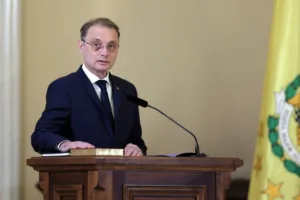
Professor Jeff Hearn, the paper’s editor and a professor of sociology at the University of Huddersfield in northern England, said: “There is now plenty of research that shows clear negative impacts of some men’s behaviour on the environment and climate.”
He added: “What is astonishing is how this aspect does not figure in most debates and policy in a more sustainable world.”
The paper reserves particular criticism for “elite, white Eurowestern men”, whom it contrasts unfavourably with low-income men in the global south. It also acknowledges, in passing, that some men are working “urgently and energetically” to change such tendencies.
The new framework arrives wrapped in dense terminology. Beyond the “(M)Anthropocene” of the title, readers are introduced to “masculinity stress”, “Eurowestern” men and “extractive industries”, with the authors presenting their findings as a contribution to a more sustainable future.
It remains to be seen how readily such language will travel beyond the seminar room. The conclusions arrive at an awkward moment for European Union climate policy: the Green Deal and a string of green regulations have run into stiff resistance from farmers, member states and voters across the bloc — a great many of whom, by the paper’s own logic, would presumably be men.
Whether telling roughly half the population that their behaviour is “bad for the planet” is the most promising route to winning them over is a question the paper does not address.