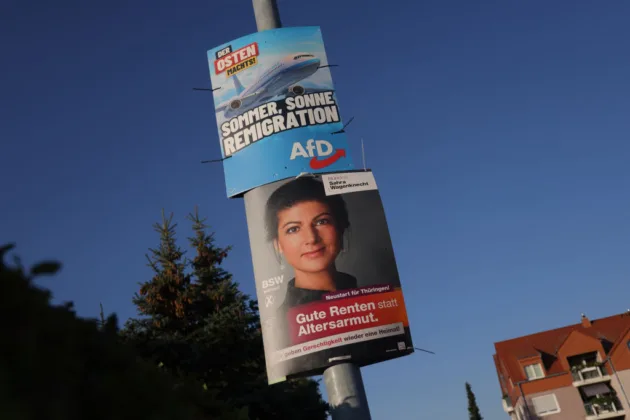





The Sahra Wagenknecht Alliance (BSW), a left-wing populist party, has called on the Alternative for Germany (AfD) to hold two public debates before regional elections in eastern Germany, in a fresh attempt to dismantle the political cordon that keeps the AfD out of power.
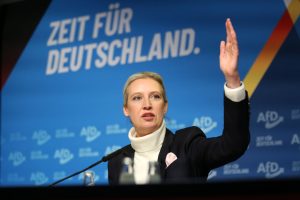
In a letter dated June 26, the BSW leadership proposed staged confrontations between party founder Sahra Wagenknecht and AfD co-leader Alice Weidel on market squares in Magdeburg and Schwerin. The two capitals sit in Saxony-Anhalt and Mecklenburg-Vorpommern, the eastern states heading to the polls in September.
The letter was signed by BSW co-leaders Fabio De Masi, a member of the European Parliament (MEP), and Amira Mohamed Ali, alongside secretary general Oliver Ruhnert. It was addressed to Weidel and her AfD co-leader Tino Chrupalla.
The BSW argued that the so-called firewall, the refusal of mainstream parties to cooperate with the right-wing AfD, was undemocratic and self-defeating. It said the exclusion benefited the AfD by concealing what it described as the real overlaps between the AfD and the governing parties.
Weidel rejected the offer of joint campaign events and panel discussions. A spokesman for her office told Der Spiegel that the AfD remained willing to talk to the BSW.
Wagenknecht, who stepped down as party leader in November but retains an active role, has long promoted a model she calls a citizens’ government. Under it, non-partisan figures would head state administrations and govern with shifting parliamentary majorities that include the AfD.
The BSW said its aim after the September votes would be to unseat the incumbents in both states and replace them with such cross-party premiers. Ruhnert insisted his party would not help elect a premier from the Christian Democratic Union (CDU), the Social Democrats or the AfD.
The two parties share ground on immigration, opposition to arms deliveries to Ukraine and a call to restore Russian energy imports. The BSW has criticised the AfD’s backing for the federal government’s rearmament drive and its closeness to US President Donald Trump, saying neither served German interests.
The overture comes as the BSW struggles in the polls. Support has slid to around 4 per cent from about 14 per cent at the start of the year, leaving it at risk of missing the 5 per cent threshold in Saxony-Anhalt, though it could enter the Schwerin parliament for the first time.
Saxony-Anhalt votes on September 6, 2026, with Mecklenburg-Vorpommern following on September 20.