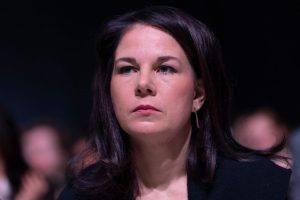





Annalena Baerbock is set to leave her post as President of the United Nations General Assembly and take up a teaching position in Global Leadership at Columbia University in New York.
The move was first reported by German portal Table Briefings on August 24 and confirmed to news agency dpa by informed sources. Baerbock is expected to join Columbia in the autumn, after her UN mandate ends in September, as a Professor of Professional Practice and co-director of the Master of Public Administration in Global Leadership at the School of International and Public Affairs.
The three-year, full-time appointment is a practice-oriented professorship rather than a research chair. She no longer requires clearance from Berlin, as the cooling-off period for former ministers expires this autumn.
It marks another step in the rise of a politician who went from Germany’s Green Party to the Foreign Ministry and then to one of the UN’s most prominent posts, but whose career has also been dogged by controversy, from her “feminist foreign policy” to her uncompromising position on Russia, as well as questions over her CV, academic record and political book.
Born in Hanover in 1980, Baerbock joined the Greens in 2005 and became the party’s co-chair alongside Robert Habeck in 2018. In 2021, she was chosen as the Greens’ candidate for chancellor and initially emerged as a serious potential winner.
Her campaign was soon hit by a series of controversies. Her CV had to be corrected after inaccurate descriptions of memberships and her academic background were published, while her book Jetzt. Wie wir unser Land erneuern became the subject of plagiarism allegations after researcher Stefan Weber identified passages closely resembling material from other publications and websites.
The controversies contributed to the collapse of her early lead, and the Greens ultimately finished third in the election.
The Greens entered government as part of a coalition with the Social Democrats and the Free Democrats, and Baerbock became Germany’s first female foreign minister in December 2021.
Her tenure was dominated by Russia’s invasion of Ukraine. She became one of the strongest advocates of continued military and political support for Kyiv, but her rhetoric repeatedly attracted criticism.
On August 31, 2022, while speaking at the Forum 2000 conference in Prague, she said Germany would stand by Ukraine “no matter what my German voters think”. Critics accused her of placing Ukraine above the interests of German voters.
Her rhetoric on Russia became controversial again on January 24, 2023, when Baerbock told the Parliamentary Assembly of the Council of Europe in Strasbourg: “We are fighting a war against Russia and not against each other.” The wording triggered criticism because Germany was supporting Ukraine militarily but was not formally at war with Russia.
Her other signature initiative was Germany’s “feminist foreign policy”, whose guidelines were presented in March 2023 with development minister Svenja Schulze. Based on the principles of “rights, representation and resources”, it sought to place women’s rights and marginalised groups more prominently in German foreign policy.
Critics questioned whether the concept was more ideological than practical and whether it sat comfortably alongside Baerbock’s increasingly hawkish approach to Russia and military support for Ukraine.
On January 3, 2025, near the end of her time as foreign minister, Baerbock travelled to Damascus with French foreign minister Jean-Noël Barrot to meet Syria’s new de facto leader Ahmad al-Sharaa, formerly known as Abu Mohammed al-Jolani, whose Hayat Tahrir al-Sham (HTS) had previously been affiliated with al-Qaeda. During the meeting, al-Sharaa shook Barrot’s hand but did not shake Baerbock’s, instead greeting her with a gesture placing his hand on his chest.
The episode offered an awkward image for critics of her feminist foreign policy, who questioned how a doctrine centred on gender equality and women’s rights could coexist with engagement with an Islamist leader whose movement had been associated with restrictive views on women.
Baerbock left the Foreign Ministry in May 2025, following the collapse of Olaf Scholz’s coalition government, and was subsequently nominated by Germany for the presidency of the United Nations General Assembly. She was elected in June 2025 with 167 votes in a secret ballot forced by Russia, with 14 abstentions and seven states backing the original German candidate, Helga Schmid.
At the UN, she made multilateralism and the defence of the international rules-based order central themes of her presidency.
Her term is ending with another controversy. Baerbock pushed for a more transparent process to select the next UN Secretary-General, organising public dialogues with candidates and an audience survey at a July 23 town hall.
The move drew criticism from Washington at a Security Council briefing on August 19, when US ambassador Jennifer Locetta accused her of “irresponsible actions” and argued that she had exceeded the traditional role of the General Assembly president.
Russia also objected. Its UN ambassador, Vassily Nebenzia, said he was concerned by the role the Assembly president was assigning herself in a process where the Security Council retains the decisive say.
Eight candidates are competing to succeed Secretary-General António Guterres, whose term ends on December 31.
Baerbock’s mandate ends on September 8, when she will be succeeded by Khalilur Rahman of Bangladesh. She is reportedly preparing to remain in New York, this time as an academic.