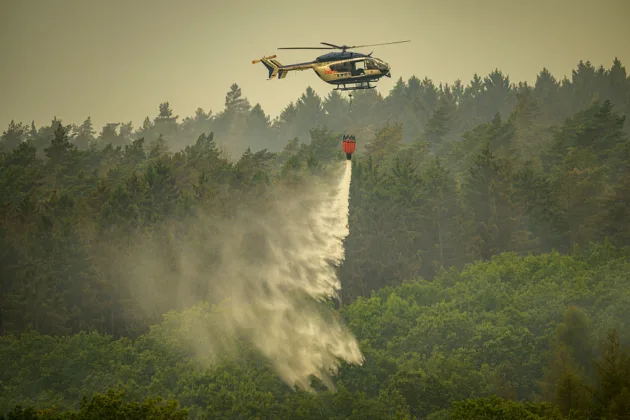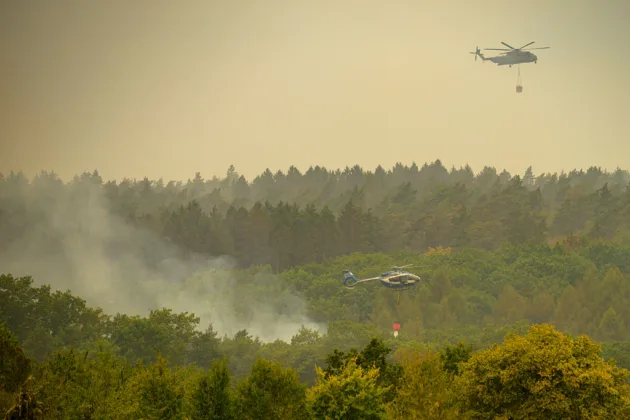












Belgium’s largest wildfire in more than a century has been traced to a plot managed by the Walloon nature department that was being mown by a private contractor on the day it started, according to an investigation by public broadcaster RTBF.
The fire broke out around midday on August 14 in the High Fens (Hautes Fagnes/Hoge Venen), a Natura 2000 protected peatland reserve on the Liège plateau near the German border.
It consumed more than 3,366 hectares before being brought under control on August 20, after days of operations involving hundreds of firefighters, soldiers, farmers and European aircraft.
This is more than 33 square kilometres, equivalent to more than 4,000 football pitches or 10 times Central Park in New York.
Authorities described it as the country’s worst such blaze since 1911.
RTBF used satellite imagery from Copernicus Sentinel-2, amateur video shot by parachutists at 1.14pm and on-the-ground reporting to pinpoint the origin to a rectangular parcel beside the Allée du Grand Fossé, about 300 metres west of Croix Mockel.
Images show the same parcel changing from green on August 10 to partly grey by August 14, consistent with recent mowing.
The site belongs to the Malmedy directorate of the Département de la Nature et des Forêts (DNF).
The DNF confirmed that mowing of invasive purple moor-grass (molinia) was under way that day as part of long-standing biodiversity restoration work.
The task, previously done in-house, has been subcontracted to private firms for the past two years. The contractor declined to comment.
Jean-Luc Evrard, managing director of a company that sells and repairs the mowers used in the reserve, said flail mowers spinning at around 2,000 rpm can strike stones and produce sparks.
“It is scandalous to have commissioned a contractor with a machine like this in well-known drought conditions. Working with mechanised equipment on sites that dry was not recommended at all,” he told RTBF.
Liège prosecutors have opened a judicial investigation into negligent arson and are examining the agricultural vehicle hypothesis. Two experts have been appointed.
No mowing ban was in force despite a high fire-risk warning linked to prolonged drought.
Liège provincial governor Hervé Jamar did issue a preventive police order, with a list of banned actions that could spark a wildfire, but it did not mention the use of specific vehicles.
Healthy raised bog is by nature waterlogged and should not burn readily.
Peat forms over millennia in persistently wet, oxygen-poor conditions and typically holds about 90 per cent water in its upper layer.
Experts have noted that a peatland in good hydrological condition would be unlikely to ignite even under a changing climate.
Decades of drainage, spruce planting and summer drought had left the High Fens surface dry and combustible. The fire then smouldered into the peat itself, complicating extinction and raising the prospect of flare-ups for weeks.
Restoration of such peat can take decades or longer.
Peat combustion releases large quantities of stored carbon as well as particulates and other pollutants.
Air-quality measurements recorded high concentrations of fine particles downwind. Exact emission totals have not yet been published.
Officials and climate advocates rapidly framed the fire as a warning of climate change, citing hotter, drier summers that increase the chance of large blazes even if most ignitions remain human.
Interior Minister Bernard Quintin announced a national resilience plan in which climate-related wildfire risk would feature prominently.
The Liège prosecutor’s office has said the investigation will take months. Walloon Minister-President Adrien Dolimont has pledged a review of prevention measures once the site is fully secure.
It is not the first time governments have blamed climate change for disasters that also followed their own decisions. In 2021, intensive rainfall hit Wallonia and caused a huge flood.
Politicians depicted it as almost inevitable, but Damien Ernst, a professor at the University of Liège, called the handling of the Eupen dam a “colossal error”, arguing the reservoir should have been drawn down preventively as was done at Robertville and Butgenbach.