




After the Second World War, the states of Western Europe built generous social welfare states for some very good reasons. The pre-war years showed that workers impoverished by economic calamity could be radicalised by fascists and communists. Political stability required a state that protected its citizens from the vagaries of the business cycle. And so Europe cultivated “cradle to grave” welfare: the state would provide pensions, disability and jobless benefits, healthcare and education. All financed by rapid post-war economic and population growth. For several glorious decades, European economies boomed, populations grew, and citizens became wealthy and extremely fond of their generous state benefits. As long as each dependent was supported by the taxes paid by four, six and even eight workers, these new benefits were sustainable. In France, Germany and Italy, the automobile industry became the economic substrate of social welfare spending. Burgeoning consumer demand for cars created greater investment, more jobs and higher tax revenues. Fiat, Volkswagen and Renault became integral parts of thriving social welfare states.
Even after the oil shocks of the 1970s and the gradual slowing of national economies, population growth and industrial innovation, European states continued to expand social benefits. By the turn of the century, many Europeans believed they had achieved the perfect balance between social welfare and the capitalism needed to pay for it. America might lead the world in innovative technologies, but her workers were deprived of healthcare, decent holidays and strong unions. Deep thinkers like Tony Judt, Francis Fukuyama and Mark Leonard cited European social democracy as the natural endpoint of political development. This belief was also convenient for European politicians handing out new benefits to grateful constituents. They weren’t buying votes; they were engaged in a higher mission, the perfection of liberal democracy.
Yet today we see the great edifice of European social democracy decaying at its fiscal foundations. Current pension and health care obligations have outstripped the tax base needed to meet them. Declining fertility means there are not nearly enough future workers to support retirees. The EU fertility rate fell to a record low of 1.34 births per woman in 2024, against the 2.1 needed to keep a population stable, according to Eurostat. Migrants aren’t the answer: they are a net drain on public coffers, requiring housing, education and income support, apparently indefinitely. Swedish statistics show that migrants from the Middle East and North Africa remain net beneficiaries of state spending throughout their working lives. They remain dependents, not contributors, and have brought a host of toxic and divisive cultural preferences to European polities accustomed to high levels of social trust and cohesion. Native workers clock fewer hours and retire earlier than Americans, often on generous disability benefits. Extracting more revenues from a given population requires longer hours and greater productivity, yet Europe remains stagnant in both productivity growth and the innovation that could unlock new industrial sectors. Job protections make it difficult to fire substandard employees, while complex work rules hinder the deployment of better industrial practices and labour-saving technologies.
The situation in France is critical. The second-largest net payer into EU coffers is incapable of paying for the state it has built, running a deficit the government puts at 5.4 per cent of GDP this year and carrying a debt load the finance ministry expects to reach 119.3 per cent of GDP in 2026 and a record 121.7 per cent in 2027. French President Emmanuel Macron, who came to office promising to tame spending and reinvigorate the French economy, has failed miserably. He abandoned proposals to increase fuel taxes after the gilets jaunes protests. His plan to raise the retirement age sparked massive demonstrations, has since been suspended and is likely to be overturned after the presidential election in April 2027. Macron has been unable to achieve his party’s promised Renaissance: France is in worse financial shape than when he took office in 2017. Macron is not entirely to blame: French voters have learned to expect more benefits than they are willing to pay for, and hold the state responsible for magicking up the difference.
Macron is the very apotheosis of the elite technocrats who run France, yet none of these sophisticated énarques have managed in more than 30 years to confront their citizens with fiscal reality and balance a national budget. Should a run on her bonds force France to swoon into the not-so-loving arms of the European Central Bank, her people will be subjected to a punishing austerity programme. Given the magnitude of state spending — 57 per cent of GDP — cuts in government programmes will knock an immediate, appreciable amount off national income. Marine Le Pen will be happy to lead a populist backlash against Parisian elites, the ECB and the EU. Renationalising funds from Brussels is easier than wresting benefits from les citoyens.
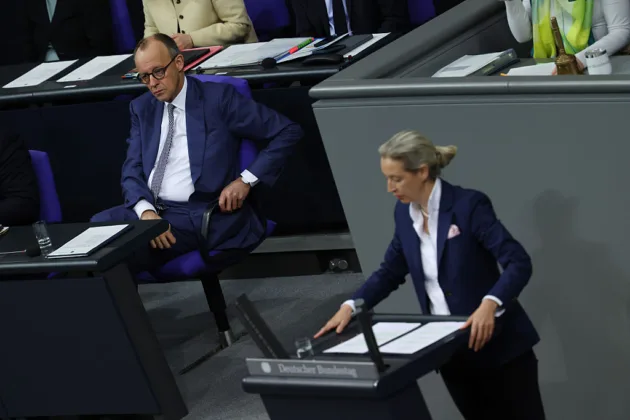
After years of cosy prosperity, Germany is also facing a grim financial future. For all of the post-war era, German industry was Europe’s golden goose. It gained a second wind after the initial Wirtschaftswunder by unlocking lucrative export markets, which paid for national benefits and financed the growth of the European project. China provided a further boost with what appeared to be an insatiable demand for German cars and industrial equipment. Now Germany finds it has taught China all it needs to reverse that demand, and is besieged in her home markets by cheap, competitive Chinese imports. The EU ran a trade deficit with China of €359.8 billion in 2025, close to €1 billion a day, according to Eurostat, but has yet to forge an agreement between 27 member states on how to cope with the “China Shock”. The decline in export markets and the rise of neo-mercantilism around the world suggest that Germany is no longer in a position to finance the European project. German Chancellor Friedrich Merz’s pleas for large cuts to the proposed EU budget, restated at the European Council of October 15-16, are evidence of his need for those monies at home, to fund the benefits due to German retirees.
The war in Ukraine and the need to deter Russia impose further strains on national budgets. The United States has made it clear that Europe must take over more of the funding for NATO and all of the support for Ukraine. Kyiv has already burned through much of the European funding intended to last through 2027, and is back asking for another large cash grant if it is to survive the winter. The EU’s €90 billion loan was meant to cover Ukraine to the end of 2027; Kyiv’s shortfall for next year is now put at some €70 billion. High energy prices and the loss of Russian oil and gas cripple the competitiveness of European industry, while Net Zero saddles European governments with lavish subsidies for renewables. Europe is faced with grave budget demands that can no longer be smoothed over with dollops of German cash.
The first victim of tightening state budgets is likely to be the EU itself. A true global profile for the EU comparable to the world’s great powers is impossible without sufficient funds. The Commission’s request for a budget befitting its ambitions is dying in the face of resistance from key national capitals. Faced with a choice between the EU’s grand aspirations and their own domestic demands, member states will always prefer to fund pensions. Sacrificing Brussels for Bordeaux is an easy call.
Even though it has endured for almost 70 years, European social democracy was always a highly contingent phenomenon. The vast state expenditures that built it depended on favourable demographics, industrial supremacy and profitable export markets. Now that these conditions no longer pertain, Europe cannot sustain the benefits promised to its people. The great social welfare supercycle is coming to an end with no foreseeable revenue sources in sight. The US market is protected by new tariffs, while China floods Europe with its subsidised exports. The consumer demand generated by the Single Market alone is insufficient to replace the export earnings that have powered Germany and the broader European economy for decades. The example of France, and the prior example of Greece suggest that social democracies lack the political capacity to reform themselves. They are very good at creating new benefits, but very bad at reducing them. What awaits is bitter austerity medicine administered by the ECB, or failing that, by the rabid carnivores of the international bond markets. The great European project will become just another line item in national budgets scheduled for reduction.