




Poland has demanded an explanation from Kyiv after a Ukrainian drone flew through its airspace before entering and crashing in Lithuania, as Polish radar had failed to detect it and there had been no notification of Ukrainian drones flying through Polish territory on their way to attack Russia.
The incident is the latest drone incursion into a country on NATO’s eastern flank and comes amid heightened concerns in Poland and the Baltics of spillover from Russia’s war on Ukraine.
Polish Prime Minister Donald Tusk on October 20 said that Poland does not permit operations on or over its territory without its explicit consent, as Warsaw and Vilnius worked together to establish how a Ukrainian drone came to explode in Lithuania near the Latvian border.
Speaking before a cabinet meeting Tusk conceded that, according to all available data, the drone had entered from the Polish side.
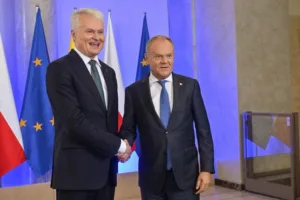
He said he would discuss the incident with Lithuanian President Gitanas Nausėda later in the day and promised that all circumstances would be examined.
Tusk added he expected “full cooperation” from Ukraine and that he would act “without emotion, without any ill intent,” but would be “very insistent” in seeking answers.
“Regardless of the outcome, Poland does not permit operations on or over its territory without the explicit consent of the Polish state,” Tusk said.
“That will not change, regardless of who would carry them out,” he added.
Lithuania’s defence ministry said debris of a drone that violated its airspace was found in the north of the country, in the village of Juodžionys, in the Pasvalys district bordering Latvia.
The cause of the explosion has not been established. Possible scenarios include a malfunction, fuel exhaustion or a collision with the ground or trees.
A civilian vehicle was damaged in the explosion, but nobody was injured.
Lithuanian Prime Minister Mindaugas Sinkevičius said on October 19 that Ukraine had admitted that it had lost contact with one of its drones on October 18.
He explained that it was an FPV (first-person view) drone carrying explosives and that it had flown into Lithuania from Poland.
NATO jets were scrambled in response to the incursion but were not able to visually identify the object.
Lithuanian Armed Forces Chief of Defence Staff Giedrius Premeneckas said the delay between the drone entering Lithuanian territory and the public being alerted was due to the fact that the object had not come from a hostile country and the authorities had to identify it properly.
“Because the object was coming from a Schengen country, a friendly country, rather than from Belarus or Russia, the procedure was different. We had to determine whether it was a potentially dangerous object or simply some kind of general aviation aircraft flying without a flight plan,” he said.
Lithuanian defence minister Robertas Kaunas revealed that preliminary information indicated the drone had entered from Polish airspace.
“I have already contacted the Polish defence minister and asked Poland to join the investigation so that we can look into this incident together,” said Kaunas, quoted by broadcaster LRT.
Poland’s deputy prime minister and defence minister Władysław Kosiniak-Kamysz confirmed on October 19 that he was in contact with his Lithuanian counterpart and said several scenarios were being examined.
Poland’s defence ministry, though, at first said that “there is no confirmation from our radar systems of an object crossing the border from Poland to Lithuania”.
Nausėda said on October 20, during a visit to Poland, that the two defence ministries had set up a joint working group to establish the causes of the explosion. He added that detection capability was not ideal and that Lithuania would improve its technical means.
The incident came as Ukraine launched a drone attack on St Petersburg and surrounding areas of Russia overnight on October 17-18.
St Petersburg governor Alexander Beglov said on social media on October 18 that a massive drone attack on the city had left one person dead and five others injured. Beglov said fires had broken out at oil facilities, including a terminal and depot.
Russian online retailer Ozon said that one of its logistics centres in the city had come under a drone attack.
Also on October 18, Alexander Drozdenko, the governor of the neighbouring Leningrad region, said that Ukrainian drones had struck a power substation, residential buildings, as well as a data centre for a major Russian social networking site VKontakte. The governor added that 145 drones had been shot down, while the Russian defence ministry put the overnight national total at 1,015 drones. Ten people were injured in the region and Pulkovo airport restricted operations, cancelling 26 flights.
Air-raid alerts were sounded in Lithuania and Latvia at the time of the attack on Russian territory conducted by Ukrainian drones.
President Gitanas Nausėda said that the incident was further evidence that “Russia’s war of aggression against Ukraine is spilling over onto the Eastern flank of NATO and the EU”.
On October 20 PM Sinkevičius also said Lithuania would begin consultations with NATO on changing procedures to allow objects violating its airspace to be shot down without first being visually identified.
Ukraine has apologised for the incident, saying that Russian electronic warfare had diverted the drone’s path during an operation against military targets in Russia.
Heorhii Tykhyi, the spokesman for Ukraine’s foreign ministry, appeared to confirm that the drone was Ukrainian.
“We regret the incident that occurred this morning in Lithuanian airspace, which may have resulted from Russian electronic warfare diverting drones during an operation against legitimate military targets in Russia,” wrote Tykhyi. “We apologise for any disruption, risks, and concern this may have caused.”
The spokesman said that Ukraine would “share all relevant information with our Lithuanian partners to establish the full circumstances of the incident”. He gave no further information, though, on what type of drone was involved, where it was launched from, and what its target was.
Lithuania borders Belarus, an ally of Russia, and the Russian exclave of Kaliningrad, as well as Poland and Latvia. In March and May this year, a number of Ukrainian drones aimed at targets in Russia entered the airspaces of NATO members Lithuania, Latvia, Estonia and Finland, likely due to Russian electronic jamming.
In September 2025 Poland suffered a drone incursion by around 20 Russian drones with some of them being shot down by NATO fighter planes, the first time the alliance had engaged such targets over its own territory.
That response highlighted the fact that Poland did not have adequate drone defences and was having to use expensive rockets from fighter aircraft to counter such a threat, one which turned out to be composed of decoy drones.
More question marks appeared over Poland’s air defences on July 30 this year when a Russian Kh-101 cruise missile entered Polish territory where it flew for six minutes before crashing in a field at Tarnawa-Kolonia, in Lublin province, eastern Poland, some 50km from the city of Lublin and not far from a defence plant. It was not shot down.
That incident raised concern because there had been no alarm siren or text message alert warning the population that a rocket had entered Polish territory.
The latest incident involving a Ukrainian drone flying through Polish airspace has again raised eyebrows because of the fact that the defence ministry and the military seemed not to have tracked the object on Polish radar.
On November 15, 2022, a Ukrainian air defence missile crashed into a grain facility at Przewodów, in Lublin province, killing two farm workers. Ukraine at first claimed that this was a Russian missile, raising suspicions in Poland that it was trying to drag the Poles into the Russia-Ukraine war and Ukraine did not apologise for the incursion even after NATO had confirmed that the missile was Ukrainian.
The idea that Ukrainian drones may be flying through Polish territory on their way to Russia will raise concern that this could lead to the Russians attempting to strike them down over Polish territory with the escalation of the military conflict in the region.
Poland has for months been claiming that it has been the object of Russian hybrid warfare via arson attacks, hackings, attempts to sabotage railway lines and air incursions on Polish territory.
Russia has not admitted it was responsible for any of the cited incidents but has of late warned Poland and other NATO states that it reserves the right to target those facilities which are assisting Ukraine in its ongoing campaign of air strikes deep into Russia which have seen damage caused to oil refineries, military facilities and some major Russian companies such as Wildberries.
If it materialised that Ukraine was actually using the territory of NATO states in its attacks on Russia the eastern flank of NATO could become susceptible to Russian military retaliation at a time when the US, which is NATO’s most powerful state, is clearly attempting to engage with Russia over ending the war in Ukraine, increasing the supply of fuel onto world markets and seeking to restart talks about nuclear de-escalation.